

Threat forward: Iran Doesn't Need to Close the Strait. It Just Needs to Keep It Expensive
Threat forward: Iran Doesn't Need to Close the Strait. It Just Needs to Keep It Expensive
How war risk premiums became Tehran's most effective weapon
John Hendricks
Editor & Host, Global Recon

March 18, 2026 🕒 8 min read
GEOPOLITICS & MARITIME SECURITY | OSINT ANALYSIS
How war risk premiums became Tehran’s most effective weapon and why Washington stepped in as insurer of last resort
The United States is now openly considering naval escorts for commercial tankers and a federal backstop for maritime war insurance. The last time Washington did that was World War II. That single fact explains how serious the Strait of Hormuz crisis has become.
By John Hendricks
Unclassified with John Hendricks
March 2026
Washington Just Admitted the Market Is Failing
On March 1, 2026, President Trump announced that U.S. forces had carried out a major series of strikes against Iranian military and naval assets as part of Operation Epic Fury, the joint U.S.–Israeli campaign against Iran’s nuclear program that began on February 28. The administration framed the operation as a decisive blow, emphasizing degraded Iranian capabilities and restored deterrence.
That was the public headline.
Inside the global shipping and insurance markets, a different signal landed with greater force.
Within the same 72-hour window, senior U.S. officials confirmed that Washington is actively evaluating two measures that would have been politically unthinkable weeks earlier: U.S. Navy escorts for commercial tankers transiting the Strait of Hormuz, and direct U.S. government involvement in backstopping maritime war risk insurance as private insurers withdraw coverage or reprice risk beyond commercially viable levels.
The second proposal is the tell.
The last time the U.S. government intervened directly to stabilize maritime war insurance markets was during World War II. The fact that such discussions are occurring now is not a show of confidence. It is an admission that the commercial mechanisms which normally absorb geopolitical risk are no longer functioning.
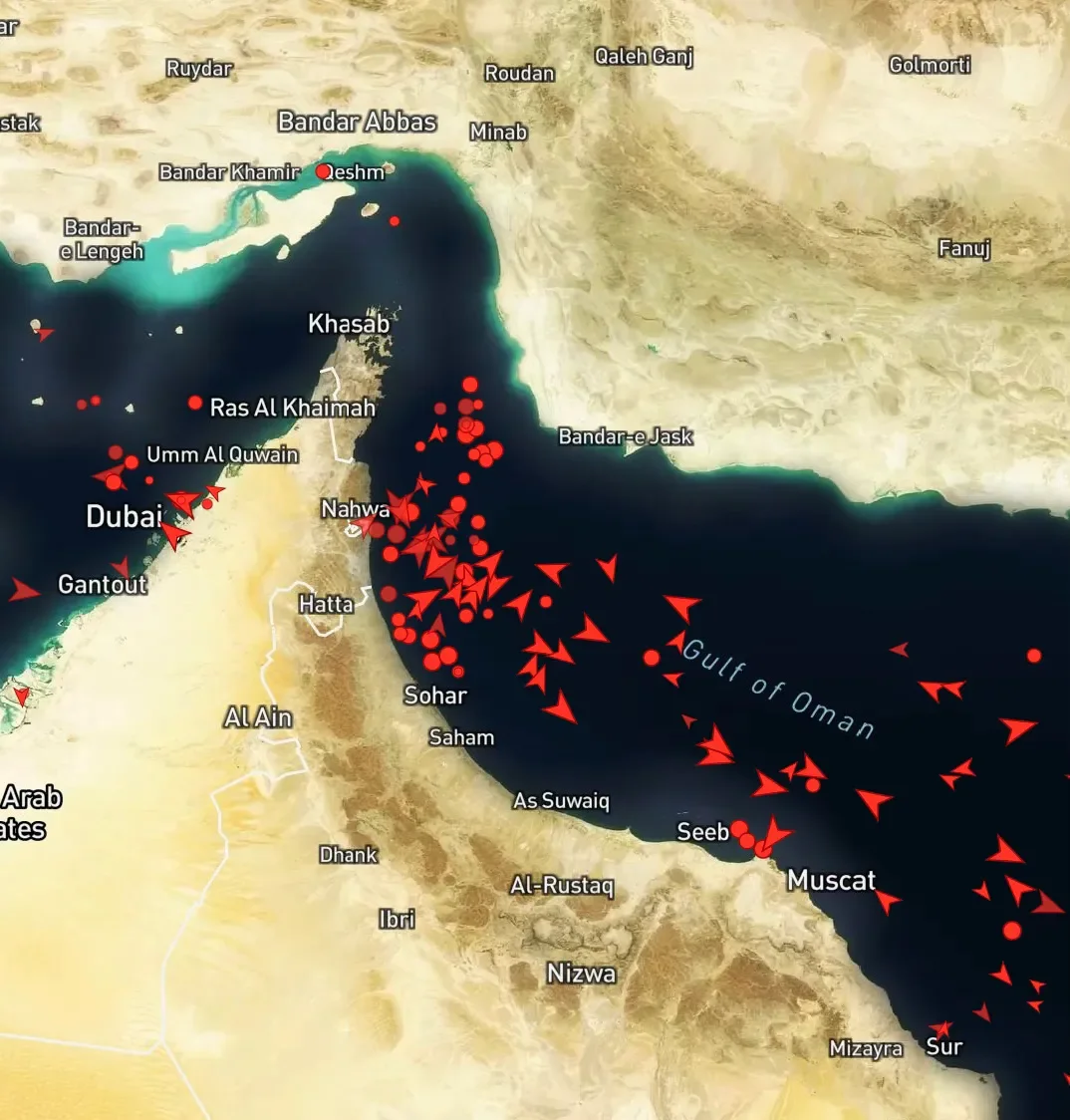
At the same time, senior IRGC naval commanders issued explicit public threats warning that any vessel attempting to transit the strait would be targeted. CENTCOM continued to state that the waterway remained technically open. Shipowners did not wait for a formal closure. They looked at premium quotes, exclusions, and liability exposure and chose to anchor, loiter, or divert.
This is what a modern chokepoint crisis actually looks like. Not a declared blockade, but an insurance-driven behavioral shutdown that achieves many of the same effects without a single legal act of closure.
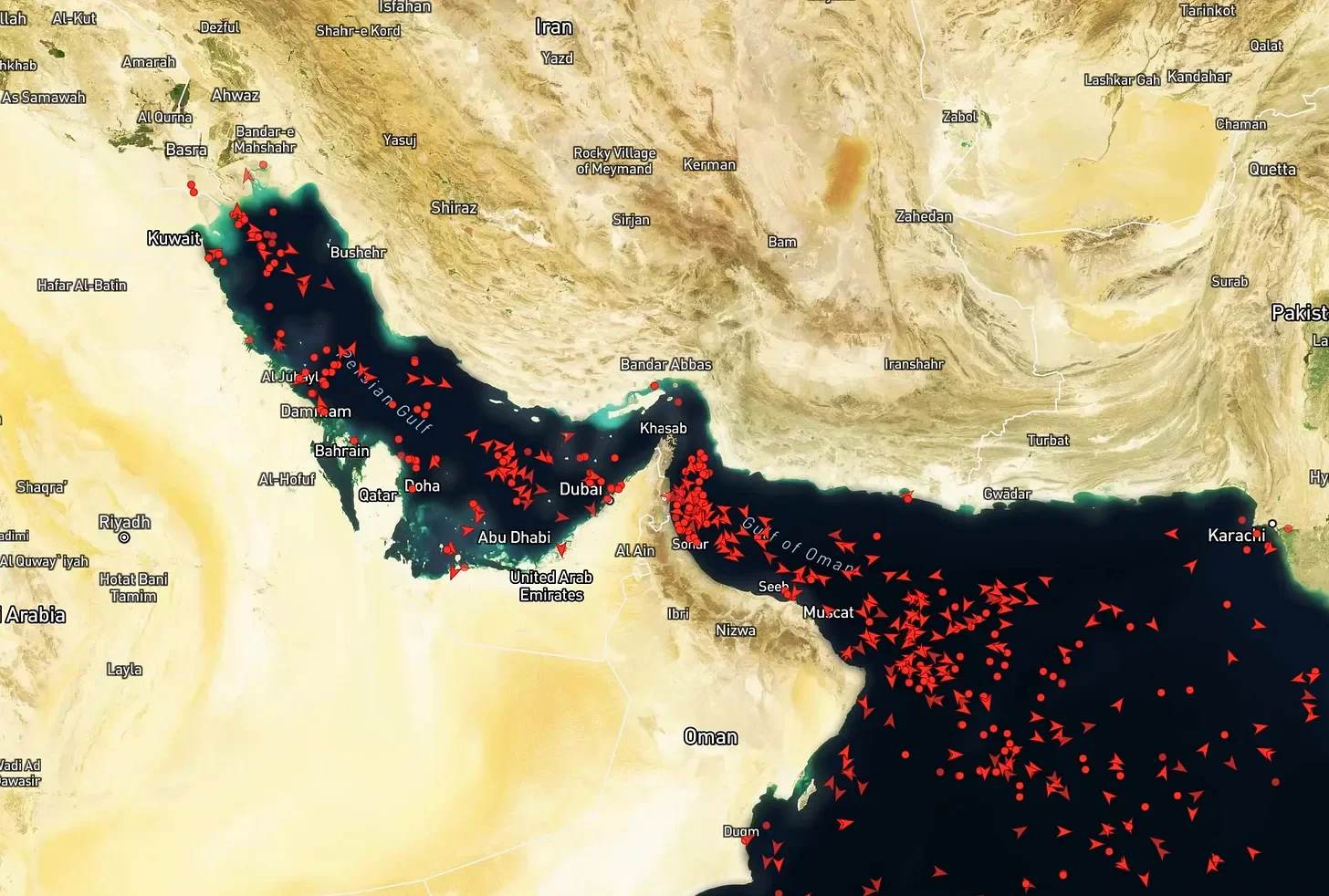
AIS-derived tanker traffic across the Persian Gulf and Strait of Hormuz, March 3, 2026.
Dense clustering in the Gulf of Oman reflects vessels holding position
rather than transiting the strait. Source: MarineTraffic.
Forty Years of Chokepoint Economics
The Strait of Hormuz has been a pressure point in global energy geopolitics since the 1980s. During the Iran–Iraq Tanker War of 1984–1988, attacks on oil infrastructure and merchant shipping triggered the first modern surge in marine war risk premiums. Predictions that insurance costs alone would close the strait proved wrong, but the economic logic established during that period has governed every crisis since.
The math is straightforward. A fully laden VLCC carrying roughly two million barrels of crude represents cargo value exceeding $150 million at current prices. Even sharp increases in war risk premiums add only a few dollars per barrel. As long as insurance exists and physical risk remains bounded, tankers tend to move.
That calculus breaks down under two conditions: when insurance becomes selectively unavailable, or when perceived physical risk exceeds what insurers are willing to price at any level. In early March 2026, the market moved uncomfortably close to both.
That proximity explains why Washington is now discussing stepping in as insurer of last resort.
How War Risk Premiums Actually Work
Marine war risk insurance is a distinct coverage layer separate from standard hull and cargo policies. It covers losses arising from armed conflict, seizure, mines, and hostile acts. In low-risk environments, premiums are marginal, historically around 0.05 percent of a vessel’s insured value per voyage.
The Lloyd’s Market Association Joint War Committee (JWC) maintains a “Listed Areas” framework used across the London insurance market. While the JWC does not mandate underwriting decisions, its guidance functions as a trigger for premium escalation, exclusions, and voyage-by-voyage approval requirements. Once a region is elevated within this framework, automatic clauses embedded in charter party contracts activate, forcing coverage renegotiation or suspension pending new terms.
Following the February 28 strikes, underwriters began reassessing Gulf transit exposure, with updated guidance affecting the Gulf of Oman and Hormuz approaches expected within days.
War Risk Premium Evolution at the Strait of Hormuz
Source: Marsh McLennan, Marine Insight, Ship Universe, Bertling Logistics (compiled analysis)
Pre-2019 peacetime baseline: ~0.05% (≈$50,000 per VLCC voyage)
2019 tanker attacks: ~0.10% (≈$100,000)
2023–2024 Red Sea escalation: ~0.125% (≈$125,000)
Post-February 2026 escalation: ~0.20–0.40% (≈$200,000–$400,000)
Select U.S./Israeli-linked exposures (peak): up to ~0.70% (≈$700,000)
For a VLCC insured at $100 million, this re-pricing translated into a per-voyage increase from roughly $250,000 to as high as $700,000 in certain cases. Analysts described near-term increases of 25–50 percent as a floor, with higher rates applied selectively based on ownership, flag, and commercial affiliations.
These costs do not remain with shipowners. They pass through to charterers, traders, refiners, airlines, utilities, and ultimately consumers.
“The more consequential development may not be price escalation, but selective uninsurability.”
— BIMCO advisory
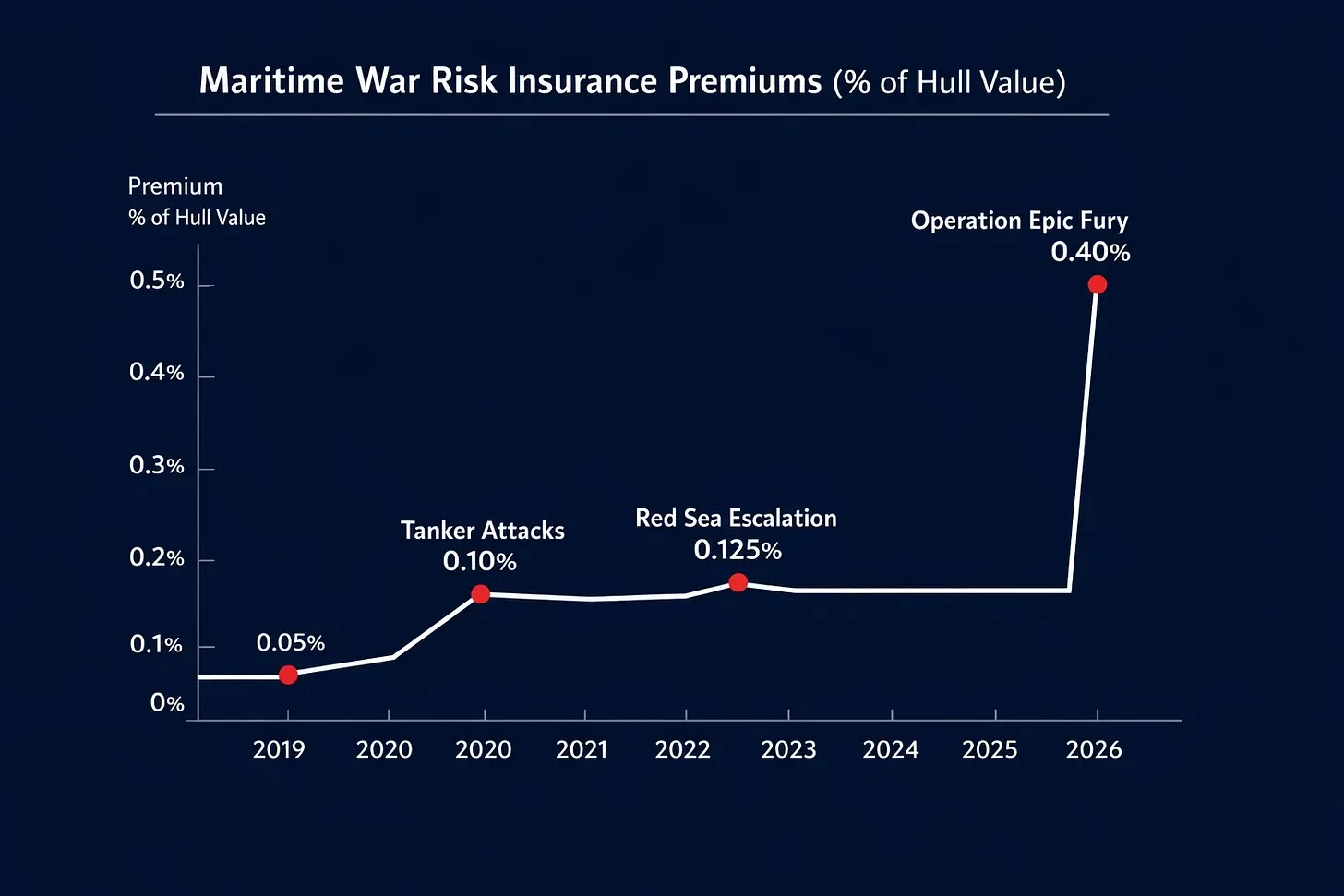
War risk insurance premiums for vessels transiting the Strait of Hormuz, 2019–2026.
The 2026 spike following Operation Epic Fury represents the sharpest single
escalation in the modern era. Source: Marsh McLennan, Bertling Logistics, Marine
Insight (compiled analysis).
What Open-Source Intelligence Shows About Ship Behavior
Maritime risk appears in behavior before it appears in official statements. AIS transponder data allows analysts to observe that behavior in near real time.
Using AIS data filtered for crude oil, product, and LNG tankers within defined anchorage and holding areas east of the Strait of Hormuz, including Fujairah and Gulf of Oman approach lanes, vessels exhibiting sustained speeds below 0.5 knots or repeated position clustering over six-hour intervals were classified as anchored or loitering rather than transiting.
Applying this methodology in the 48 hours following the February 28 strikes yields a count in the range of roughly 140 to 160 tankers delayed or holding position. Exact totals vary by platform and time window, but the deviation from baseline traffic flow and clustering pattern is consistent across datasets.
Additional indicators reinforce the picture. Multiple vessels altered course on approach rather than proceeding into the strait, producing anomalous AIS track histories inconsistent with routine transit. Iranian-flagged and Iran-affiliated vessels operating under sanctions-evasion protocols continued to exhibit AIS gaps or transponder shutdowns near Iranian waters, patterns verifiable through satellite cross-checking.
Maritime advisory firms also reported radio warnings to commercial vessels claiming the strait was closed. No formal closure was declared. The operational effect, in insurance pricing and ship behavior, was similar.
Iran did not need to issue an order. The market reacted anyway.
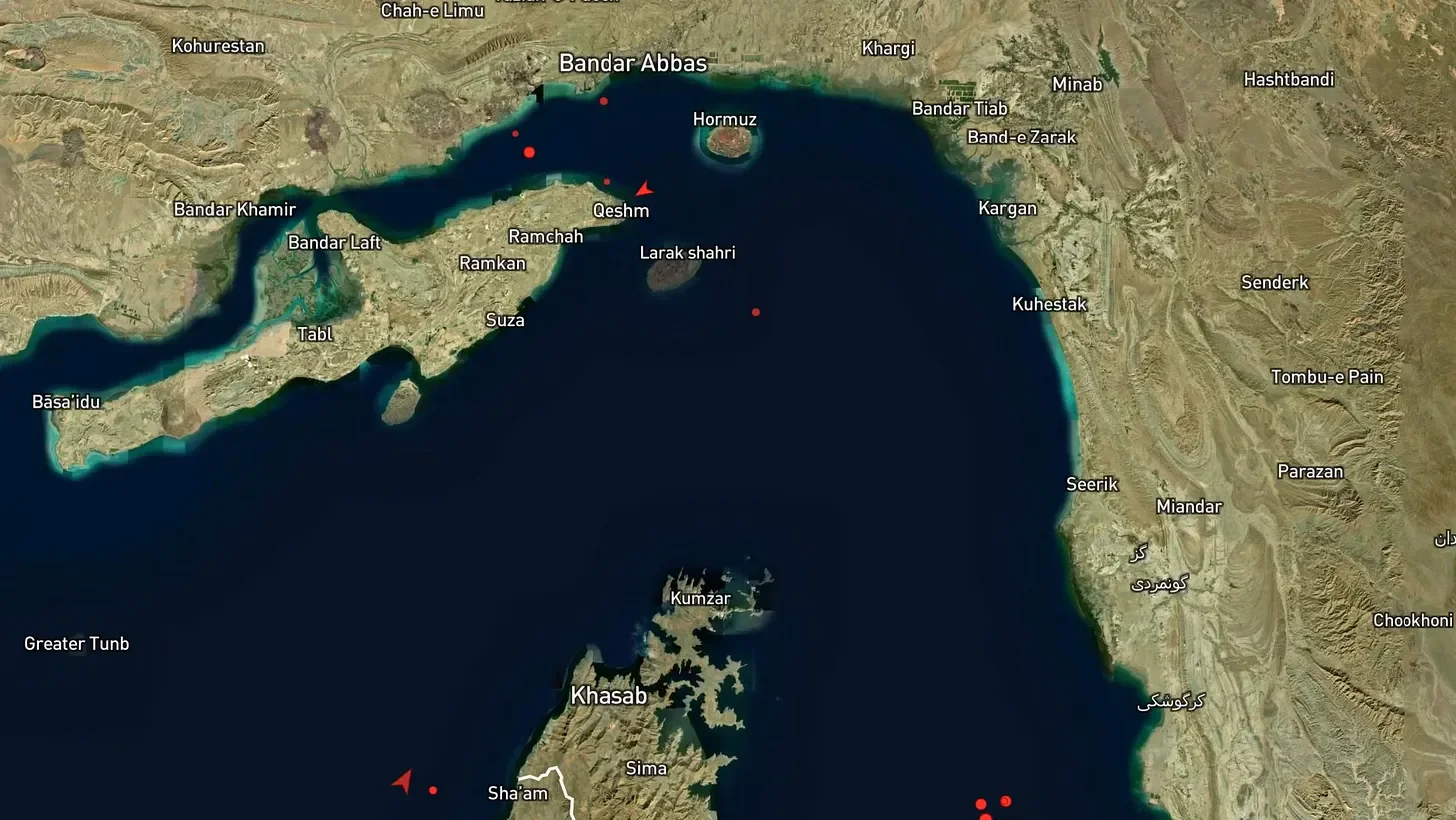
The Strait of Hormuz at the chokepoint narrows, March 3, 2026. Qeshm Island —
home to IRGC naval assets — visible center left. Near-zero commercial tanker
traffic in the strait proper. Source: MarineTraffic.
Iran’s Strategic Calculus: Ambiguity as Leverage
Tehran has threatened to close the Strait of Hormuz repeatedly since 1979. It has never sustained a full closure. The reason is not restraint, but leverage. A fully closed strait would damage Iran economically alongside its adversaries.
Instead, Iran has refined a strategy of calibrated ambiguity. IRGC Navy seizures, harassment incidents, and selective enforcement actions over the past decade have imposed costs without crossing thresholds that would guarantee full-scale retaliation. Each incident nudged premiums upward without requiring sustained combat.
The 2026 escalation altered the calculus. U.S. strikes directly targeted Iranian sovereign territory. Iran’s parliament authorized conditional closure of the strait, and senior IRGC commanders issued explicit threats against transiting vessels. The U.S. response — escort discussions and insurance backstop considerations — signals that Washington now views shipping disruption itself as a national security problem.
Iran does not need to close the strait to constrain it. Keeping it perpetually expensive is enough.
The Red Sea Compounding Effect
The Hormuz crisis unfolded against an already stressed maritime system. Since late 2023, Iranian-backed Houthi forces have conducted sustained attacks on commercial shipping in the Red Sea and Bab el-Mandeb. War risk premiums on that route reached 0.5–2.0 percent, and transit volumes fell sharply.
Traffic displaced from the Red Sea was forced either around the Cape of Good Hope or through the Strait of Hormuz. Pressure in one chokepoint increased dependency on another under Iranian influence.
With both corridors simultaneously elevated risk, shipping companies face constrained routing choices. Some cargo moves at dramatically higher cost. Some does not move at all. LNG exports from Qatar, which must transit Hormuz, are particularly exposed.
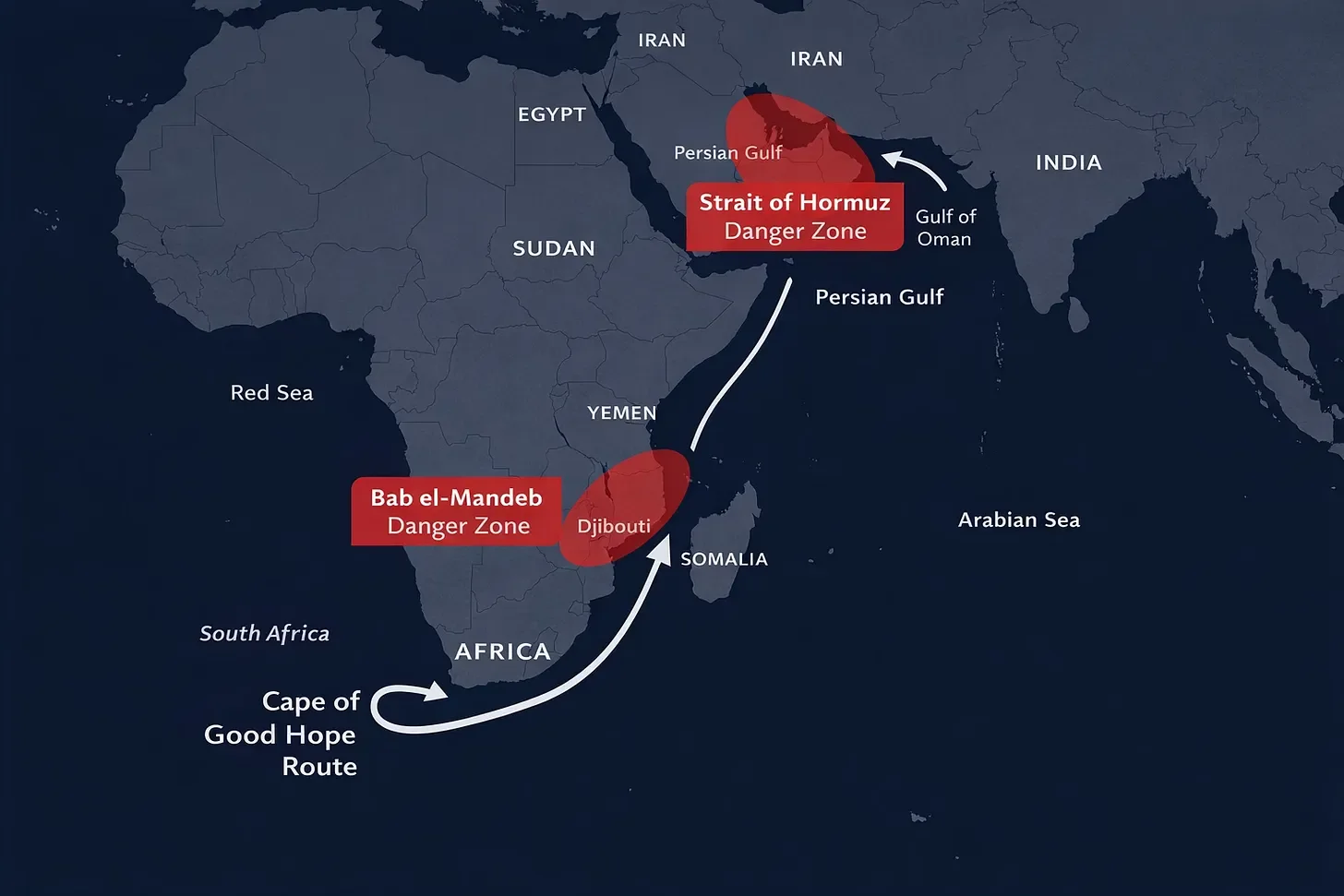
The dual chokepoint problem. Iranian-backed Houthi forces control the Bab el-Mandeb
approach to the Red Sea while Iran dominates the Strait of Hormuz. Ships avoiding
one corridor increasingly depend on the other or absorb the cost of rerouting around Africa.
Source: Global Recon analysis.
What Happens Next
Insurance markets provide the clearest real-time signal of professional risk assessment.
Stabilization Through Intervention
U.S. escorts and insurance backstopping could restore transit at elevated but manageable cost, effectively socializing risk while embedding U.S. forces deeper into proximity with Iranian assets.
Prolonged Ambiguity
Continued harassment without formal closure sustains elevated premiums and volatility. Government backstopping becomes a long-term subsidy to global energy markets.
Escalation
Close-quarters naval operations combined with explicit threats create miscalculation risk. A strike on an escorted vessel would force responses that neither insurers nor markets have priced.
The Bottom Line
The Strait of Hormuz does not need to close to impose damage. It only needs to remain expensive long enough to force governments to underwrite global trade.
Washington’s discussion of a federal insurance backstop is not a sign of strength. It is an admission that the commercial system that quietly kept energy flowing for decades is under stress beyond what markets alone can absorb.
Iran spent forty years learning how to squeeze a strait without closing it. That strategy just forced Washington’s hand.
The insurance market told you this was coming.
OSINT Methodology Note
Vessel movement analysis draws on open-source AIS data from MarineTraffic and VesselFinder. Vessel counts are derived from geofenced observations of tanker classes and speed behavior and are reproducible using standard commercial platforms. War risk premium data is sourced from Marsh McLennan, Bertling Logistics, Marine Insight, and Ship Universe. Independent verification may be conducted through Lloyd’s Joint War Committee updates, BIMCO circulars, and UKMTO advisories.
John Hendricks is an OSINT analyst and founder of Global Recon. Follow on X: @IGRecon
Subscribe to Unclassified with John Hendricks on Substack for geopolitical intelligence analysis, OSINT breakdowns, and national security reportin
Related Analysis

ANALYSIS
The mind is not a vessel to be filled but a fire to be kindled: A Discussion with former KGB Officer Jack Barsky
Jack Barsky, former KGB officer, explores Intelligence, Insight, ana tne power of critical thinking in shaping perspective.
ANALYSIS
Do not wait to strike till the iron is hot; but make it hot by Striking: A discussion with Hrulf, the founder of the Norman Brigade
Hrult, tounder ot me Norman Bngaae, shares Insignts on taking Imtiatlve, shaping opportunity, and leading with strategy.