

The Pressure Trap
The Pressure Trap
How Iran’s campaign to coerce the Gulf is accelerating the regional alignment it was meant to prevent.
John Hendricks
Editor & Host, Global Recon

March 17, 2026 🕒 8 min read
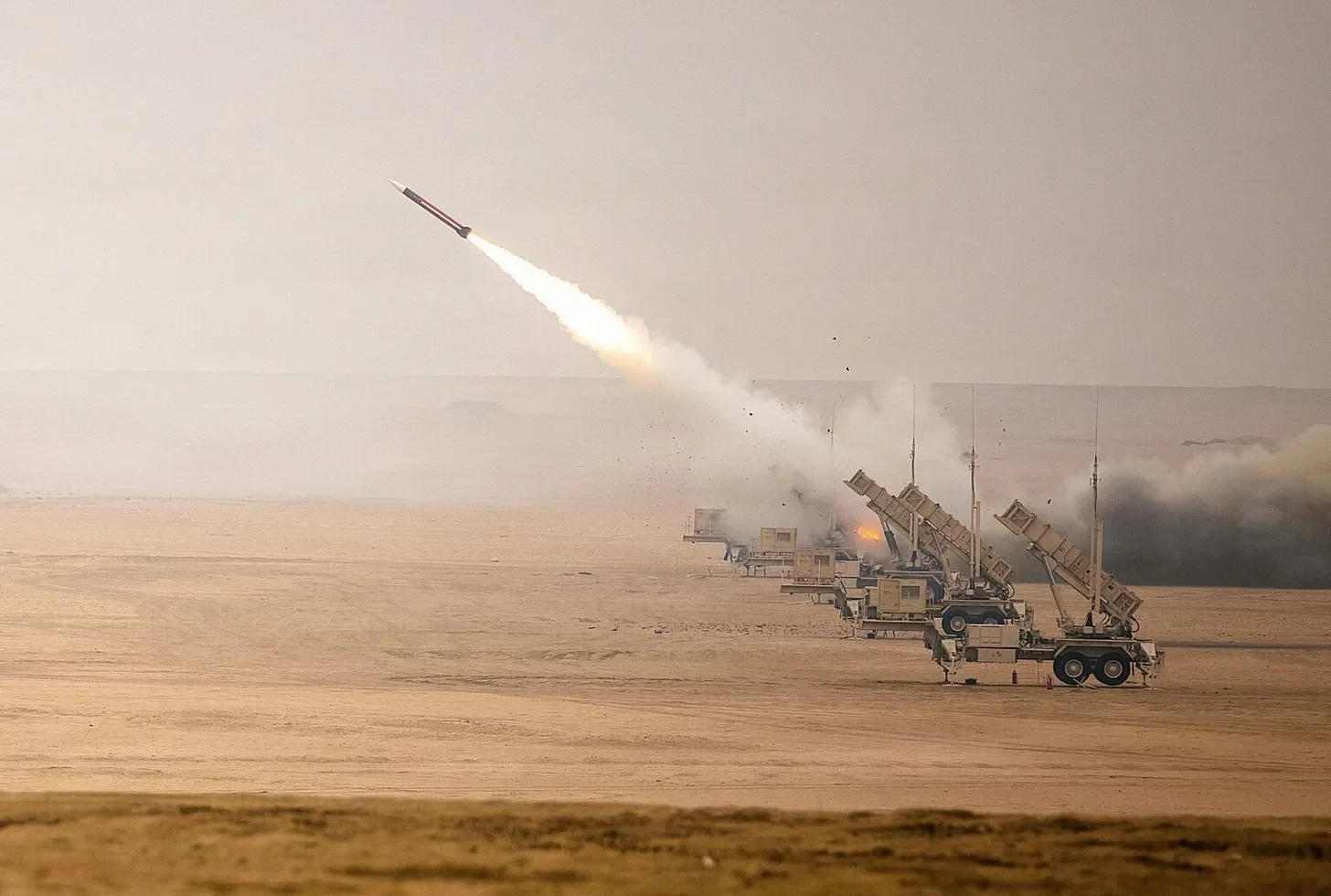
Patriot missile launches at the Udari Range Complex, Kuwait, Dec. 9, 2025. (Courtesy Photo)
THE PRESSURE TRAP How Iran’s Gulf Strategy Is Producing the Opposite of What Tehran Intended
When Operation Epic Fury began on February 28, Iran faced a choice. Absorb the strikes and appear weak, or retaliate and risk widening the war. Tehran chose to widen it but not in the direction most observers expected.
Rather than concentrating its retaliation against Israel or U.S. forces directly, Iran unleashed a sustained missile and drone campaign across the entire Gulf Cooperation Council. Bahrain, Kuwait, Qatar, Saudi Arabia, the UAE, and even Oman absorbed hundreds of ballistic missiles and drones in the opening days. Airports were struck. Hotels burned. Oil refineries went offline. Amazon Web Services infrastructure in Abu Dhabi took hits. For the first time, a single actor launched missile and drone strikes against all six GCC states within 24 hours.
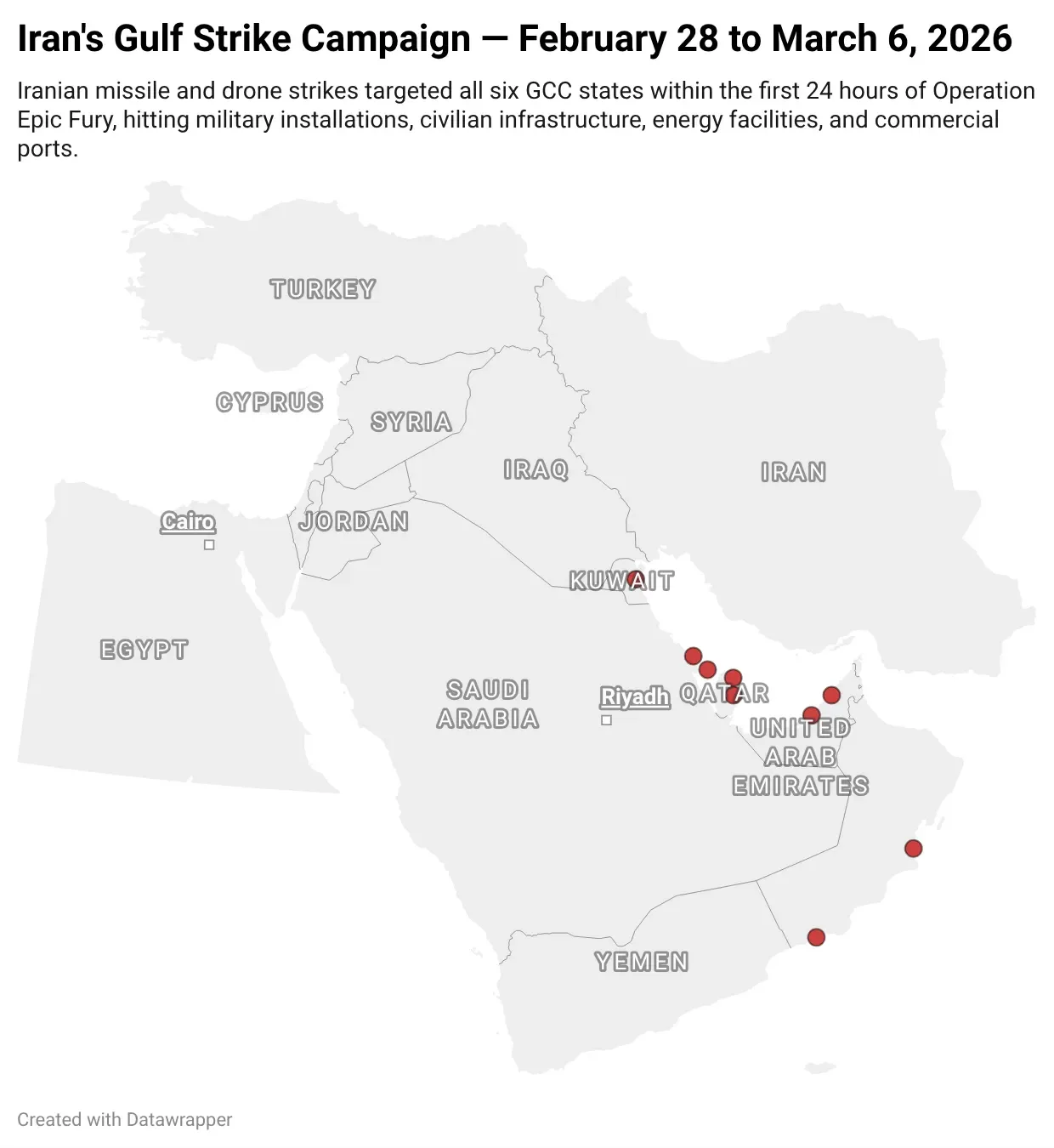
Map: Iranian missile and drone strikes targeted all six GCC states within the first 24 hours of Operation Epic Fury. Interactive version: datawrapper.dwcdn.net/MO50B/1
The immediate coverage focused on the strikes themselves the intercept numbers, the damage assessments, the dramatic footage of Gulf skylines lit up with interceptor trails. What that coverage largely missed was the more important question: why the Gulf so extensively, and what is Tehran actually trying to accomplish?
To answer that, you have to understand how Iran sees this war and why the strategy it chose, constrained as it is, reflects a coherent logic that deserves to be taken seriously before examining where it leads.
II. Iran’s Theory of Victory
Iran entered this conflict under no illusions about the military balance. A direct conventional confrontation with the United States and Israel was never winnable. That assessment isn’t a weakness it’s strategic realism, and Tehran has been planning around it for decades.
The doctrine Iran has developed in response is often described as mosaic defense a decentralized, distributed approach designed not to defeat an adversary outright but to make the cost of fighting prohibitive. Rather than concentrating force in ways that invite decisive strikes, Iran disperses it. Military cells operate on pre-issued instructions with significant autonomy. No single strike can decapitate the system.
Iranian Foreign Minister Araghchi described it plainly in an interview during the conflict’s opening days: “We’ve had two decades to study defeats of the U.S. military to our immediate east and west. We’ve incorporated lessons accordingly.”
Applied to the Gulf campaign, that doctrine translates into four distinct pressure levers.
The first is energy disruption. Strikes on Saudi Arabia’s Ras Tanura refinery processing roughly 550,000 barrels per day forced a temporary shutdown. Iranian drones targeted Qatar’s LNG infrastructure, taking offline facilities responsible for roughly 20 percent of global LNG supply.
The second lever is civilian and economic infrastructure pressure. Airports in Dubai, Abu Dhabi, Doha, and Erbil were targeted. Hotels on Dubai’s Palm Jumeirah took hits. Amazon Web Services infrastructure in the UAE was struck, sending a specific signal about the Gulf’s ambitions as a global technology hub. These are not random targets they are the arteries of the post-oil economic model Gulf states have spent the last decade building.
The third lever is proxy activation. Militia networks across Iraq, Yemen, and Lebanon have widened the geographic footprint of the conflict, multiplying pressure points and stretching U.S. and Gulf defensive resources across a vast theater.
The fourth and most consequential lever held in reserve is the Strait of Hormuz itself. Closing it would be an act of economic war against the entire global energy system, including China and India, Iran’s two most important trading partners. The fact that Tehran has not closed it yet is deliberate. The threat is more useful than the action.
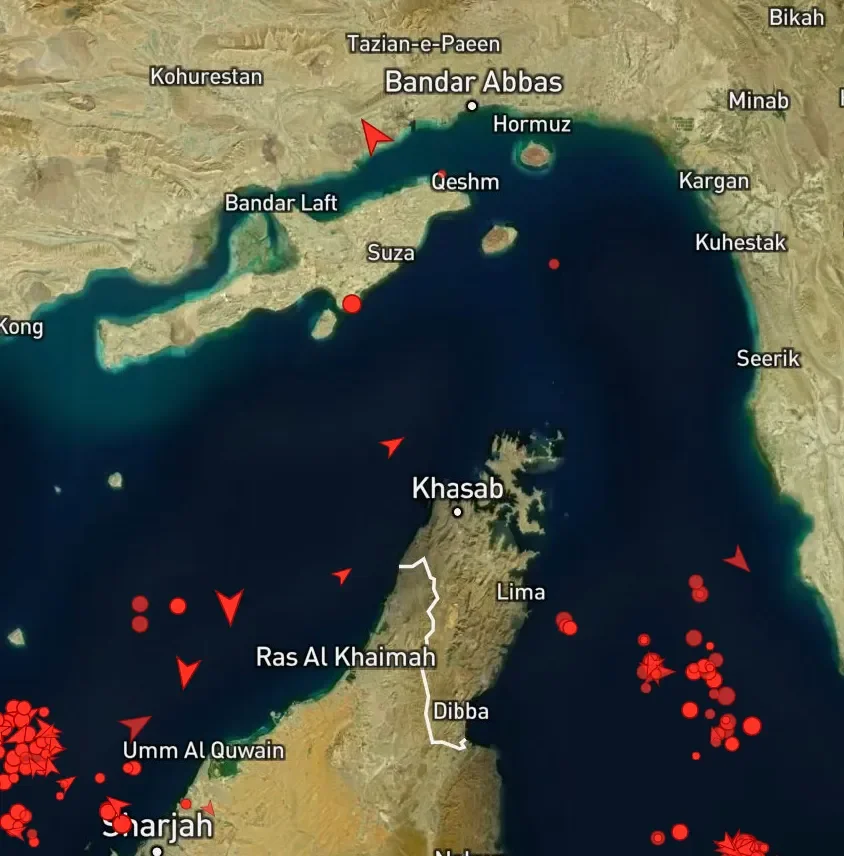
MarineTraffic live vessel tracking, March 6, 2026. The Strait of Hormuz at its narrowest — 21 miles wide, two 1-mile shipping lanes. Iran controls the northern shore. Approximately 20% of global oil supply transits here daily.
The strategic logic binding all four levers together is straightforward: if Gulf economies feel sustained pain, Gulf rulers will pressure Washington to de-escalate.
Iran’s diplomatic framing reinforces this. By insisting it is targeting U.S. military infrastructure rather than the Gulf states themselves, Tehran attempts to give Gulf governments a face-saving off-ramp while the pressure builds.
It is a coherent theory of asymmetric coercion. Whether it is working is a different question.
III. The Strategy Working on the Surface
In the immediate term, the pressure campaign is producing real effects. Dismissing them would be a mistake.
Energy markets reacted sharply from the opening hours of the conflict. Oil prices spiked as tankers backed up near the Strait of Hormuz and Iranian attacks on Gulf shipping lanes created genuine uncertainty about supply continuity.
QatarEnergy declared a full halt to LNG production after Iranian drones struck its facilities at Ras Laffan and Mesaieed Industrial City the world’s largest LNG export complex. The company declared force majeure, freeing it from contracted delivery obligations. European gas futures surged more than 50 percent. Asian benchmark prices jumped nearly 40 percent. Twenty percent of global LNG supply does not go offline without consequences. European buyers, still rebuilding their energy security architecture after Russia’s invasion of Ukraine, watched closely.
On the ground across the Gulf, the human and economic disruption has been significant. Dubai International Airport one of the busiest in the world sustained damage and closures. Abu Dhabi’s Zayed International Airport was struck, killing at least one person. Kuwait’s international airport came under attack.

Interceptor flares light the sky over Doha, Qatar, March 2026. Qatar's air defenses intercepted 98 of 101 ballistic missiles fired during the campaign. (Source: social media/X)
Tens of thousands of travelers were stranded as airspace closures cascaded across the region. Schools shifted to remote learning. Residents in Doha, Manama, Abu Dhabi, and Riyadh received shelter-in-place alerts.
The Gulf's carefully cultivated image as an oasis of stability, the bedrock of its economic diversification strategy, took a visible and measurable hit
The interceptor depletion problem is real and worth noting. During Israel’s 12-day war with Iran in June 2025, the United States burned through roughly a quarter of its THAAD interceptor inventory. A sustained saturation campaign of drones and missiles is expensive to defend against economically and logistically. Each Patriot interceptor costs multiples of the drones it is knocking down. Iran understands this arithmetic.
Iran’s mosaic defense was designed to complicate the U.S. and Israeli effort to land a decisive blow: dispersed cells, autonomous operations, and pre-issued instructions. In the opening days it created genuine targeting complexity. But the attrition has been significant.
Israeli military officials reported that more than 60 percent of Iran’s ballistic missile launchers and roughly 80 percent of its air defense systems have been destroyed. Shahed drone production and launch infrastructure has taken serious damage, and the volume of incoming fire into the Gulf has measurably slowed.
Hegseth declared the IRGC air force and navy “obliterated.” The launches continuing despite that degradation reflect the doctrine’s residual capacity but the trajectory is clearly downward. Iran’s window for sustained coercive pressure is narrowing, not expanding.
IV. The Quiet U.S.–Gulf Tension
Beneath the public messaging of allied solidarity, something more complicated is unfolding in the relationship between Washington and its Gulf partners.
Gulf states spent weeks before Operation Epic Fury lobbying the Trump administration against striking Iran. This wasn’t squeamishness. It was strategic calculation. These governments understood what Iranian retaliation against the Gulf would look like, and they had spent years building diplomatic architecture designed specifically to avoid it. Qatar’s Emir had been working Washington extensively. Oman’s foreign minister appeared on American television days before the strikes declaring peace was “within reach.” The Saudi–Iran rapprochement represented years of careful diplomatic investment.
When Epic Fury launched, some Gulf capitals felt they had limited warning and limited time to prepare for what followed. Reporting from the Washington Post indicated the Trump administration was confronting discontent from Gulf allies who said they were not given adequate time to prepare for the Iranian barrage. Trump calling the Gulf retaliation “probably the biggest surprise” of the war did not help in capitals that had warned Washington this was coming, that framing was noted.
The frustration reflects a recalibration, not a rupture. Gulf states host roughly 40,000 American troops and have spent hundreds of billions on U.S. weapons systems over decades a security architecture that held. Intercept rates above 90% across multiple GCC states are a direct product of that investment. The quieter question now is how allied coordination evolves from here, and what consultation looks like the next time Washington moves.
Those questions do not have clean answers yet. What is clear is how Gulf states are choosing to respond to the immediate crisis.
V. The Gulf Response: Defensive Militarily, Offensive Economically
The Gulf response to Iran’s pressure campaign has been deliberate and carefully calibrated and it looks very different depending on which domain you examine.
Militarily, the posture has been defensive. Air defense systems across the GCC have performed well. The UAE reported intercepting 93 percent of incoming Iranian missiles and drones, a figure its government has amplified deliberately projecting confidence domestically while demonstrating to global investors and residents that the country remains functional and resilient. Dubai officials toured shopping malls. Emirati influencers coordinated messaging emphasizing normalcy. Etihad Airways announced the resumption of limited flights as of March 6. The narrative management has been as deliberate as the missile interceptions.

Sources: UAE Defense Ministry, Qatar Ministry of Defence, Bahrain Ministry of Defence. Dark bars represent missiles intercepted, light bars represent drones intercepted. Figures cover February 28 to March 6, 2026.
Diplomatically, Gulf states moved quickly to establish legal and political legitimacy for whatever comes next. The GCC invoked Article 51 of the UN Charter the self-defense provision at an emergency meeting, establishing the collective legal architecture for a coordinated response if one becomes necessary. A joint GCC–EU statement followed, framing Iranian strikes as a violation of international law and affirming the right of Gulf states to take all necessary measures to defend themselves. A formal file is being prepared for the UN Security Council. There has also been discussion of pursuing Iran at the International Criminal Court for targeting civilian infrastructure. The goal is to internationalize Iranian aggression shifting the narrative from a regional confrontation to a global legal and diplomatic issue.
But the most significant and least reported dimension of the Gulf response may be economic.
Dubai is, by most assessments, Iran’s financial lung. Despite years of sanctions, Iranian commercial networks have operated extensively through UAE financial and trade infrastructure. Iranian companies, trading intermediaries, and financial flows have used Dubai as a gateway to the global economy in ways that partially offset the pressure of Western sanctions.
Gulf states are now signaling that gateway may close. Discussion among Gulf analysts and officials points toward freezing Iranian assets, restricting Iranian business networks operating through Emirati commercial hubs, and tightening trade channels that have quietly kept Iranian commerce breathing. The UAE’s position as a top-ten global soft-power hub home to more than 200 nationalities gives it financial leverage missiles cannot replicate.
This is the Gulf’s preferred battlefield. Not the skies over Manama or Dubai, but the financial architecture that Iran depends on to survive sanctions. If Gulf states follow through on economic pressure at scale, the impact on Tehran could be considerably more damaging than anything playing out in the air defense exchanges.
The restraint on the military side is therefore not passivity. It is a choice reflecting a clear-eyed assessment that the Gulf’s real leverage over Iran is economic and diplomatic, not kinetic. Let the United States and Israel handle the military campaign. Hit Iran where it is actually vulnerable.
VI. The Strategic Dilemma Iran Has Created
Here is where Iran’s pressure campaign produces its most consequential unintended effect not in the damage it has inflicted, but in the position it has forced Gulf states into.
The Gulf wants Iran weakened. That much is straightforward. A degraded Iran means fewer proxy attacks, reduced missile pressure, a weaker IRGC regional network, and less leverage over Gulf shipping lanes. There is quiet strategic satisfaction in Gulf capitals at watching U.S. and Israeli strikes systematically dismantle Iranian military infrastructure that has threatened the region for decades.
But the Gulf does not want Iran destabilized.
That distinction between weakened and destabilized is the fault line running beneath every Gulf statement, every call for restraint, every expression of concern about Washington’s endgame.
A destabilized Iran produces a different set of problems entirely: internal fragmentation, IRGC factions operating independently without central command authority, proxy networks across Iraq, Yemen, and Lebanon potentially becoming unmoored from coherent political direction, refugee flows toward Gulf territory, and extreme volatility in energy markets that would damage the same Gulf economies Iran was attempting to pressure.
This is why Gulf messaging has seemed contradictory to outside observers. Strong condemnation of Iranian strikes paired with persistent calls for de-escalation. Alignment with U.S. security structures alongside visible frustration with Washington’s approach. Reservation of the right to respond militarily combined with a clear preference not to.
These are not mixed signals. They are one coherent strategy navigating an extremely narrow path attempting to secure the benefits of Iranian degradation without triggering the chaos of Iranian collapse.
The ideal Gulf outcome is specific: an Iran whose military capabilities are significantly reduced, whose regional influence is curtailed, but whose government remains intact and functional enough to control its own territory, its own proxies, and its own population.
That is a narrow target to hit from the outside. And Iran, by launching this pressure campaign, has made it narrower.
Every missile that lands in a Gulf city shrinks the political space for moderation. Every strike on civilian infrastructure makes the argument for Iranian state preservation harder to sustain domestically. Iran did not simply create military problems for its neighbors it created a strategic dilemma with no clean exit.
VII. Strategic Consequences Emerging for Iran
Whatever the final military outcome of this conflict, several regional shifts are already underway that will outlast it and they run in precisely the opposite direction from what Iran’s pressure campaign was designed to produce.
The 2023 Saudi–Iran rapprochement, brokered by China and representing years of careful diplomatic work on both sides, is effectively dead. Saudi Arabia condemned the strikes as “treacherous.” Crown Prince Mohammed bin Salman has been in direct consultation with Washington, signaling a shift from cautious mediator to active participant in regional coalition building against Iran.

Sources: Chinese Foreign Ministry, Saudi Ministry of Foreign Affairs. The 2023 Beijing Agreement normalized Saudi-Iran relations after seven years of severed diplomatic ties. Iran's strikes on Saudi territory in March 2026 rendered the agreement functionally void.
The targeting of Oman deserves particular attention. Oman had no U.S. military base. Its foreign minister was on American television days before the strikes declaring peace within reach. Oman had been actively mediating between Washington and Tehran, representing perhaps the last functioning diplomatic channel available to Iran.
Tehran struck it anyway.
Whatever residual goodwill Iran retained among Gulf states genuinely attempting to keep diplomatic channels open was likely extinguished in that moment.
The numbers reinforce the perception forming across the region. According to U.S. Central Command, Iran launched more than 500 ballistic missiles and over 2,000 drones in the first four days of the conflict. The UAE Ministry of Defense alone reported absorbing 172 ballistic missiles and 755 drones. The volume directed at Gulf states exceeded what Iran fired at Israel by a wide margin. For a campaign publicly framed as retaliation against U.S. and Israeli aggression, that targeting ratio is difficult to explain to Gulf audiences.
The isolation forming around Iran is striking in its breadth. Every GCC state it struck is now openly hostile. The Palestinian Authority called for evacuation from Iran. Kazakhstan ordered its citizens to leave. Syria and Turkey condemned the strikes.
Iran handed its adversaries a common enemy and a common cause simultaneously. The Axis of Resistance has responded, but not at the scale Tehran’s strategy appeared to anticipate. Hezbollah continues limited operations along Israel’s northern border but has stopped well short of full mobilization. The Houthis have not reopened the Red Sea campaign. The coordinated multi front pressure Iran’s doctrine is meant to generate has so far remained restrained and uneven rather than overwhelming.
And perhaps most consequentially for Iran’s long-term strategic position, the Gulf–Israel security alignment Tehran spent decades trying to prevent is now accelerating quietly. Intelligence sharing, missile defense coordination, and security architecture that would have been politically impossible before February 28 are now being discussed in practical terms. A senior Gulf official summarized the shift bluntly: Tehran had “lost all goodwill from Islamic and Arab states.”
That is not a tactical setback. It is a generation’s worth of regional positioning dismantled in the opening week of a war Iran chose to widen in this direction.
VIII. The Strategic Question the War Has Opened
The conflict has now entered a phase where the immediate military exchanges intercept numbers, strike damage assessments, launch rates tell only part of the story.
They matter the measurable degradation of Iran’s ballistic missile launchers and Shahed drone infrastructure directly affects how much coercive runway Tehran still has.
But running parallel to those battlefield metrics are structural questions that will shape the region long after the last drone is intercepted.
The most consequential question Gulf governments are grappling with in real time is simple: what does the end of this war actually look like, and what role do they play in shaping it?
If Iran emerges from this conflict with its military capabilities significantly degraded but its government intact, the Gulf achieves something close to its preferred outcome a weaker Iran within a still-functioning regional order.
But that outcome requires the United States and Israel to stop at degradation rather than pursue regime collapse, and it requires Iran to find an off-ramp before the pressure becomes existential.
Neither condition currently exists.
If the campaign continues at its current intensity, the probability of controlled degradation decreases and the probability of something far more destabilizing increases.
This is the trap Iran created. By drawing the Gulf into the blast radius of a conflict it did not choose, Tehran has given Gulf states every reason to want Iran punished while simultaneously giving them every reason to fear what full punishment might look like.
The Gulf is now invested in an outcome it cannot fully control, shaped by decisions made in Washington and Tel Aviv whose consequences land in Riyadh, Abu Dhabi, and Doha.
The longer-term structural shifts are becoming visible regardless of how the immediate conflict resolves. Gulf states will militarize more aggressively and accelerate diversification away from dependence on any single security guarantor. Saudi Arabia alone allocated $78 billion to defense in 2025, representing 21 percent of total government spending and ranking among the largest military budgets in the world. That figure will go higher.

Sources: GAMI (Saudi Arabia), IISS Military Balance 2025. Saudi Arabia's $78 billion
defense budget represents 21% of total government spending.
Collective GCC security coordination, described by analysts as operationally non-existent beyond the public statement before this conflict, is now being stress-tested into something more functional.
The financial pressure networks targeting Iran will tighten. Dubai’s role as Iran’s economic gateway is under direct political pressure in a way it has never been before. If Gulf states follow through on restricting Iranian commercial access to their financial systems, the cumulative effect on an already sanctions-battered Iranian economy could be severe.
And given that Gulf states and Israel have spent the past week absorbing strikes from the same adversary and coordinating through the same U.S. defense architecture, quiet security cooperation that once remained politically impossible is rapidly becoming practical.
None of these shifts were inevitable before February 28. Iran’s pressure campaign made them so.
IX. Conclusion
Iran’s pressure campaign against the Gulf reflects a rational strategic calculation. Facing adversaries it cannot defeat conventionally, Tehran chose to expand the cost of the war outward targeting the economic arteries, civilian infrastructure, and security confidence of the Gulf states hosting American forces.
The logic was coherent.
The execution has been something else.
In one week, Iran has managed to kill the diplomatic thaw it spent years building with Saudi Arabia, alienate the one regional mediator attempting to preserve its interests, fire more ordnance at Arab states than at the country that struck it, and accelerate the precise regional security alignment it spent decades trying to prevent.
The Gulf response has been measured but far from passive. Behind the intercept statistics and diplomatic statements, a different kind of campaign is taking shape one built around financial networks, legal architecture, and economic pressure rather than missiles.
Dubai’s role as Iran’s commercial gateway is now under direct political scrutiny. The legal frameworks for collective self-defense are in place.
Meanwhile Gulf governments navigate a dilemma Iran created for them: wanting Iran weakened enough to stop being a threat, but stable enough not to become a different kind of catastrophe.
That is a narrow path and every missile that lands in a Gulf city makes it narrower.
The ultimate military outcome of the conflict remains uncertain. Launch rates are declining. Iranian infrastructure is degrading.
But the structural shifts set in motion over the past week are not waiting for a ceasefire.
The regional architecture Iran attempted to pressure into submission is instead consolidating against it.
Iran did not simply miscalculate the Gulf’s willingness to absorb punishment.
It miscalculated what the Gulf would do with the justification Tehran handed it.
John Hendricks is an OSINT analyst and founder of Global Recon. Follow on X: @IGRecon
Subscribe to Unclassified with John Hendricks on Substack.
Related Analysis
ANALYSIS
The mind is not a vessel to be filled but a fire to be kindled: A Discussion with former KGB Officer Jack Barsky
Jack Barsky, former KGB officer, explores Intelligence, Insight, ana tne power of critical thinking in shaping perspective.
ANALYSIS
Do not wait to strike till the iron is hot; but make it hot by Striking: A discussion with Hrulf, the founder of the Norman Brigade
Hrult, tounder ot me Norman Bngaae, shares Insignts on taking Imtiatlve, shaping opportunity, and leading with strategy.