

The Drone Clock: How Long Can Iran Sustain Its Campaign?
The Drone Clock: How Long Can Iran Sustain Its Campaign?
A five-variable sustainability model for Iran's one-way attack drone campaign.
John Hendricks
Editor & Host, Global Recon

March 17, 2026 🕒 8 min read
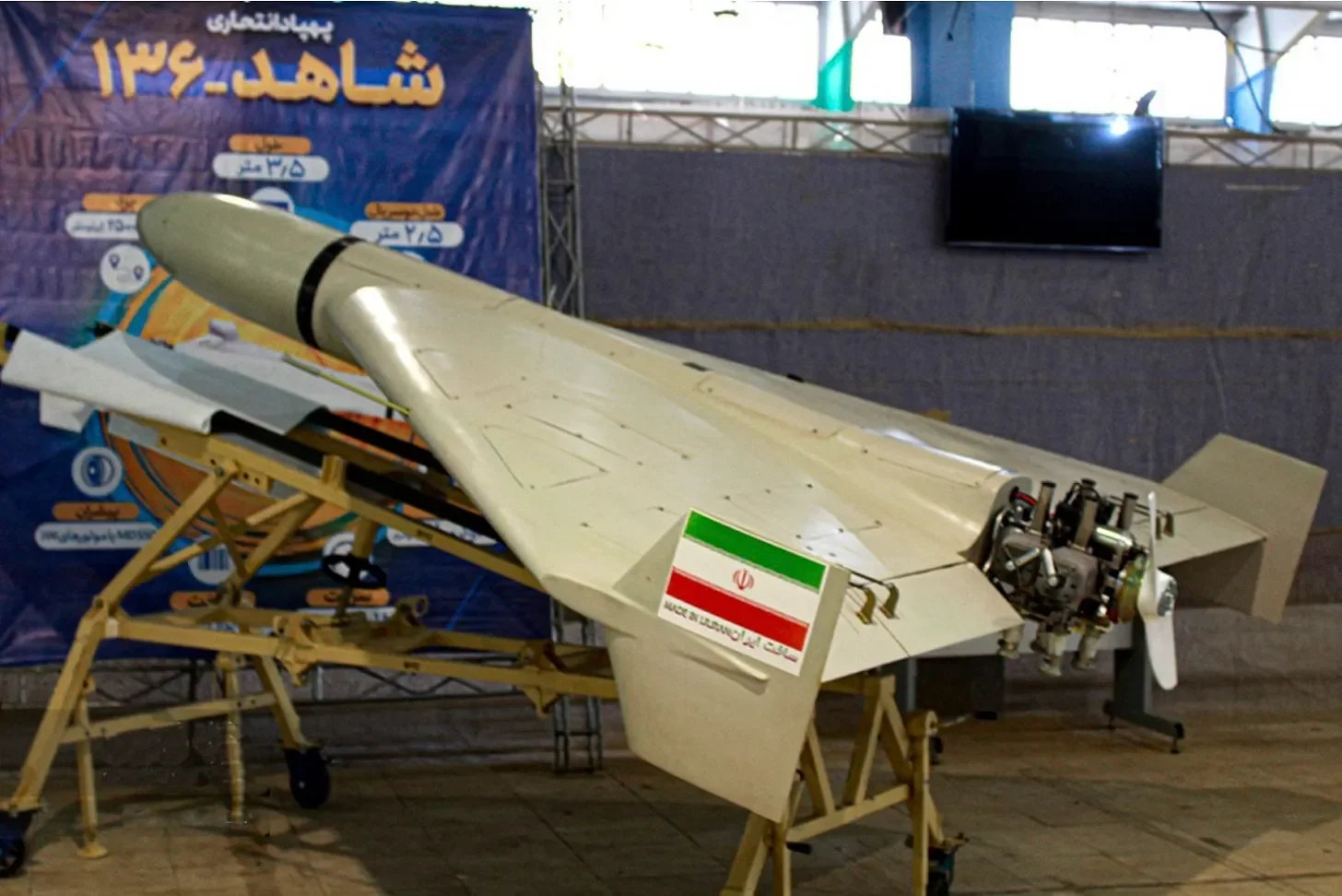
A Shahed-136 one-way attack drone. Iran's loitering munitions have become the centerpiece of its retaliatory campaign against US and allied positions across the Gulf. (Wikimedia Commons)
The First Week’s Tempo
Iran’s retaliatory drone campaign is past its first week. Beyond other results, the opening strikes made sustainability a strategic issue. Iran launched over 2,000 drones in five days, alongside hundreds of ballistic missiles, according to US officials. Drone and missile attacks hit US bases, Gulf infrastructure, and civilian areas. By Day 4, an unnamed Gulf ally requested an emergency resupply of interceptors from Washington.
Then the tempo dropped. Pentagon briefings reported that Iranian one-way attack drone launches fell 73% from Day 1 levels, while ballistic missile shots declined 86%. That drop is the most important data point of the war’s first week, and the least understood. It could mean Iran is running low. It could mean that US and Israeli strikes have degraded launch infrastructure. It could mean Iran is deliberately pacing itself, shifting from shock-value saturation to a sustainable harassment tempo. It could be some combination of all three. The honest answer is that no one outside of IRGC operational planning knows which explanation carries the most weight, and anyone who tells you they know for certain is guessing.
What we can do is model the possibilities. The rest of this piece does that using five variables: observed burn rate, pre-war stockpile estimates, domestic production capacity, launch infrastructure survivability, and the potential for Russian resupply. The three scenario projections presented below will each specify their core assumptions about these variables, clarifying the operational outlooks they represent. The interaction between those variables determines whether Iran’s drone campaign is a weeks-long problem or a months-long one.
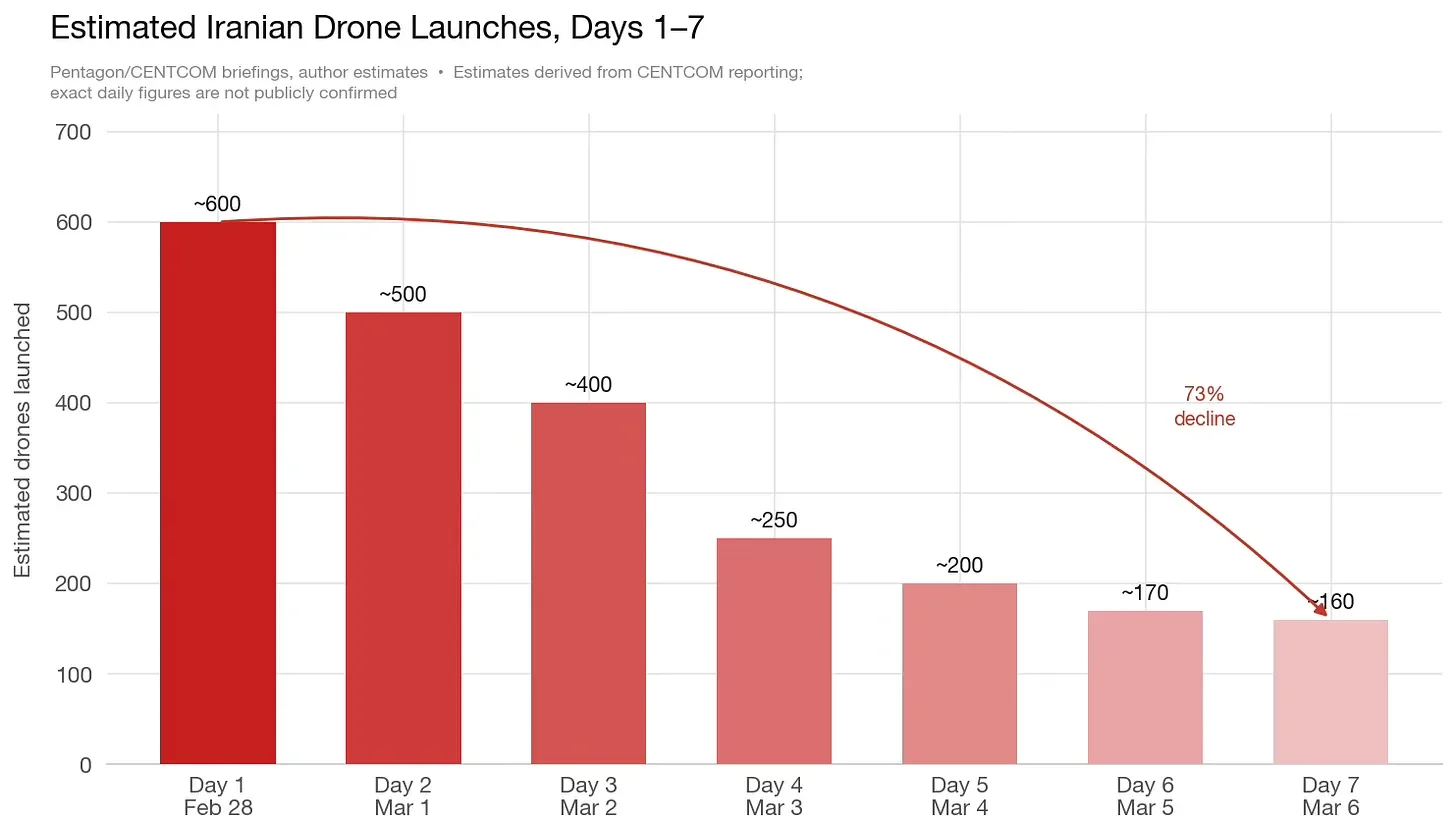
Estimated daily Iranian drone launches during the first week of Operation Epic Fury. Figures are derived from CENTCOM reporting; exact daily breakdowns are not publicly confirmed.
What Iran Likely Started With
Estimating Iran’s pre-war drone stockpile is an exercise in informed uncertainty. The US Office of the Director of National Intelligence assessed in early 2025 that Iran possessed the largest missile and drone stockpile in the Middle East. The UK-based Centre for Information Resilience estimated Iranian drone production capacity at roughly 10,000 units per month. Open-source estimates of actual standing inventory vary widely, and public claims about Iranian drone stockpiles often blur the line between production capacity, cumulative output, and standing inventory. A production capacity of 10,000 per month does not automatically translate into a stockpile of equivalent scale. Capacity is not the same as output, and output is not the same as inventory. Iran transferred significant numbers of Shaheds to Russia for use in Ukraine. Iran’s proxy networks in Lebanon and Yemen absorbed portions of production. The twelve-day war with Israel in June 2025 burned through drone and missile stocks that had to be rebuilt. Some of that rebuild happened. How much is the open question?
The missile picture is clearer but disputed. Pre-war analyst estimates ranged from 2,500 to 6,000 missiles. How much survived the June 2025 war and later strikes is unclear. The drone tally is harder to pinpoint because drones are smaller, cheaper, more dispersed, and often produced in dual-use civilian-military facilities.
For modeling, the credible range for Iran’s pre-war Shahed inventory is in the low tens of thousands, depending on production devoted to inventory, exports, and operational use over the past two years.
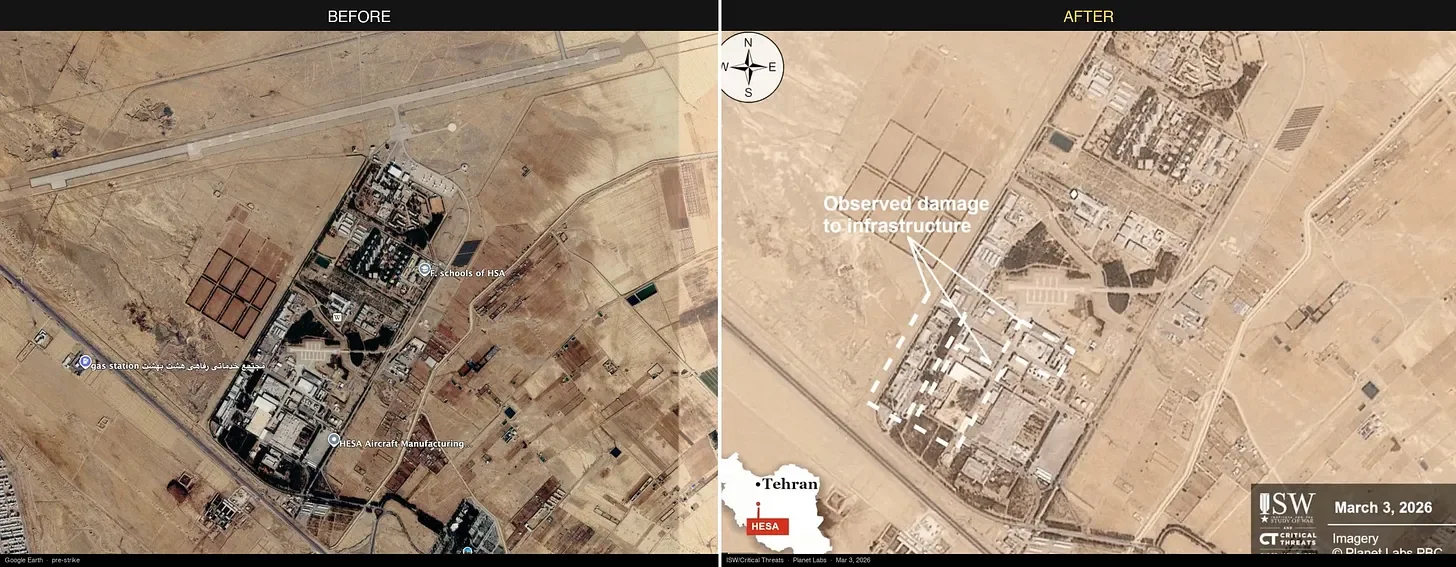
HESA facility in Isfahan, Iran. Left: pre-strike imagery via Google Earth. Right: post-strike damage assessment dated March 3, 2026 via ISW/Critical Threats, imagery by Planet Labs. HESA is Iran's primary known drone production facility.
What Iran Can Still Produce
The stockpile matters less than coverage suggests. Regeneration is more important. If Iran can keep producing while fighting, the stockpile is only a buffer. If production stops, the stockpile becomes a countdown.
Pre-war estimates pointed to a dispersed manufacturing ecosystem spread across multiple provinces, with modular components, multiple assembly sites, and dual-use facilities that complicate targeting. Iran’s industrial philosophy for its drone program has emphasized exactly this: dispersion, redundancy, and the ability to reconstitute quickly after strikes. This is not theoretical. Iran rebuilt its capacity after the June 2025 war in just months.
US and Israeli strikes in the first week of Operation Epic Fury targeted drone production and storage sites, missile launchers, air defenses, and command infrastructure. CENTCOM reported nearly 2,000 Iranian targets hit with over 2,000 munitions. The question is how much of Iran’s dispersed production network those strikes reached. Destroying a known assembly plant is one thing. Finding and striking numerous smaller, civilian-shielded facilities across a country the size of Alaska is fundamentally different.
Iran’s production will not return to pre-war levels. The question is not whether production has been degraded, it has but whether it has declined by 30%, 60%, or 80%. The difference determines if the campaign can regenerate or will slowly bleed out.
Launch Infrastructure: The Bottleneck Nobody Is Talking About
Inventory and production capacity are meaningless without the ability to launch drones. This factor may matter more than stockpile size, yet it is the least discussed in current coverage.
The 86% drop in ballistic missile launches since Day 1 is partly a story about launchers. Fixed launch sites are targetable, and US and Israeli strikes have hit them hard. The IRGC’s “Decentralized Mosaic Defense” disperses command structures, weapons, and units across Iran to survive such attacks. Some dispersal has worked; Iran still launches. But a slower tempo signals that surviving infrastructure can’t sustain opening-day rates, or Iran is cautious about pushing its limits.
Mobile launchers and improvised sites extend the campaign’s duration but lower its intensity. A Shahed launched from a truck and still flies, but dispersed operations require more logistics and personnel than fixed facilities. Underground storage protects inventory but creates retrieval problems if above-ground sites are hit.
The launch infrastructure variable distinguishes between a scenario in which Iran cannot effectively use its drones and one in which it maintains an operationally meaningful rate of fire.
The Russian Variable: Support, Components, and Competition for Output
Russia’s role became clear in the first week. AP reported US intelligence that Russia provided Iran targeting data, backed by CNN and the Washington Post. US and Israeli strike targeting may itself be a supporting indicator. Coalition operations have reportedly prioritized Iranian command, control, and targeting infrastructure alongside launch sites and production facilities. That prioritization suggests the coalition assesses Iran’s targeting capability as actively supported from outside its own degraded sensor network, a read consistent with the AP reporting on Russian intelligence sharing. While the targeting data story matters on its own terms, the bigger question for this analysis is whether Russia will resupply Iranian drone operations with hardware.
The answer is more complex than assumed. Russian Shahed-type production has grown, estimated at 2,700 to 5,500 monthly. But Russia is also consuming them at enormous rates in Ukraine, launching tens of thousands in 2025. Large transfers to Iran compete directly with Russia’s own operational needs.
Delivery is another issue. The Caspian Sea is the most cited route. Overland options run through politically tricky Azerbaijan or Armenia. Air transport is possible but visible. These routes add political or logistical friction, limiting fast, large resupply. The phrase “Russian resupply” implies a simpler logistics picture than actually exists.
Russia is more likely to provide components, guidance system upgrades, electronic warfare hardening, and technical improvements learned from four years of launching Shaheds against Ukrainian defenses, not finished airframes in bulk. That kind of support is harder to detect, easier to move, and potentially more valuable than raw numbers.
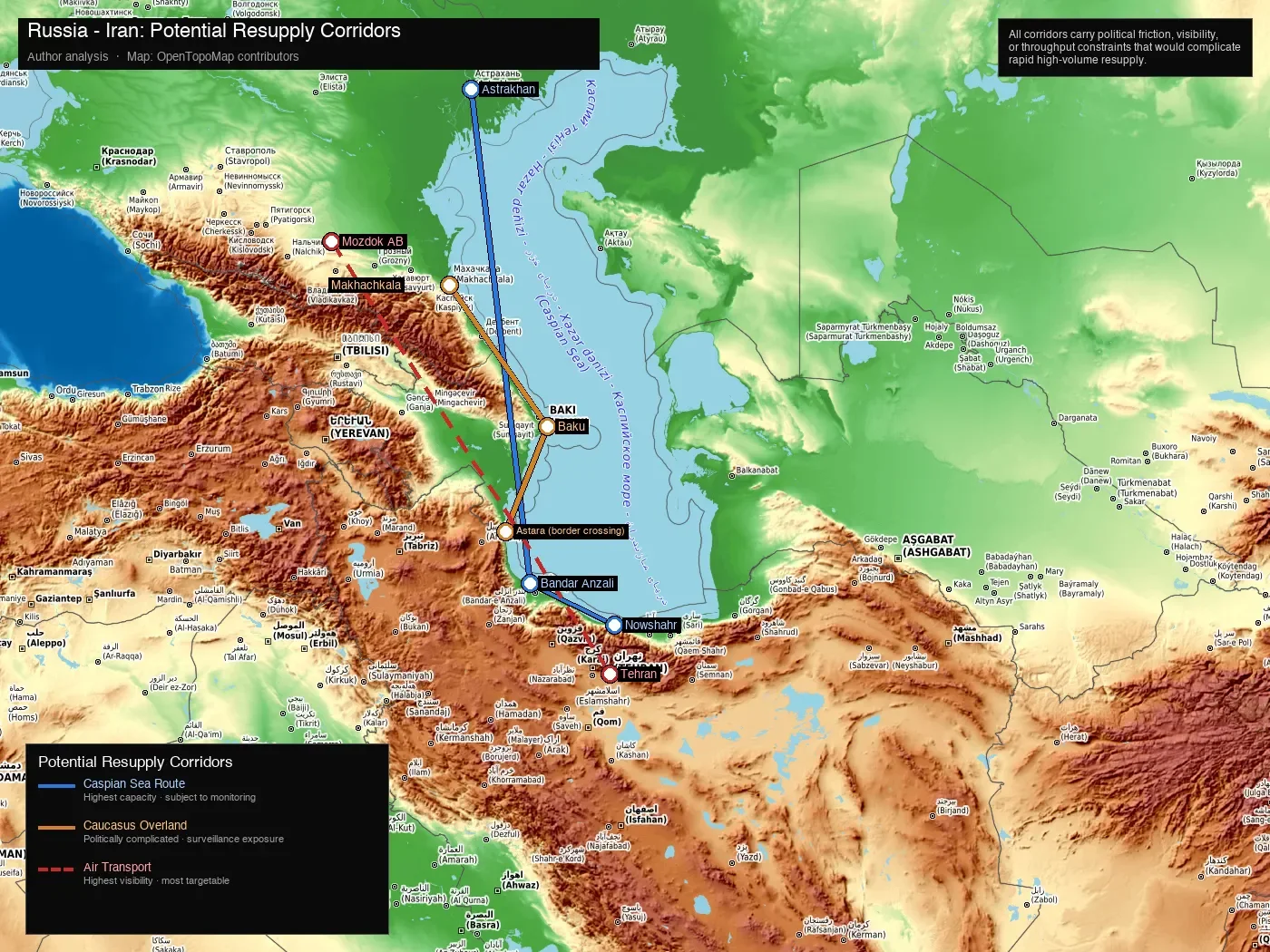
Potential Russian resupply corridors to Iran. Each route carries distinct political, logistical, and visibility constraints. Author analysis, base map via OpenTopoMap.
Three Scenarios
The following projections are derived from the interaction of the five variables above. The starting inventory ranges are modeled rather than independently confirmed. The value of this exercise is not in predicting the exact week Iran runs dry but in understanding which variables matter most and where the tipping points sit.
Scenario 1: Rapid Depletion (2 to 4 weeks)
This scenario assumes a lower-end pre-war inventory, significant production degradation due to strikes (a 60% or greater reduction in output), no meaningful Russian resupply, and a continued high burn rate driven by political pressure to maintain visible retaliation. Under these conditions, Iran exhausts its ability to sustain saturation-level attacks within weeks and is forced into a conservation posture, husbanding remaining stocks for high-value or symbolic strikes rather than sustained harassment. The 73% tempo decline observed in Week 1 would, in this scenario, represent genuine pressure to deplete rather than a tactical choice.
Scenario 2: Managed Attrition (6 to 10 weeks)
This scenario assumes a mid-range inventory, production degraded by 30 to 40% but partially reconstituted through dispersed facilities, limited Russian component resupply through the Caspian corridor, and a deliberate reduction in tempo to roughly 150 to 200 launches per day. Iran cannot maintain the opening week’s intensity but sustains enough pressure to keep Gulf air defenses engaged, shipping disrupted, and the interceptor cost clock running. This is the scenario in which Iran treats its drone campaign as a war of economic attrition rather than a knockout blow.
Scenario 3: Industrial Resilience (3 to 6 months)
This scenario assumes a higher-end pre-war inventory, dispersed production networks largely surviving the initial strike campaign, active Russian resupply of components and guidance systems at a meaningful scale, and disciplined tempo management at roughly 100-150 launches per day. Iran maintains an operationally significant campaign well into summer 2026, forcing the coalition into a prolonged problem of interceptor consumption with no clear resolution. This scenario requires the most optimistic assumptions about Iranian industrial survivability and the most pessimistic assumptions about US/Israeli targeting effectiveness.
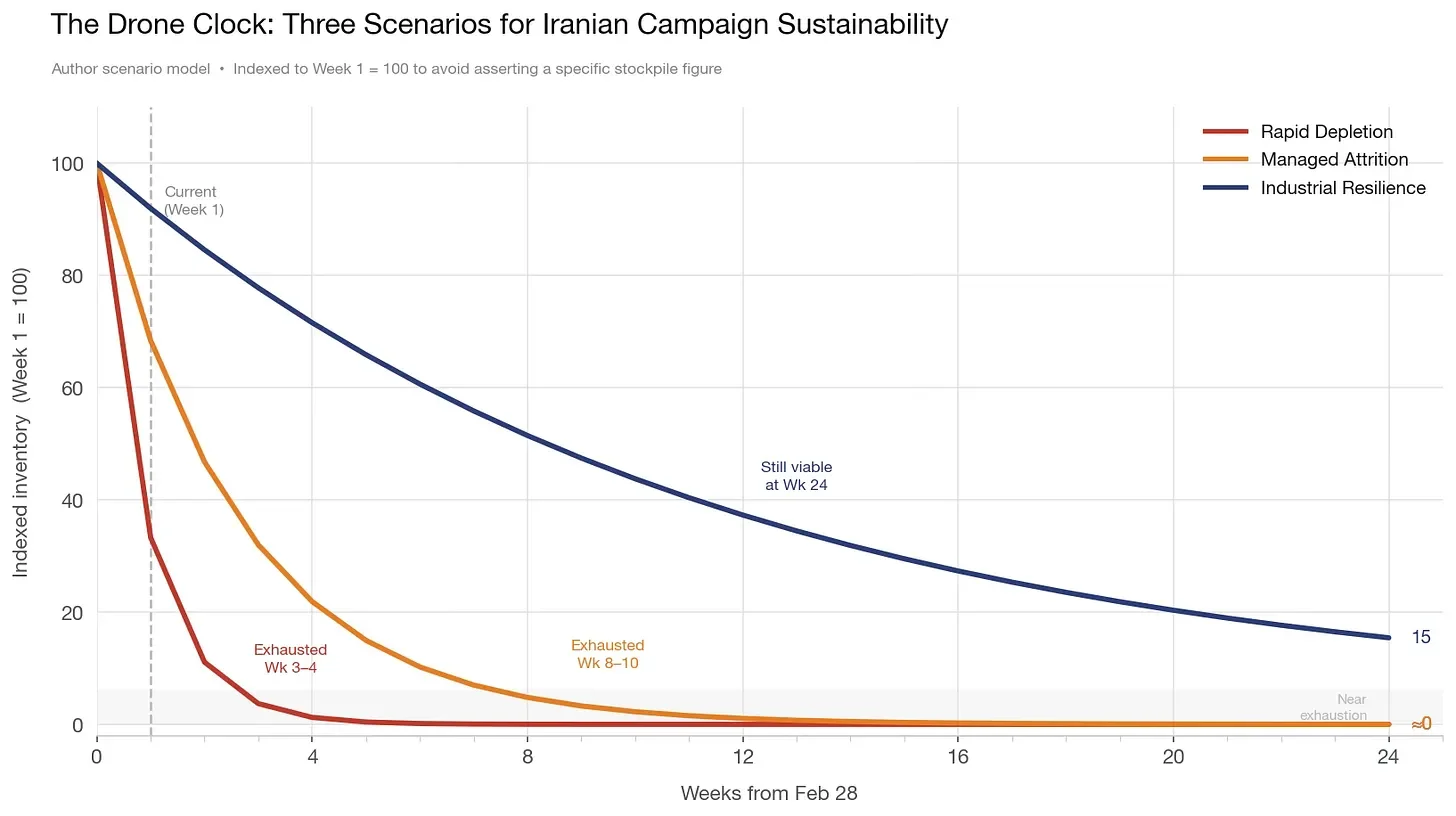
Three scenario projections for Iranian drone campaign sustainability. Indexed to Week 1 = 100 to avoid asserting a specific stockpile figure. Author scenario model.
The Interceptor Mirror
Iran’s sustainability is only half the equation. The other half is whether the coalition can afford to keep shooting down what Iran sends.
Each Shahed costs an estimated $20,000 to $50,000 to produce. Each PAC-3 interceptor fired from Patriot batteries deployed across the Gulf costs roughly $4 million. Lockheed Martin delivered more than 600 PAC-3 MSE interceptors in 2025, with a January 2026 framework agreement targeting annual production capacity of 2,000. RTX plans to increase SM-6 output from roughly 125 per year to over 500 annually. THAAD interceptor inventories are finite with lengthy replenishment timelines. Bloomberg reported an internal analysis suggesting Qatar’s Patriot reserves could last roughly four days at the rate of usage observed in the war’s opening phase. CNN separately reported at least one Gulf state had requested emergency resupply from Washington by Day 4.
The production targets already reflected urgency before the first strike landed. On March 6, the White House convened CEOs from Lockheed Martin, RTX, Northrop Grumman, Boeing, BAE Systems, Honeywell, and L3Harris to discuss accelerating munitions production. Trump posted afterward that the companies had agreed to “quadruple” output of high-end weaponry, though no specific quantities, systems, or timelines accompanied the claim. The fact that interceptor production has become a principals-level political conversation one week into the war tells you where the sustainability math is heading.
The cost asymmetry is not a new observation, but the current war is the first time it has played out at this scale against US and allied forces simultaneously. Ukraine’s experience suggests a possible way out of the cost trap: low-cost interceptor drones. Kyiv has developed cheaper counter-Shahed layers over four years of absorbing Iranian-designed drone attacks, and Reuters reported that the US and Qatar are discussing Ukrainian interceptor drone technology as an alternative to burning high-end missiles against every incoming target. Whether that technology transfers to the Gulf theater fast enough to matter in this war is a separate question.
[Image placeholder: Datawrapper comparison chart or table showing interceptor cost per unit versus Shahed cost per unit, with Ukrainian drone interceptor cost included as third comparison point]
Assessment
Scenario 2 is the most likely outcome, with a meaningful risk of sliding toward Scenario 3 if Russian component resupply materializes at scale and Iranian dispersed production proves more resilient than initial strike damage assessments suggest. Scenario 1 remains possible but would require a level of strike effectiveness against dispersed infrastructure that the US and Israel have historically struggled to achieve against Iran’s hardened and distributed military architecture.
The strategic logic of Iran’s drone campaign holds under any of the three scenarios. Even rapid depletion achieves Tehran’s minimum objective: forcing the coalition into an interceptor cost conversation that exposes the structural vulnerability of defending against cheap mass with expensive precision. Every PAC-3 fired at a Shahed is a small victory for Iran’s theory of the war, regardless of whether the Shahed is intercepted.
The shadow that extends beyond this theater is the one that should concern planners most. Every high-end interceptor expended in the Gulf is one that is not sitting in a magazine in the Western Pacific. China’s doctrine emphasizes exactly the kind of saturation and mass that Iran is demonstrating in miniature. The drone clock in the Gulf is not just an Iranian problem. It is a preview of the interceptor sustainability question the US will face at scale if deterrence fails in the Pacific.
Week one gave us enough data to start modeling the campaign’s sustainability. The answer depends less on headline strike counts than on the interaction between burn rate, production, and launch survivability. That interaction is what determines whether this is a weeks-long problem or a months-long one.
John Hendricks is an OSINT analyst and the founder of Global Recon. Follow on X: @IGRecon.
Subscribe to Unclassified with John Hendricks on Substack for original national security analysis.
Related Analysis

ANALYSIS
The mind is not a vessel to be filled but a fire to be kindled: A Discussion with former KGB Officer Jack Barsky
Jack Barsky, former KGB officer, explores Intelligence, Insight, ana tne power of critical thinking in shaping perspective.
ANALYSIS
Do not wait to strike till the iron is hot; but make it hot by Striking: A discussion with Hrulf, the founder of the Norman Brigade
Hrult, tounder ot me Norman Bngaae, shares Insignts on taking Imtiatlve, shaping opportunity, and leading with strategy.