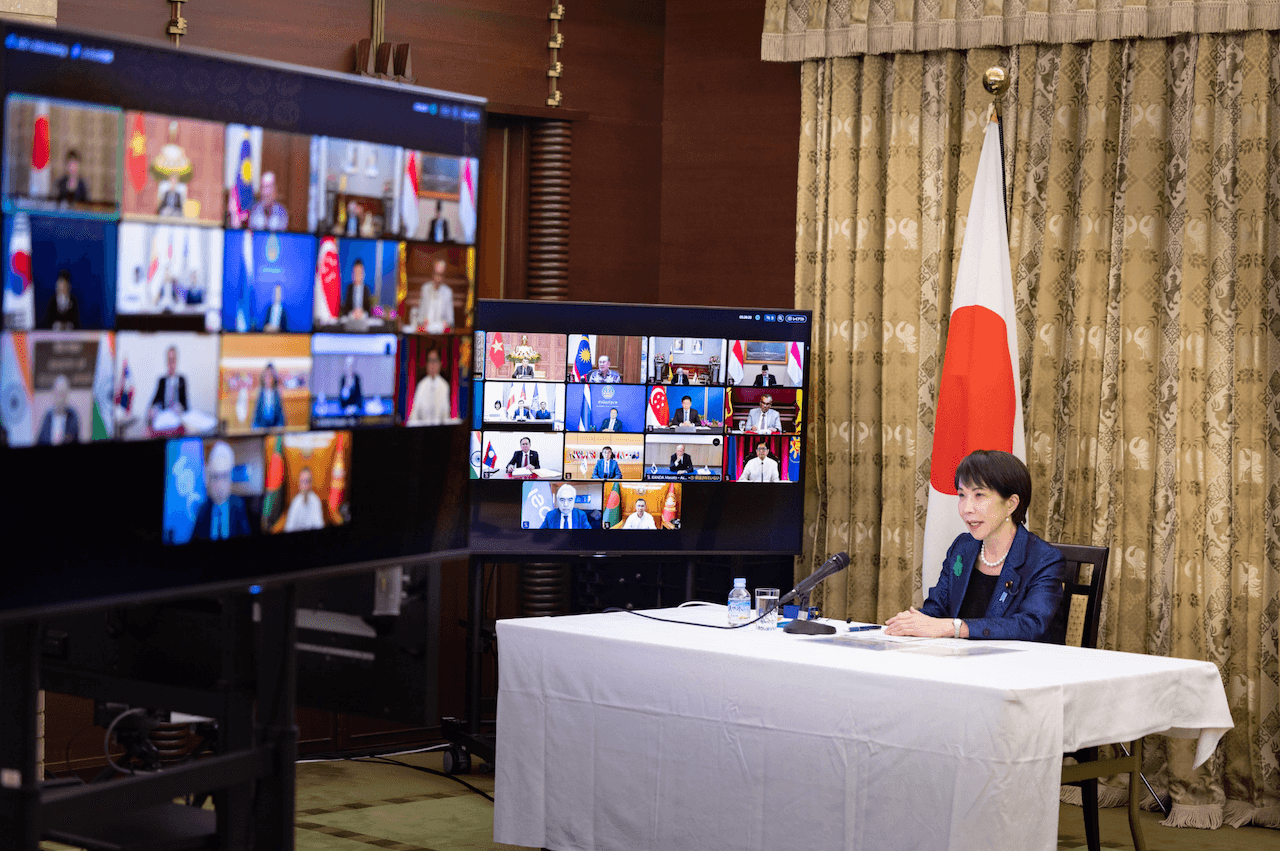
Prime Minister Sanae Takaichi announced Wednesday at the AZEC Plus online summit that Japan will deploy a $10 billion financial support package through the Japan Bank for International Cooperation to help Southeast Asian economies procure crude oil during the Hormuz supply shock. The package, equivalent to roughly 1.2 billion barrels or one year of ASEAN crude imports, includes credit provision for local companies to source alternative supply including U.S. cargoes. Leaders from the Philippines, Malaysia, Singapore, Thailand, and Vietnam attended. Japan itself depends on Middle Eastern crude for roughly 95 percent of its oil supply.
Tokyo is not spending $10 billion out of regional solidarity. It is buying the role of Asia’s energy security guarantor at the exact moment Beijing cannot credibly offer the same, because China’s continued Hormuz access depends on a bilateral arrangement with Tehran that every other Asian economy lacks.
The structural inversion is the story. China’s privileged Hormuz access, secured through direct dealings with Iran, is simultaneously Beijing’s credibility problem. It cannot position itself as a regional security provider when its own supply depends on a bilateral deal with the belligerent blocking everyone else. Japan’s AZEC Plus commitments flow through sovereign capital channels, JBIC and affiliated institutions, which means they outlast the news cycle. Belt and Road lending has been the dominant instrument of Chinese influence in ASEAN energy sectors for a decade. This is the first Japanese-led vehicle sized to compete with it on the same terms.
Whether AZEC Plus commitments persist after Hormuz normalizes is the next signal. Institutional capital, once disbursed, creates relationships that outlive the crisis that justified them. Track which ASEAN states sign follow-on financing agreements with JBIC over the next six months. That is where the displacement shows up.