

Can Money Buy Ukraine's Playbook?
Can Money Buy Ukraine's Playbook?
What the Gulf Can and Cannot Learn from the Drone War in Ukraine
John Hendricks
Editor & Host, Global Recon

March 18, 2026 🕒 8 min read
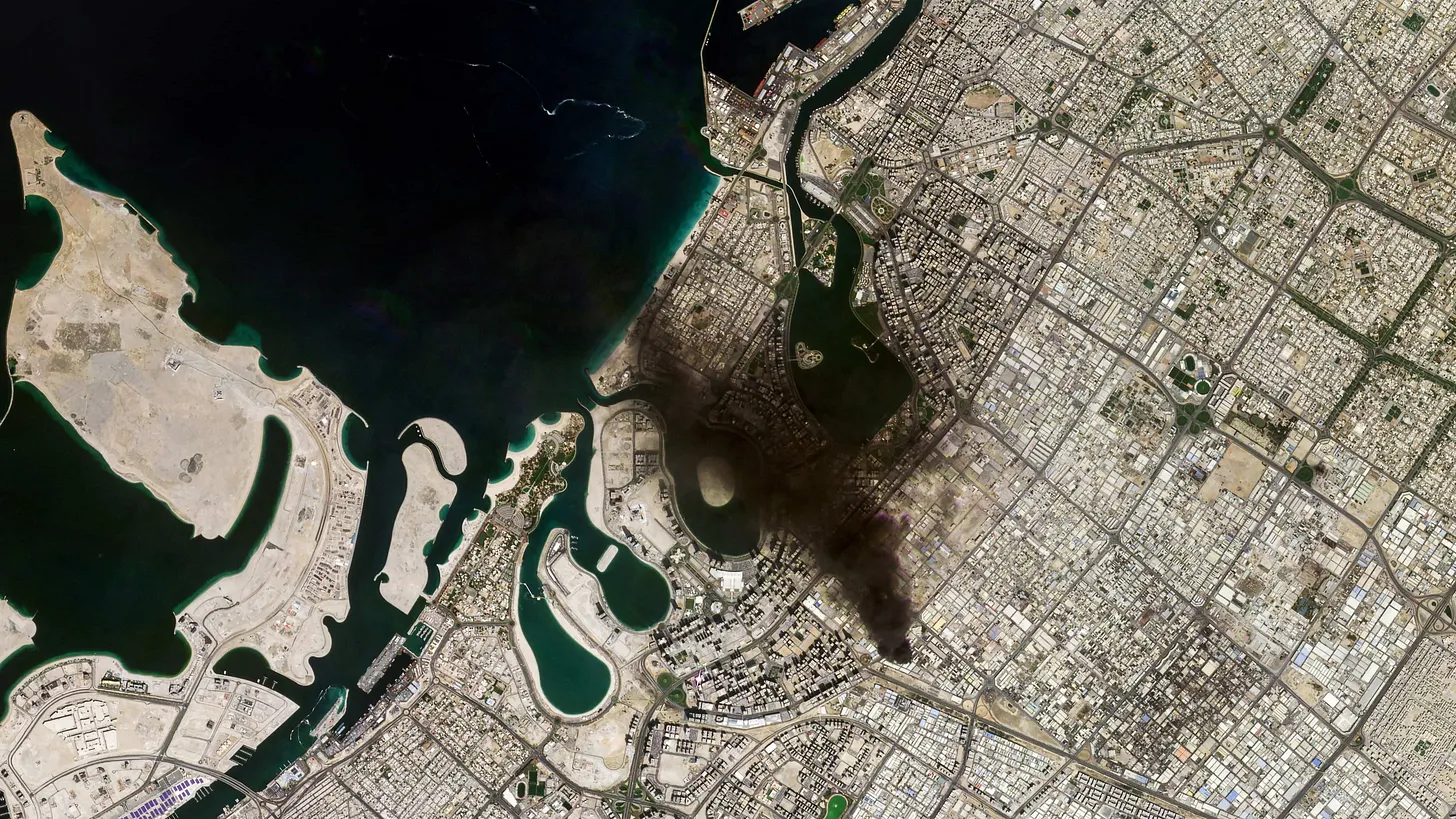
Smoke rises over Dubai following Iranian strikes, March 1, 2026. Credit: Planet Labs
Can Money Buy Ukraine’s Playbook?
Why Gulf States Are Learning the Wrong Lessons from the Drone War
On the morning of March 1, 2026, smoke rose over the port of Jebel Ali as the first wave of Iran’s retaliatory strikes reached the United Arab Emirates. Dubai International Airport shut down. Debris from intercepted drones fell across the city. The Burj Al Arab a symbol of Gulf prosperity so deliberate it was built to be visible from space sustained damage from falling interceptor fragments.
According to figures released by the UAE defense ministry, Iran fired 165 ballistic missiles, two cruise missiles, and 541 drones at the UAE in the first seventy-two hours of its retaliatory campaign following the US-Israeli strikes that killed Supreme Leader Ali Khamenei. Gulf air defenses performed remarkably. The UAE intercepted more than 92 percent of incoming projectiles. Analysts called it extraordinary.
And yet airports closed. Hotels burned. Three migrant workers a Pakistani, a Nepali, and a Bangladeshi were killed by drones that got through. Interceptor stockpiles began drawing down faster than US production lines can replenish them.
Ninety-two percent is an extraordinary interception rate. It is also, as events this week have made clear, not enough and possibly not sustainable.
Gulf states have spent decades and hundreds of billions of dollars building the most expensive air defense architecture in the world. Ukraine spent comparatively little and built something that has held against one of the largest drone campaigns in modern warfare. The question this week’s attacks are forcing into the open is whether the Gulf bought the right thing.
Modern drone warfare is less a contest of interception rates than of cost exchange and production capacity.
The answer is complicated. But it starts with understanding what Ukraine actually solved and why money alone did not solve it.
I. The Problem Ukraine Actually Solved
The core challenge of modern drone warfare is not detection or lethality. It is cost exchange.
When a defender fires a $150,000 interceptor to destroy a $20,000 Shahed drone, the transaction is tactically acceptable and strategically punishing. Do it hundreds of times in seventy-two hours and the math becomes existential. Analysts covering this week’s Gulf attacks estimate that each interception is running roughly twenty times the cost of the Iranian munition being destroyed. The UAE alone faced more than five hundred drones in the opening days, with total detections approaching seven hundred as the campaign continued.
The financial toll of sustaining that defense day after day, wave after wave is a strategic problem no interception rate resolves.
Iran understands this explicitly. It is not a flaw in their strategy. It is the strategy.
Flood the defense with cheap mass. Force the expenditure of expensive interceptors. Shift the center of gravity toward an adversary that cannot manufacture replacements fast enough. This week, analysts confirmed the United States is already racing to replenish Patriot and Standard Missile stocks for Gulf allies all drawing from the same production lines serving Israel, the Gulf, and US forces simultaneously.
Ukraine approached this problem differently. Instead of trying to win the exchange, Ukraine refused it wherever possible.
Jam before you shoot. Spoof before you jam. When you must shoot, shoot cheap. Field-modified FPV drones costing a few hundred dollars have intercepted Shaheds that would otherwise have required six-figure interceptor missiles. Civilian spotters feeding targeting data through apps ensured intercept attempts were rarely wasted on bad shots.
Most importantly, Ukraine accepted that some drones would get through because a sustainable imperfect defense beats a perfect defense that collapses after week two.
The objective was resilience, not perfection.
That distinction is no longer theoretical. It is burning in Dubai right now.
II. What Gulf States Are Actually Facing
Before asking whether Ukraine’s model transfers, it is worth asking whether Ukraine’s problem transfers. This week’s attacks suggest the answer is partially and the part that does not transfer is the dangerous part.
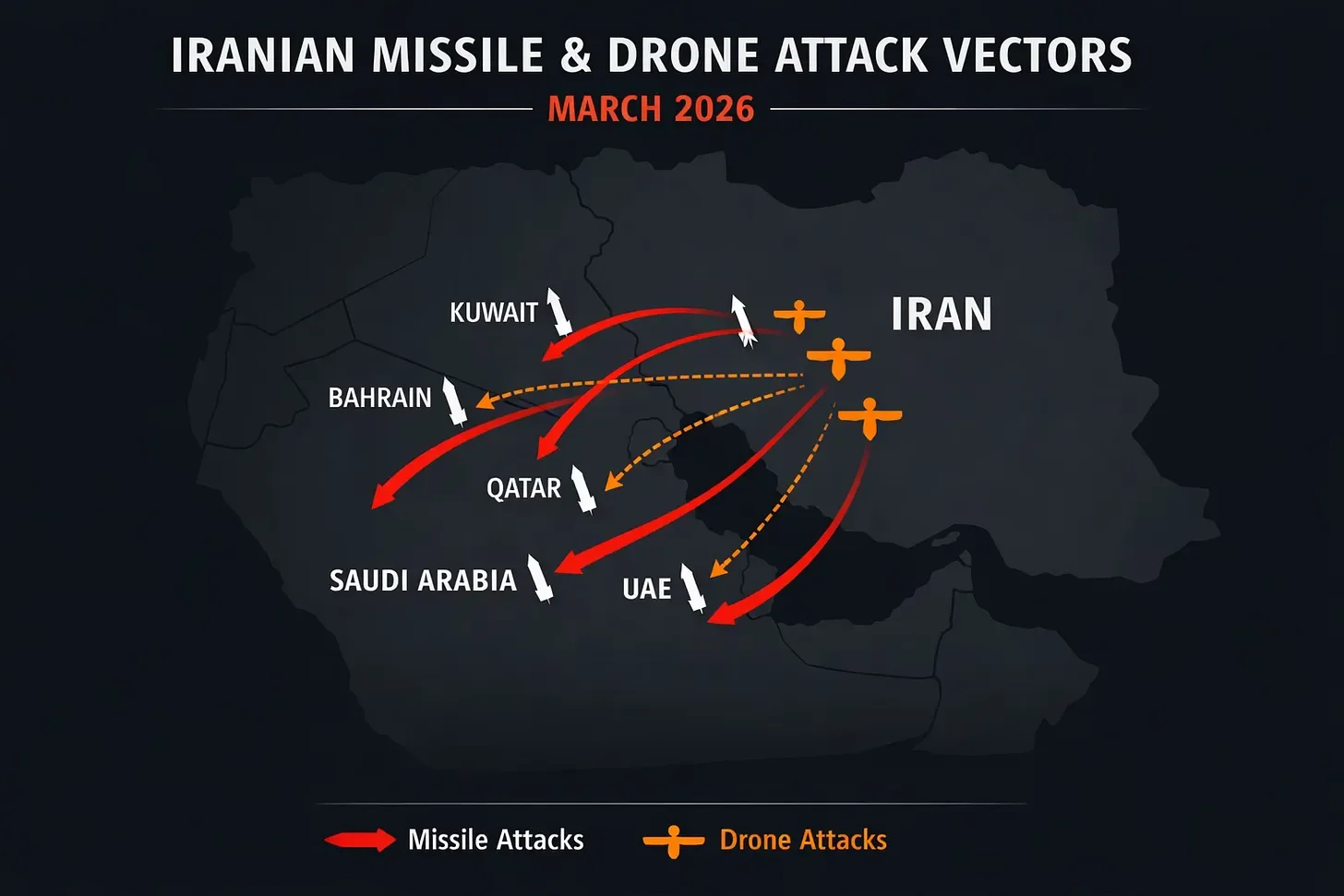
Iranian missile and drone attack vectors targeting Gulf states, March 2026.
Ukraine faces saturation along a defined front line. Russian drone campaigns are designed to overwhelm through volume waves of Shaheds exhausting air defense crews before ballistic missiles follow. The defensive problem is mass, proximity, and attrition.
What Iran is doing to Gulf states has elements of saturation but also something more strategic.
The opening salvos targeted US military installations Al Dhafra Air Base, the Fifth Fleet headquarters in Manama, Ali Al-Salem airbase in Kuwait. But within hours the target set expanded. Airports. Hotels. Oil infrastructure. Ports. The Ras Tanura refinery. Qatar’s LNG infrastructure. An AWS data center in Abu Dhabi.
This is not purely a volume problem. It is an economic coercion campaign running in parallel with a military one.
Iran is not attempting to occupy Gulf territory. It is demonstrating that no asset — not a five-star hotel, not a global shipping hub, not a data center hosting much of the region’s cloud infrastructure is beyond reach. The goal is to make the cost of hosting US forces and aligning with Washington feel permanent and unbearable.
That dual-track threat saturation combined with strategic signaling is actually harder to defend against than Ukraine’s battlefield problem. Ukraine’s adversary seeks to break defensive lines. Iran seeks to break political confidence and economic stability.
A 92 percent interception rate wins the first fight.
It slowly loses the second one as airlines suspend routes, investors grow cautious, and Gulf governments begin asking whether American security guarantees are worth what they cost.
III. The Three Things You Cannot Buy
Even if Gulf states correctly identify the transferable elements of Ukraine’s model, they face three structural constraints that no procurement budget quickly solves.
The Human Network
Ukraine’s counter-drone architecture rests on something that cannot be purchased: millions of people personally invested in the outcome. Civilian spotters feed real-time targeting data through apps. Volunteers modify commercial drones in garages. Local officials coordinate air raid warnings without waiting for central authority. The network is vast, distributed, and motivated by survival.
The three people killed in the UAE this week were a Pakistani, a Nepali, and a Bangladeshi. That detail is not incidental it is a precise illustration of the structural problem.
The UAE’s citizen population represents less than twelve percent of its residents. The remainder are expatriate workers with no legal pathway into national defense structures and no institutional connection to the country’s long-term survival. Saudi Arabia’s demographics are less extreme but structurally similar.
You can hire contractors. You cannot hire a nation.
Doctrinal Flexibility
Ukraine adapted its counter-drone doctrine in months. Units that had never conducted FPV intercept missions were running effective operations within a single fighting season. Bottom-up innovation became the primary engine of adaptation. A sergeant with a working idea could see it fielded faster than a NATO procurement office could finish its initial review.
Gulf militaries operate on the opposite model. American doctrine. American systems. American contractors. American-paced acquisition cycles.
That structure produces capable and interoperable forces. It also produces a situation where Gulf states now depend entirely on American production lines for interceptor replenishment — with no domestic capacity to bridge the gap when those lines fall behind demand. The same institutional relationships that provided access to Patriot and THAAD make it structurally difficult to develop the improvised, field-driven alternatives Ukraine turned into doctrine.
Electronic Warfare Constraints
Ukraine employs aggressive electronic warfare across large portions of its territory. GPS jamming, navigation spoofing, and communication degradation are tactically routine in areas where civilian aviation has largely ceased.
The Gulf exists in a different environment entirely. Dubai International alone handles tens of millions of passengers annually or did, until this week. Aggressive EW in Gulf airspace risks catastrophic disruption to civil aviation and regional commerce. The problem is not technical capability. It is economic tolerance.
Changing that calculus requires accepting disruptions to the economic model Gulf states exist to protect. That is a structural constraint, not a capability gap. And structural constraints do not disappear with procurement.
IV. What Is Actually Transferable
None of this means Ukraine offers no lessons. Some elements transfer genuinely well.
The FPV interceptor concept is directly adaptable. Cheap drones intercepting cheap drones fundamentally changes the cost-exchange equation. Against Shahed-type munitions, a $300-500 interceptor drone produces something close to a neutral exchange rather than a catastrophic one. That math matters at scale.
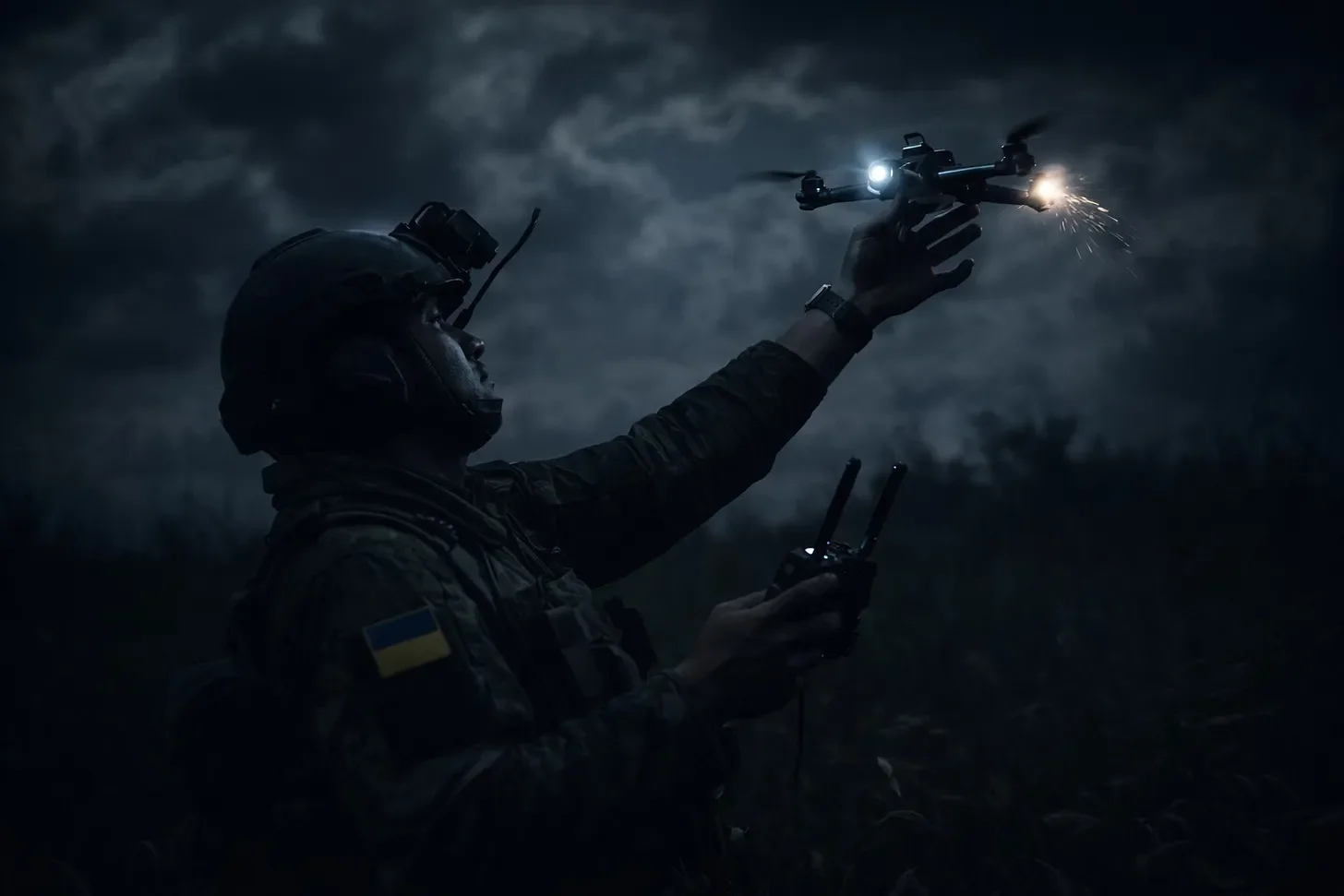
A Ukrainian drone operator launches an FPV interceptor. Ukraine's counter-drone
doctrine relies on cheap, distributed systems rather than expensive interceptor missiles
Soft-kill priority jamming and spoofing before kinetic intercept is also transferable. The challenge lies in rules of engagement within dense commercial airspace, but this week’s airport closures have already demonstrated that the alternative carries its own severe costs. The political calculus on EW may be shifting in real time.
Distributed detection networks fit Gulf geography well. Spreading sensing across numerous nodes rather than concentrating it in a few large radar installations reduces single points of failure and complicates adversary targeting. The UAE’s EDGE Group and elements of Saudi Arabia’s domestic defense industry are moving in this direction. The movement is real but incomplete.
The gap between Ukraine’s model and Gulf practice is not primarily technological. It is political and doctrinal. The technology exists. What remains uncertain is whether the institutional willingness to deploy it does.
V. The Israel Parallel and Why It Misleads
The instinctive response to this week’s attacks will be to buy more interceptors. Iron Dome. David’s Sling. Arrow. More Patriot batteries. More THAAD. More of the layered architecture that performed well by the numbers this week.
But this response leads directly back into the cost-exchange trap.
Israel fires Tamir interceptors costing tens of thousands of dollars against rockets that cost a fraction of that. The equation has been made to work because decades of American funding have subsidized Israeli interceptor stockpiles, and because Israeli population density makes any leakage politically intolerable so the expensive intercept is non-negotiable regardless of cost.
Gulf states face a different geography and a different strategic problem. They defend vast territory and dispersed infrastructure whose value depends entirely on perceptions of stability. Iran does not need to cause mass casualties to win the strategic argument. Sustained pressure alone the kind that closes airports and empties hotel lobbies erodes the perception of Gulf invulnerability. This week, that erosion has already begun.
More importantly, the visible hardware of Israel’s defense architecture hides the deeper foundations that make it function. Decades of civil defense preparation. Shelter systems that a population uses reflexively. Hardened infrastructure built around the assumption of persistent attack. Intelligence networks refined through generations of conflict.
Importing the hardware without the societal foundation risks buying the costume without the capability.
Conclusion: The Lesson Gulf States Should Take
The smoke over Dubai this week is not just the product of Iranian missiles. It is the result of a defense model built around perfect interception in a world of cheap mass.
Gulf air defenses performed remarkably under pressure. But the events of this week have revealed structural cracks that more procurement cannot close. Interceptor stockpiles drain faster than production lines replace them. The drones that slip through strike airports, hotels, and ports the economic infrastructure Gulf stability is built on. And Iran, by multiple analyst estimates, has barely begun drawing down its short-range missile and drone inventory, the category best suited to sustained Gulf strikes.
Iran does not need to win militarily. It only needs to sustain pressure long enough for confidence to erode.
Ukraine’s lesson is not a shopping list. It is a question about whether a military and the society behind it is structured to absorb cheap, persistent, asymmetric attack without strategic shock. Ukraine answered that question by distributing the defense, accepting imperfection, and changing the economics of interception.
Gulf states are still attempting to answer it with perfect interception.
That math does not improve with more spending. It improves with a fundamentally different conception of what defense means built around resilience rather than perfection, distributed systems rather than concentrated ones, sustainable cost exchange rather than technological prestige.
The drones are cheap. The adaptation is not. And money alone cannot close that gap.
John Hendricks is an OSINT analyst and founder of Global Recon. Follow on X: @IGRecon
For regular intelligence-focused geopolitical analysis, subscribe to Unclassified with John Hendricks on Substack.
Related Analysis

ANALYSIS
The mind is not a vessel to be filled but a fire to be kindled: A Discussion with former KGB Officer Jack Barsky
Jack Barsky, former KGB officer, explores Intelligence, Insight, ana tne power of critical thinking in shaping perspective.
ANALYSIS
Do not wait to strike till the iron is hot; but make it hot by Striking: A discussion with Hrulf, the founder of the Norman Brigade
Hrult, tounder ot me Norman Bngaae, shares Insignts on taking Imtiatlve, shaping opportunity, and leading with strategy.