Reports indicate Israeli strikes have occurred inside Iran. This assessment evaluates Kata’ib Hezbollah’s proxy posture and likely responses as events continue to unfold.
As U.S.–Iran tensions escalate, Kata’ib Hezbollah’s operations command has issued a mobilization order. This is what it means.
As strikes are reported inside Iran and official statements continue to emerge, proxy forces across the region are moving from rhetoric to readiness.
Kata’ib Hezbollah the Iranian-backed Iraqi faction with the deepest operational ties to the IRGC Quds Force and the longest history of attacks on American forces in the region has spent the last five days issuing a coordinated sequence of statements that move from early warning to public threat to internal mobilization order. That sequence, documented through open-source channels and verified through primary-source reporting, serves as the basis for this assessment.
This analysis evaluates what Kata’ib Hezbollah’s recent messaging indicates about near-term threats to U.S. forces in Iraq. The focus is on KH specifically, not because other Iraqi factions are irrelevant, but because KH sits at the intersection of three critical factors: established attack capability against American targets, direct command linkage to Tehran, and a geographic focus on the Kurdistan Region of Iraq where U.S. forces are now concentrated following the completion of the Ain al-Asad withdrawal in January 2026.
The Mobilization Order
On February 26, 2026, the Leadership of Operations of the Hezbollah Brigades issued a statement that went beyond the rhetorical posturing typical of proxy messaging cycles. This was not a political bureau communiqué. It came from the military command.
The statement, forwarded by Sabereen News from the Kata’ib Hezbollah operational channel Kaf, read in part:
“In the midst of American threats and military mobilization that portend a serious escalation in the region, we stress the need for all Mujahideen to prepare for a war of attrition that could be long-lasting, exceeding the estimates of the American administration. And if America dares to ignite the fuse of war in the region, it will find itself facing massive losses that are impossible to contain or compensate for.”
The statement also contained a direct warning to the government of the Kurdistan Region of Iraq against “colluding with hostile foreign forces.”
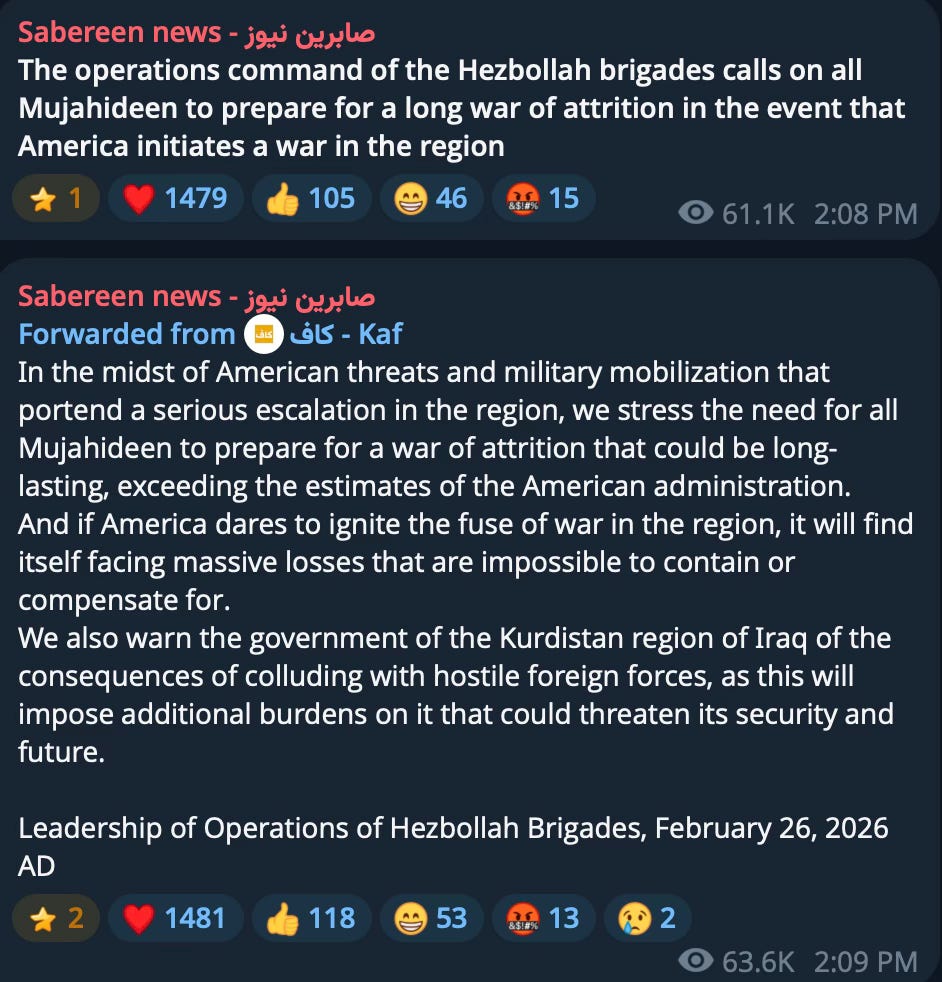
The distinction between a political bureau statement and an operations leadership statement matters. Political messaging is for public consumption. Operations leadership communications are directed at fighters. When the military command tells all Mujahideen to prepare, that is a mobilization instruction.
The Escalation Sequence
The February 26 mobilization order did not emerge in isolation. It was the third step in a documented five-day escalation sequence that began on February 23.
On February 23, Kata’ib Hezbollah issued an initial warning to the Kurdistan Regional Government against involvement in any conflict, framing Kurdish cooperation with foreign forces as a red line. Three days later, on February 26, the Operations Leadership issued the mobilization order and repeated the Kurdistan warning with greater specificity. The following day, February 27, the Political Bureau issued two separate public-facing statements within three minutes of each other.
The first, posted at 4:42 p.m., stated:
“The division has become clear between those who are subservient to foreign powers and follow their directives, and those who have stood firm in their position, refusing to submit. History will record the positions as they are, and it will not show mercy to those who align with the Americans’ wishes or collude with them.”
The second, posted at 4:45 p.m., stated:
“We will not tolerate any individual or entity that aligns with the American enemy, regardless of their position or title.”
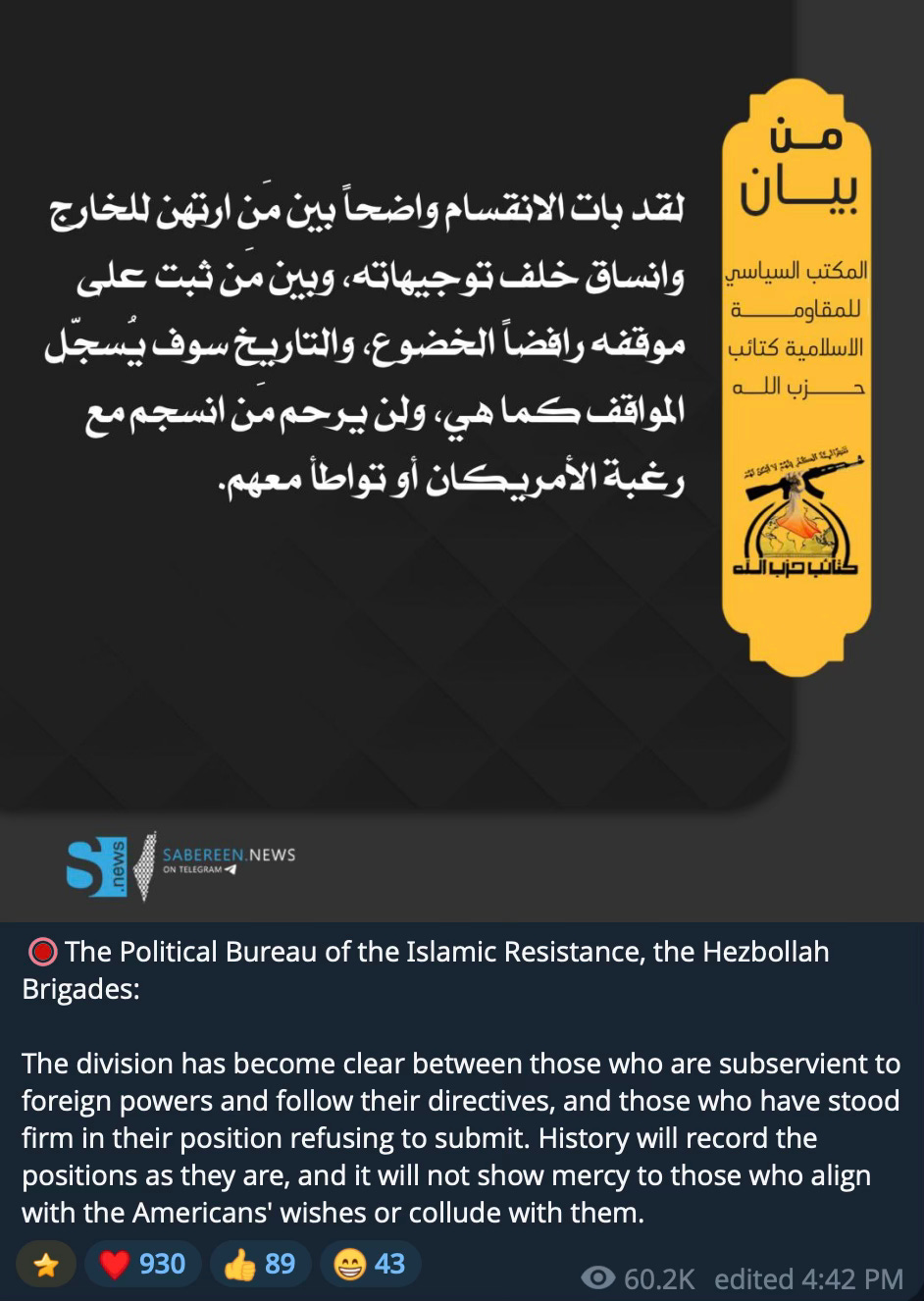
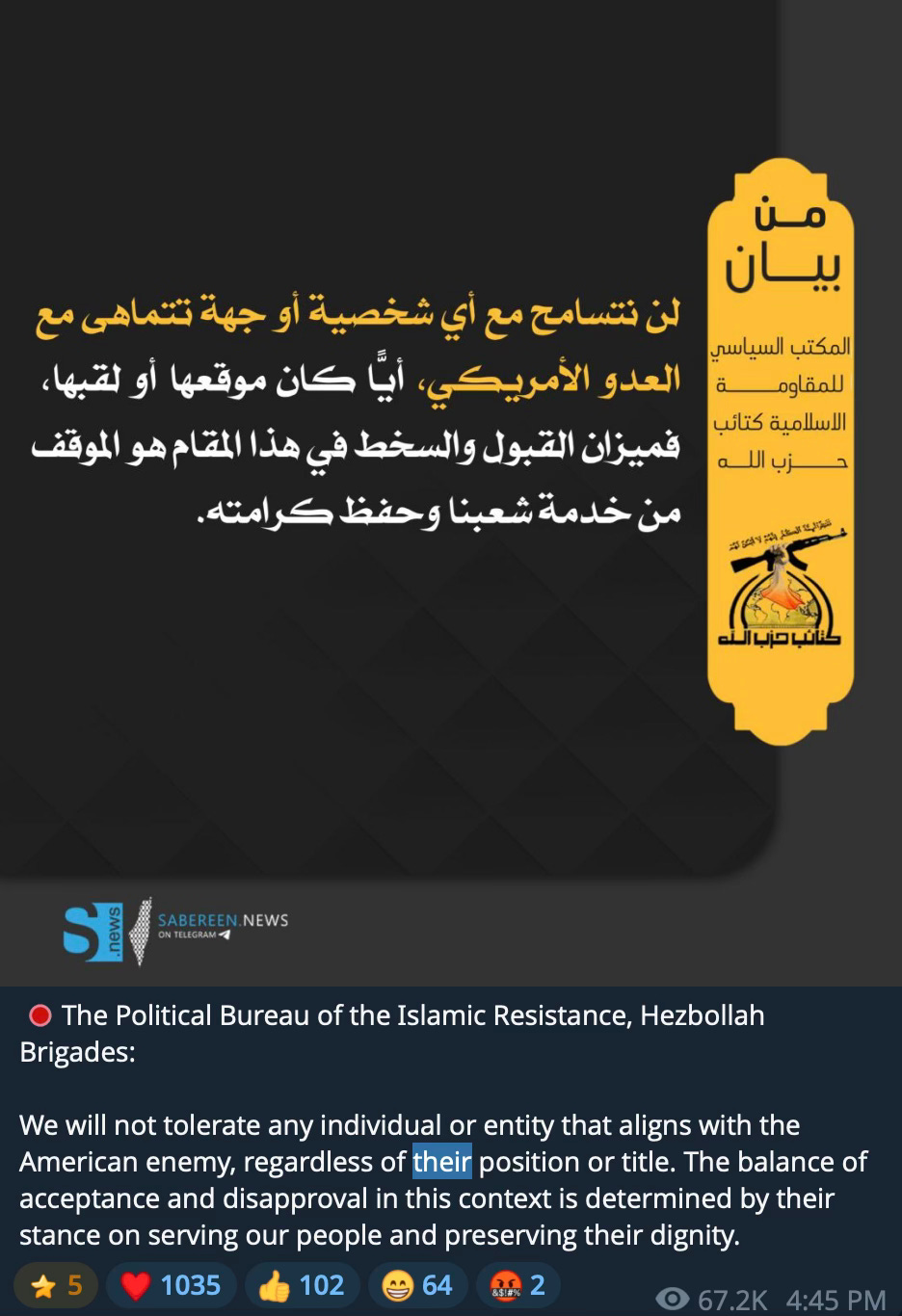
The sequencing is significant. Internal operational orders preceded public messaging by approximately 18 hours. The fighters were told first. The public was told second. That sequencing reduces the likelihood that the messaging is performative.
The Erbil Targeting Logic
The repeated warnings directed at the Kurdistan Regional Government are not rhetorical. They are operational.
To understand why, it is necessary to know where American forces are currently in Iraq.
In mid-January 2026, the United States completed its withdrawal from Ain al-Asad Airbase in Anbar Province the site of multiple Kata’ib Hezbollah rocket and drone attacks over the past several years. The Iraqi Army assumed full control on January 17. No U.S. forces remain there.
As a result, U.S. military presence in Iraq is now more concentrated in the Kurdistan Region, primarily at Erbil Air Base, which is co-located with Erbil International Airport. Fewer than 2,000 troops remain, supporting counter-ISIS operations and cross-border logistics into Syria. Several coalition partners including Norway, Sweden, Germany, Italy, and France have quietly repositioned non-essential personnel from Erbil in recent weeks amid heightened regional tensions. The full coalition drawdown from Kurdistan is scheduled for September 2026.
Kata’ib Hezbollah has been warning the Kurdistan Regional Government since February 23. Erbil is in Kurdistan. The targeting logic is straightforward.
Capability Assessment
Kata’ib Hezbollah’s ability to threaten American forces in Iraq is not theoretical. It is documented across years of attacks. What has changed is not capability, but target concentration.
Rockets and indirect fire.
KH maintains stocks of 107mm and 122mm rockets, Katyusha systems, and longer-range munitions supplied through Iranian networks. These systems were repeatedly used against Ain al-Asad and Erbil. With Ain al-Asad no longer a target of the Americans, assets previously oriented toward Anbar are now available for reorientation toward Kurdistan.
UAVs and armed drones.
KH has demonstrated the use of one-way attack drones, including Shahed variants supplied through Iranian channels. Drone attacks against Erbil have occurred previously. The co-location of Erbil Air Base with a civilian international airport complicates air defense posture and response options.
Intelligence and surveillance networks.
KH maintains an extensive human intelligence presence across Iraq, including in the Kurdistan Region. Their ability to conduct pre-attack surveillance of Erbil is well established. The repeated public warnings to the KRG also serve an intelligence function monitoring who responds, who goes quiet, and who engages U.S. counterparts.
The withdrawal from Ain al-Asad has not reduced the threat to American forces in Iraq. It has concentrated it.
The Command Layer
Kata’ib Hezbollah does not operate independently of Tehran. The relationship between KH and the IRGC Quds Force is direct and longstanding, established through Abu Mahdi al-Muhandis KH’s founder and the senior Iraqi proxy commander killed alongside Qasem Soleimani in January 2020. That command linkage was institutionalized through years of operational coordination, financial support, weapons transfers, and personnel training.
Whether this reflects direct Iranian direction or Iraqi initiative operating within Iranian-established parameters, the effect is the same. KH is preparing its forces. Tehran is aware.
The current U.S.–Iran tensions provide the strategic context. KH’s five-day escalation sequence provides the operational response.
Courses of Action
Based on the documented messaging sequence, current force posture, and KH’s established operational patterns, the following courses of action represent the most plausible proxy responses to a U.S. strike on Iran.
COA 1 — Rocket and drone strike on Erbil Air Base
The most likely and historically consistent option.
Indicators to watch:
Movement of rocket assets toward Kurdistan; KH communications blackout; increased surveillance activity around Erbil.
COA 2 — Attacks on U.S. logistics and supply routes
Lower profile, sustained pressure option.
Indicators to watch:
IED activity along logistics routes; increased surveillance near border crossings.
COA 3 — Pressure campaign against Kurdish and Iraqi political figures
Intimidation and coercion rather than direct military action.
Indicators to watch:
Security posture changes among KRG officials; reduction in public pro-U.S. statements.
COA 4 — Coordinated multi-front activation
Synchronized action with other Iranian proxy networks.
Indicators to watch:
Aligned escalatory messaging across proxy channels; IRGC signaling shifts.
Outlook
Next 72 hours.
With kinetic action now underway, the probability that Kata’ib Hezbollah transitions from signaling to action has increased.
Next two weeks.
If KH responds and the U.S. retaliates, escalation dynamics will depend on whether Washington treats KH as a proxy extension of Iran or as a discrete Iraqi actor.
Key indicators to monitor:
KH channel activity; KRG security posture; CENTCOM force-protection statements; coalition movements; Iranian diplomatic messaging toward Iraq.
This assessment is based on open-source reporting, verified Telegram monitoring, and primary-source reporting. Ground-level sourcing will be updated as additional information becomes available.
John Hendricks
OSINT Analyst
Founder, Global Recon