The United States and Indonesia signed a Major Defense Cooperation Partnership at the Pentagon on April 13, elevating a bilateral defense relationship that already includes more than 170 joint exercises per year. Secretary of War Pete Hegseth and Indonesian Defense Minister Sjafrie Sjamsoeddin framed the agreement around three pillars: military modernization, training, and operational cooperation. The language was diplomatic. The architecture beneath it deserves closer reading.
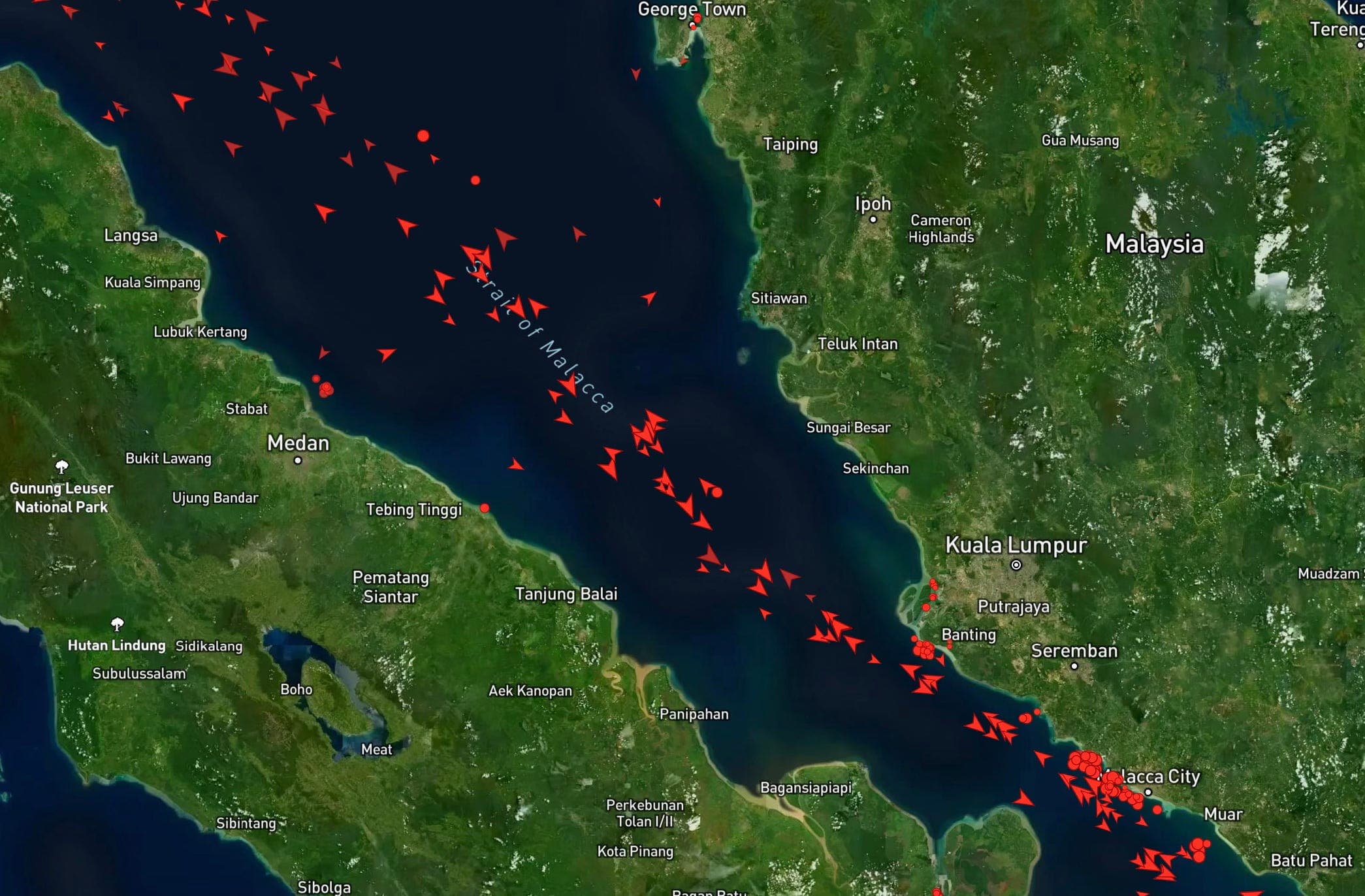
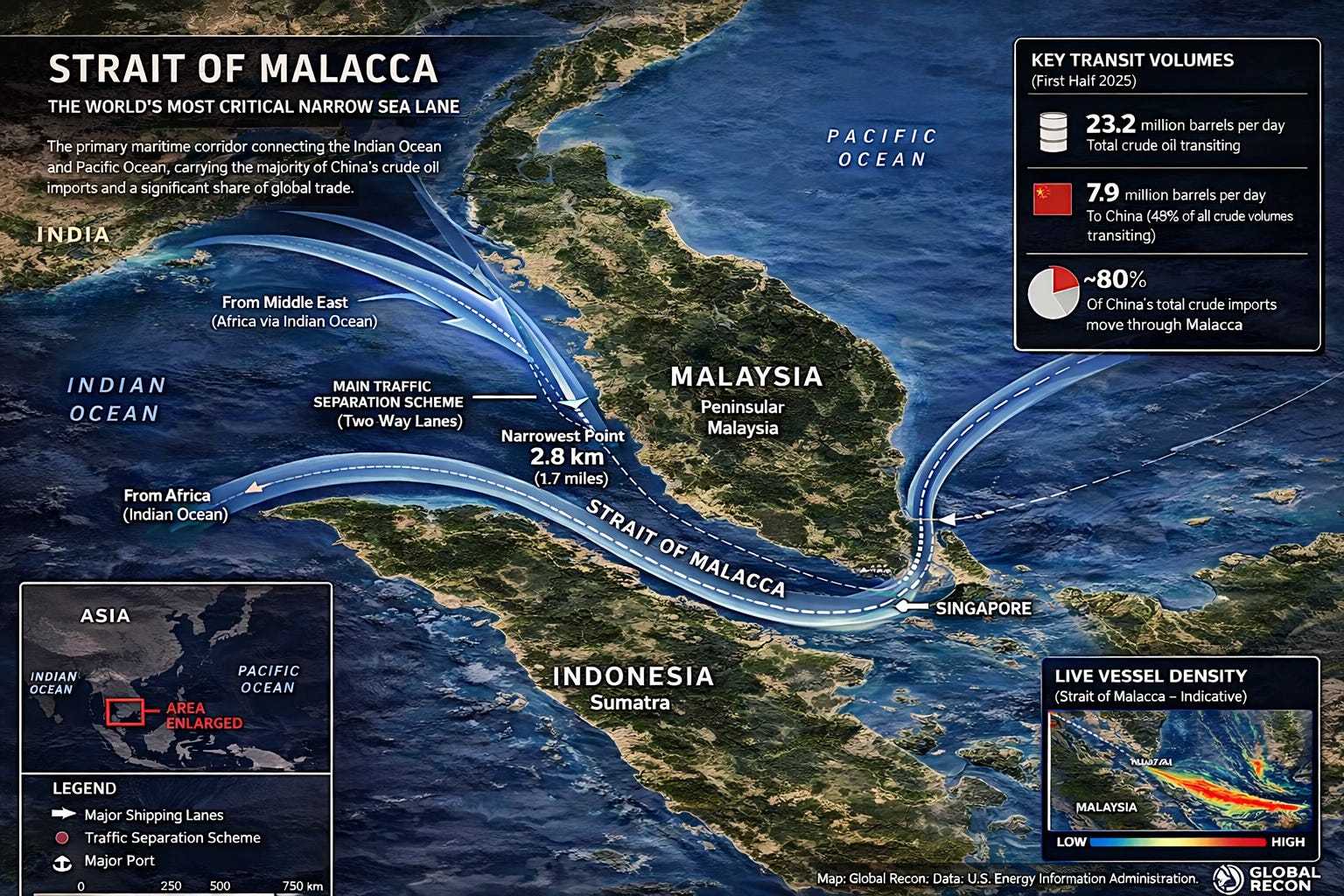
According to the Department of War readout, the MDCP covers co-development of asymmetric capabilities, next-generation technologies in the maritime, subsurface, and autonomous systems domains, expanded special forces training, and maintenance support. Read against geography, the capability set maps directly onto the problem of monitoring and controlling narrow strait transit. The Strait of Malacca, 2.8 kilometers wide at its narrowest point and the primary corridor for Chinese crude imports, is exactly that kind of water.
The Overflight Layer
The MDCP did not arrive in isolation. The Sunday Guardian reported that on February 26, the U.S. Department of War transmitted a classified document to Indonesia’s Ministry of Defence titled “Operationalizing U.S. Overflight.” The proposal would grant American military aircraft blanket transit through Indonesian airspace on a notification basis, not an approval basis. Once activated, U.S. aircraft could transit continuously until the arrangement was deactivated by either side.
Indonesian President Prabowo Subianto reportedly approved the concept during his February 19 meeting with Donald Trump in Washington. Indonesia’s defense ministry stated on April 13 that the document is a preliminary draft with no binding legal force and remains under inter-agency review. On April 14, the ministry spokesperson confirmed that the overflight proposal is not part of the MDCP and remains a separate track subject to national review.
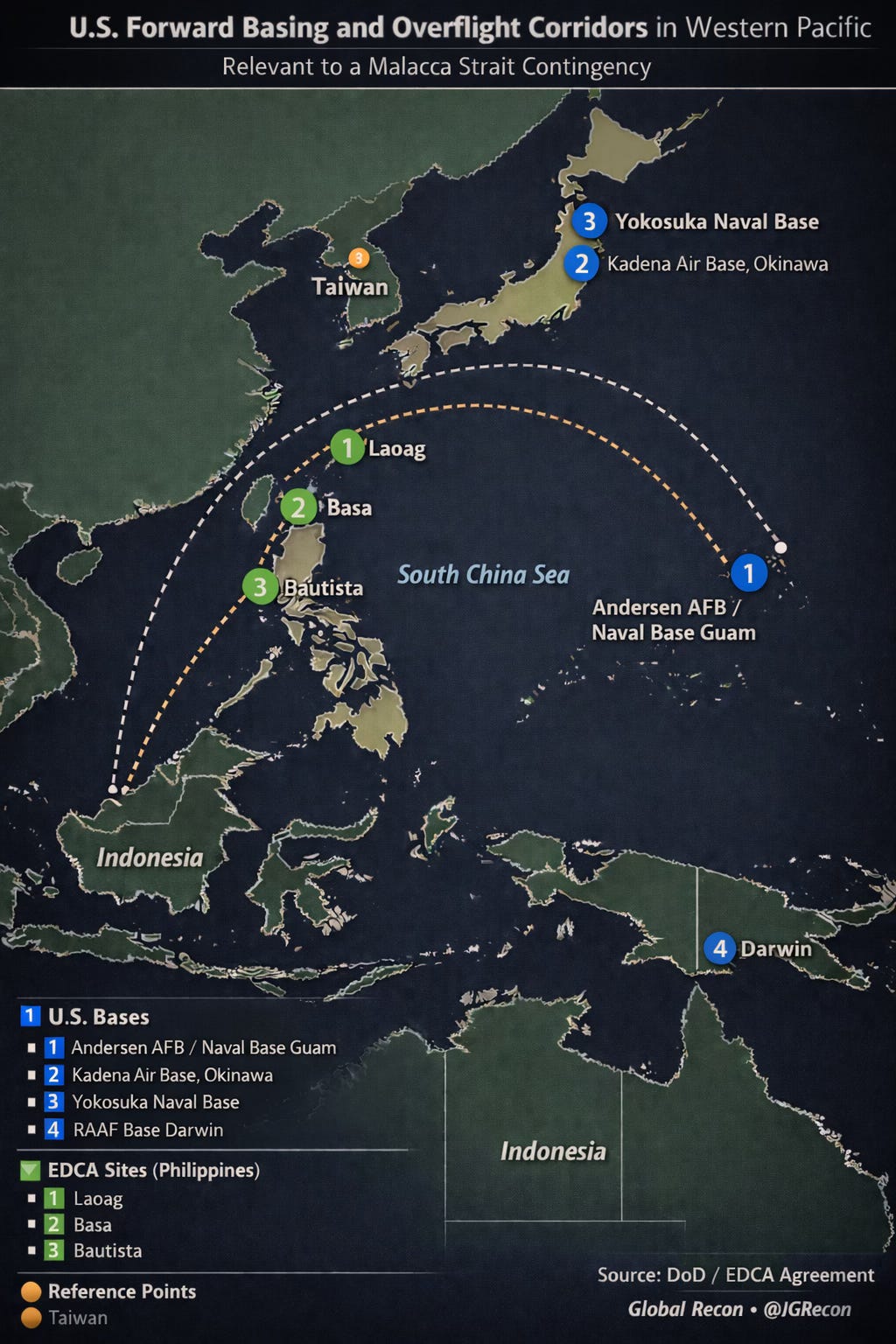
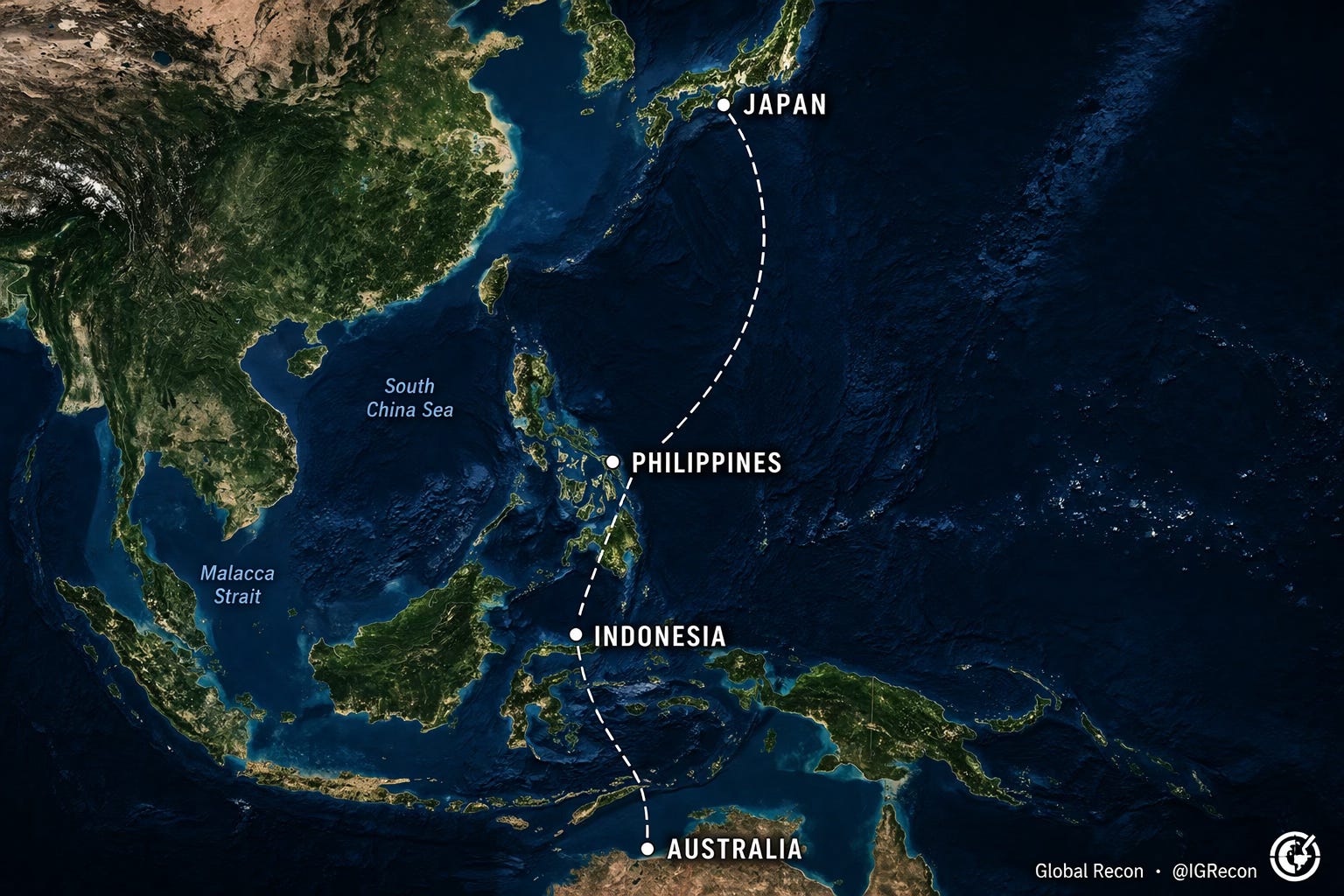
Indonesia’s archipelago straddles the shortest air corridors between U.S. facilities in Australia and the South China Sea. Without overflight access, a U.S. force package transiting to a Taiwan contingency must divert through the Timor and Arafura seas, then north through the open Pacific. A February 2026 CSIS study estimated that diversion adds approximately six days and $11 million in fuel costs.
The Volume Gap
In 2003, Chinese President Hu Jintao coined the phrase “Malacca dilemma” at a Communist Party economic conference. The concern was blunt: China’s economic rise depended on foreign oil sailing through a strait that hostile powers could close. Twenty-three years later, the numbers show the dilemma persists.
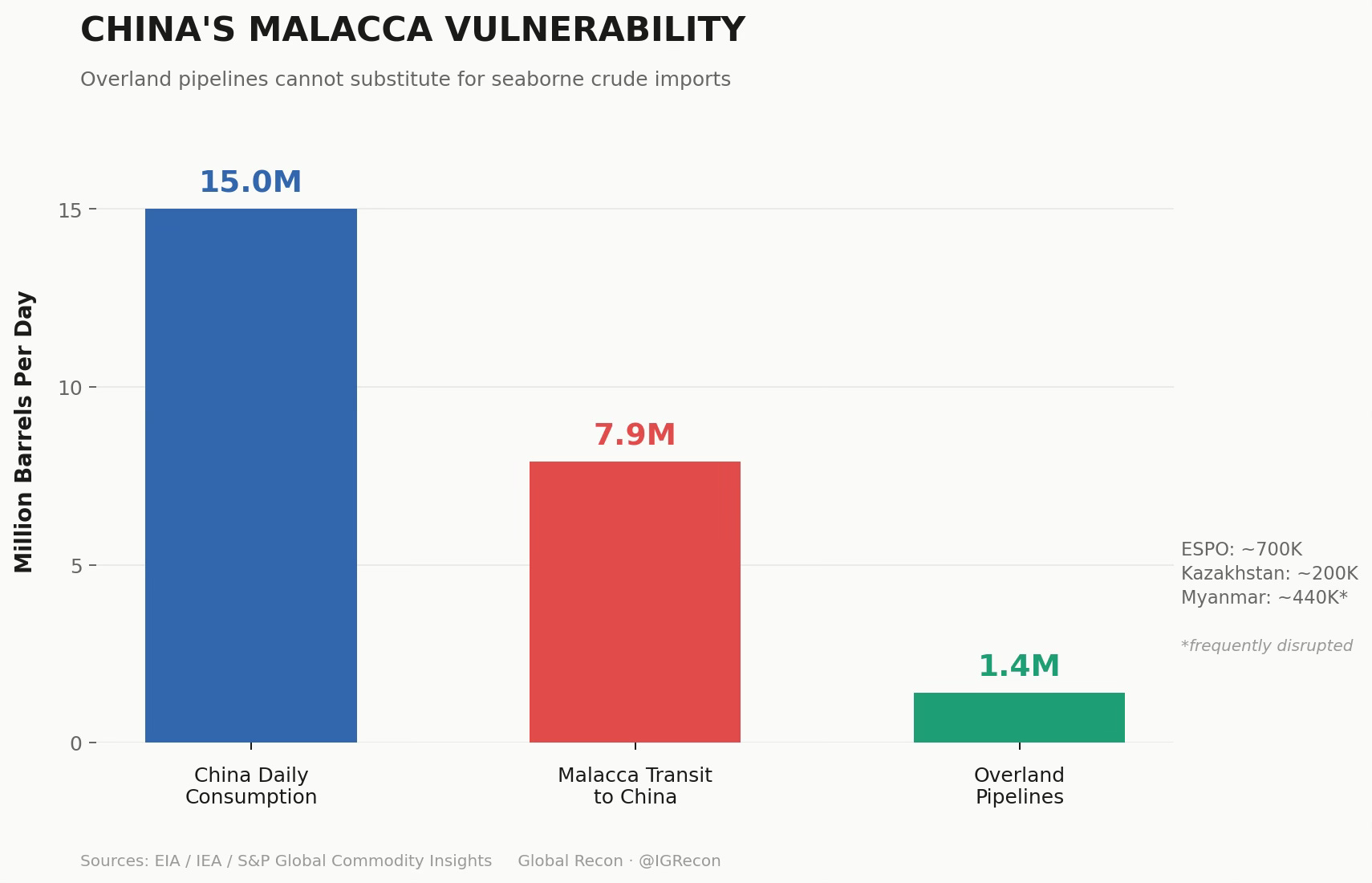
China consumes over 15 million barrels of oil per day. According to U.S. Energy Information Administration data reported by the Malay Mail, 23.2 million barrels per day transited the Strait of Malacca in the first half of 2025. China received 7.9 million barrels per day of crude and condensate through the strait, 48% of all crude volumes transiting the waterway. Around 80% of China’s total crude imports still move through Malacca.
Beijing has spent two decades building overland alternatives. The Eastern Siberia-Pacific Ocean pipeline carries Russian crude at a capacity of roughly 700,000 barrels per day, per CEPA analysis. The Kazakhstan-China pipeline runs at approximately 200,000 barrels per day in practice. The China-Myanmar pipeline from Kyaukpyu to Yunnan was designed for 440,000 barrels per day but has been severely disrupted by Myanmar’s civil war since the 2021 coup. At maximum theoretical throughput, the entire overland oil architecture delivers between 1.3 and 1.5 million barrels per day. China consumes ten times that. The gap is structural, not closing.
China has managed the Malacca dilemma. It has not escaped it. The overland routes move at the margin. The tankers still carry the load.
Hormuz as Proof of Concept
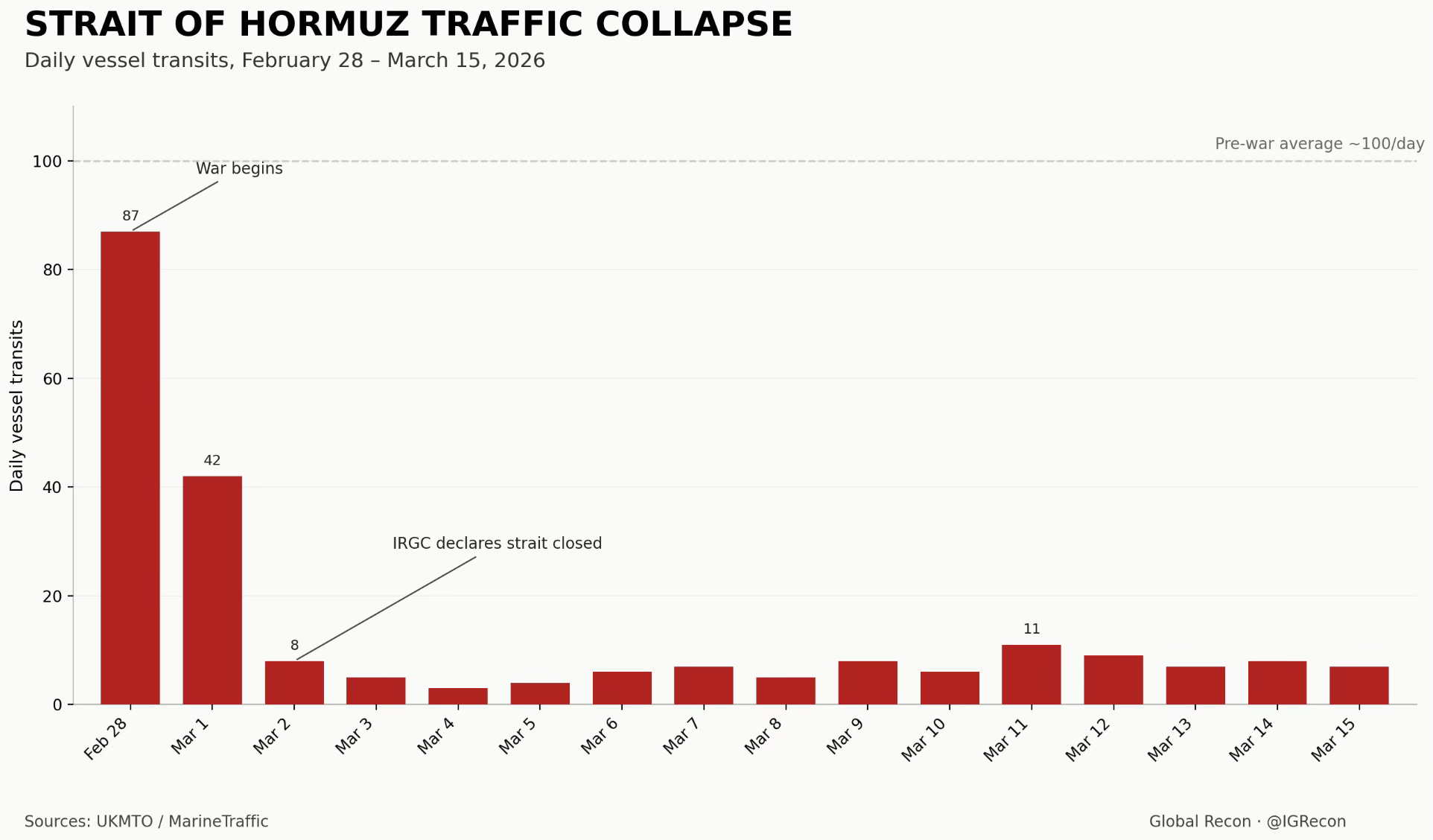
A version of the Malacca dilemma is playing out right now at a different chokepoint. After U.S. and Israeli strikes on Iran beginning in late February 2026, the IRGC attacked vessels transiting the Strait of Hormuz. Commercial traffic collapsed. According to UK Maritime Trade Operations data reported by the Anadolu Agency, only one commercial vessel passed through the strait on March 7. No oil tanker transit was recorded that day.
Iranian missiles struck Qatar’s Ras Laffan LNG complex, knocking out an estimated 17% of the facility’s capacity. Qatar had supplied 28% of China’s LNG imports in 2025, per RFE/RL reporting. Independent teapot refineries in Shandong province, built on discounted Iranian and Gulf crude, face a potential wave of bankruptcies. Brent crude jumped from roughly $70 per barrel before the crisis to over $100.
On April 13, the same day the MDCP was signed, the crisis escalated further. After U.S.-Iran talks in Islamabad collapsed without a deal, Trump ordered a naval blockade of all Iranian ports and coastal areas, effective that morning. U.S. Central Command said the blockade applies to all vessels regardless of flag. Tanker traffic that had barely recovered during a two-week ceasefire stopped again within hours, according to Lloyd’s List Intelligence.
Hormuz is demonstrating what Malacca threatens. A chokepoint closure does not need to be total to be devastating. It needs to be credible enough to spike prices, strand cargoes, and force a strategic reserve drawdown that burns through months of cushion.
What the MDCP Builds
The interoperability base is already substantial. Super Garuda Shield 2025, held across Jakarta and Sumatra last August, was the largest iteration of the annual exercise to date. More than 6,500 troops from 13 nations participated, including amphibious drills in the Riau Islands and a HIMARS live-fire exercise. The MDCP formalizes and expands a machine that is already running.
The agreement does not require Jakarta to choose sides. Indonesia’s foreign policy has been built on non-alignment since independence, and Prabowo has maintained that posture publicly even as he deepens ties with Washington. He joined Trump’s Board of Peace, signed a reciprocal trade deal eliminating tariff barriers on over 99% of American imports per the White House fact sheet, and pledged up to 8,000 troops toward the Gaza stabilization force. None of that requires a declared strategic alignment. All of it increases interoperability.
The timing made the posture visible. On the same day Sjamsoeddin signed the partnership at the Pentagon, Prabowo met Vladimir Putin at the Kremlin for five hours of talks on energy cooperation and oil supply. Washington gets the defense architecture. Moscow gets the energy consultation. Jakarta keeps both doors open.
Jakarta has its own reasons for wanting better maritime surveillance. Chinese Coast Guard vessels have repeatedly confronted Indonesian patrols around the Natuna Islands, where China’s nine-dash line overlaps Indonesia’s exclusive economic zone. In late 2024, a CCG vessel shadowed an Indonesian state oil company seismic survey for weeks before being expelled, only to return. The MDCP gives Indonesia the tools it needs for its own maritime defense, not only tools Washington wants deployed.
The operational effect is cumulative. As Indonesian officers train on U.S.-supplied surveillance and patrol systems, as exercises expand in scope, and as maritime domain awareness networks integrate across partners, the sensor coverage around the Strait of Malacca tightens. Chinese military planners contemplating a crisis over Taiwan or the South China Sea now have to model a Malacca transit corridor that is increasingly visible to a network of partners that leans, in practice, toward Washington.
Indonesia does not need to blockade anything. It does not need to choose a side in a war it has not joined. It just needs to keep training, keep sharing, and keep the door open. The strategic effect accrues regardless of Jakarta’s public posture.
If overflight access formalizes on top of the MDCP, the architecture sharpens further. The United States would gain a continuous air corridor from Australia through the Indonesian archipelago to the South China Sea, completing a mobility network that already includes basing and access agreements in Japan, the Philippines, and Australia.
The Dilemma Deepens
Beijing is not standing still. A July 2025 Rhodium Group study estimated that China’s growing electric vehicle fleet is reducing oil demand by more than one million barrels per day, with further reductions projected. Combined strategic and commercial petroleum reserves are estimated at 1.2 to 1.3 billion barrels, according to OilPrice reporting on industry estimates. Analyst estimates drawing on Baker Institute modeling suggest China could sustain a wartime economy for several months under a full blockade before reserves become critical. These are real mitigations. They are not an escape.
The pattern from Washington is consistent. Rebuilding American shipyards. Expanding Indo-Pacific maritime basing. Deepening the AUKUS submarine partnership. And now, wiring Indonesia into the surveillance and access architecture that covers the world’s busiest oil transit chokepoint.
The question for Chinese planners is no longer whether the Malacca dilemma is real. Hormuz proved that chokepoint dependency converts directly into economic pain and strategic vulnerability at speed. The question is whether the dilemma can still be solved before Washington finishes instrumenting it, or whether it has already hardened into a permanent constraint that no pipeline, no reserve stockpile, and no electric vehicle fleet can fully offset.
___
John Hendricks is an OSINT analyst and the founder of Global Recon. Follow on X: @IGRecon