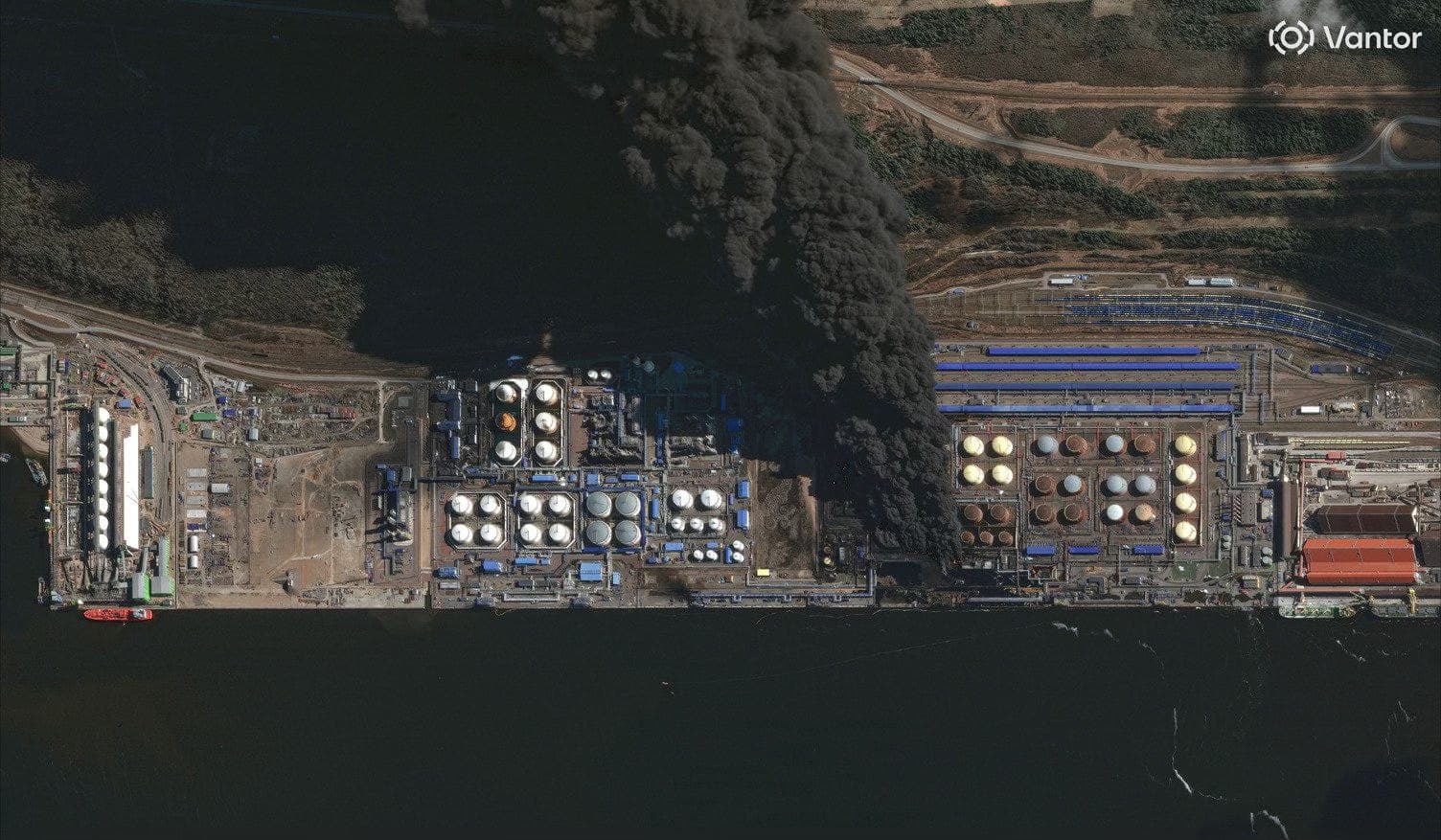
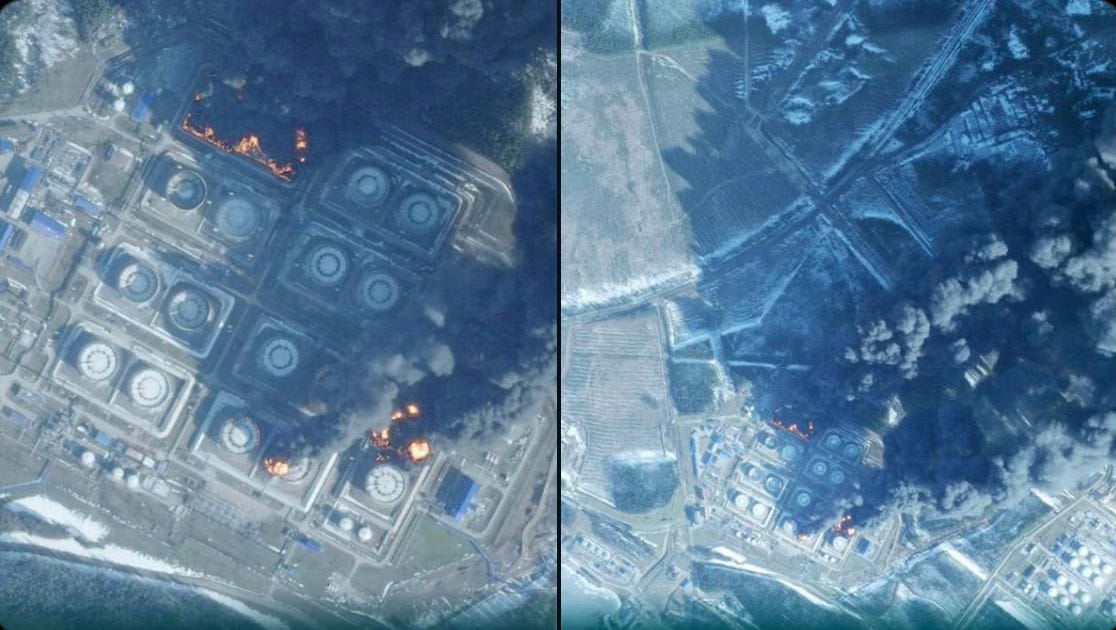
On March 22–23, Ukrainian drones reached Primorsk, a Gulf of Finland port roughly 675 miles north of Ukraine’s border. The target was a Transneft oil terminal, the endpoint of Russia’s Baltic Pipeline System. Satellite data confirmed fires across the tank farm, with at least four storage tanks burning. Both Primorsk and neighboring Ust-Luga suspended operations.
That framing misses the strategic point. Primorsk isn’t merely one node. It terminates the pipeline moving West Siberian crude to the Baltic coast for tanker export. Roughly 46.6 million tonnes of oil passed through in 2025, generating approximately $15 billion in revenue. A significant portion moves via shadow fleet vessels, aging tankers under flags of convenience with opaque ownership, designed to circumvent G7 price caps. Per a Ukrainian Security Service source cited by Ukrainska Pravda, Primorsk is a primary shadow fleet loading point. The strikes target the financial plumbing of the Russian war effort, not merely energy infrastructure.
The Machine Behind the Strikes
Ukraine’s drone industry barely existed before February 2022. By mid-2025, monthly production grew from roughly 20,000 units in summer 2024 to over 200,000, a nearly tenfold increase in under a year, per Atlantic Council and Georgetown Security Studies Review research. Annual capacity has reached 10 million units. Ukraine has fielded the Peklo, a jet-propelled strike drone with 700-kilometer range and 700 kph top speed, roughly three times faster than earlier variants. These represent purpose-built strategic platforms produced at industrial scale.
Strike range depends partly on air defense attrition. Ukraine’s SBU Alpha unit reported neutralizing approximately half of Russia’s operational Pantsir air defense systems since 2025. Each Pantsir costs $15–20 million to replace.
No Russian region can consider itself safe.
Ukraine executes sustained suppression with deliberate re-strike cycles.
Ukraine targets refineries during repairs or restarts, typically on two-to-three week intervals, converting routine maintenance into prolonged shutdowns.
Damage accumulates faster than repairs.
The Campaign Architecture
From February 1 through March 18, Ukrainian forces launched at least 110 discrete drone strike packages against Russian targets, roughly four separate targets nightly, per Kyiv Post records. Swarm sizes grew from 50–70 drones per wave in late 2025 to 100–200 in the six weeks before Primorsk.
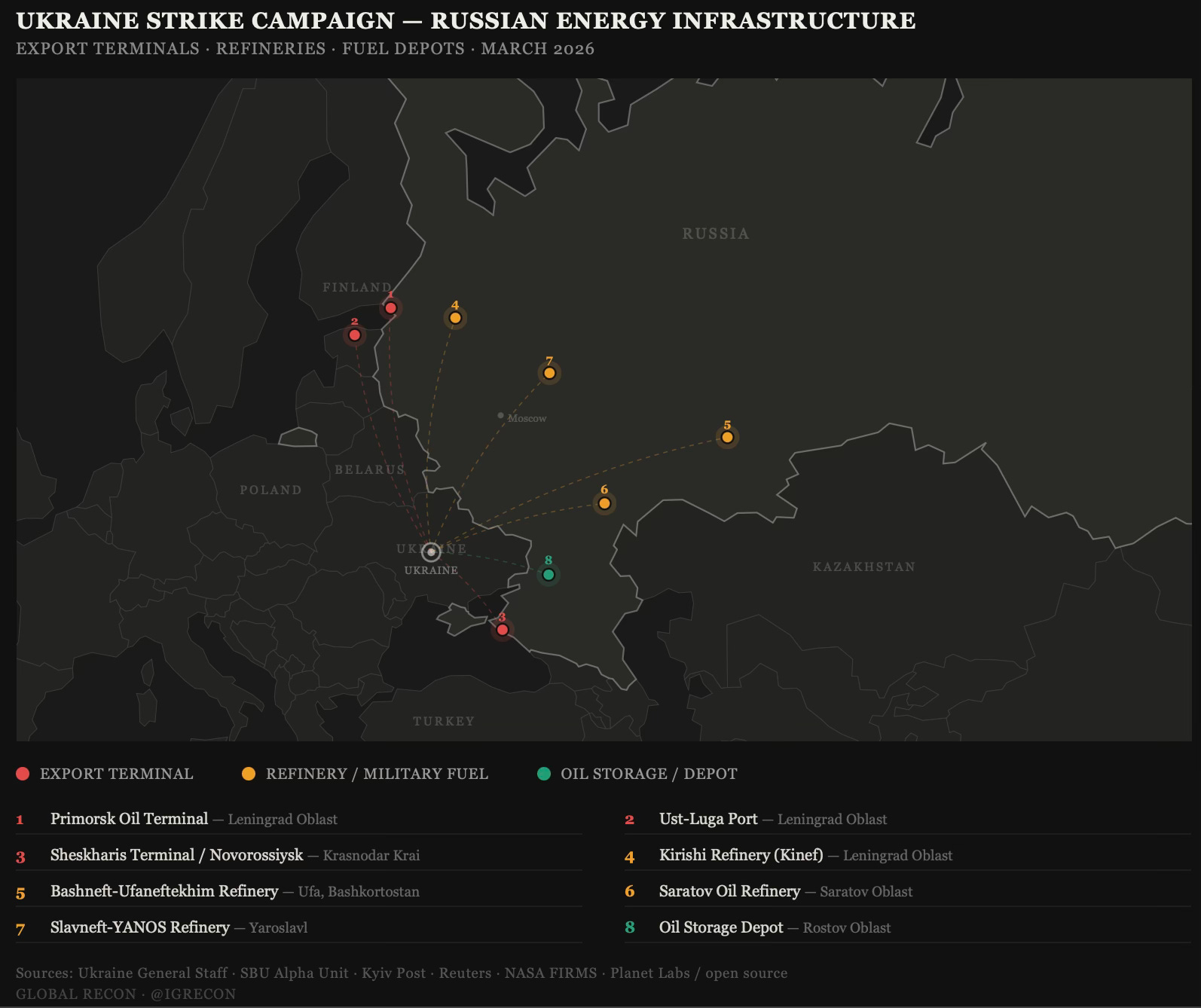
The campaign targets both export and supply infrastructure. On March 21, Ukrainian drones struck the Saratov oil refinery, a Rosneft facility linked to aviation fuel deliveries to nearby airbases. The same night Primorsk burned, drones hit the Bashneft-Ufaneftekhim refinery in Ufa, 870 miles from Ukraine’s border, a key fuel supply node for Russian forces. The strategy attacks both ends of the chain: the export terminals that generate revenue and the refineries that supply the front.
Three weeks prior, on March 1–2, Ukraine struck Novorossiysk, Russia’s largest Black Sea oil export hub, targeting the Sheskharis terminal, the endpoint of Transneft’s southern pipeline network. A Ukrainian Security Service source told the Kyiv Independent that six of seven oil-loading arms were damaged. Novorossiysk handles roughly a fifth of Russia’s total crude shipments. Both Primorsk and Novorossiysk, the two coasts through which Russian oil reaches global markets, are now targeted.
The pattern is systematic: refineries process crude into fuel; depots store it; pipelines move it; ports export it. Ukraine is hitting each layer of the chain, in sequence and simultaneously, faster than Russia can repair.
What the Numbers Mean
Reuters calculations from late 2025 estimated Ukrainian strikes reduced Russian refining capacity by 17 percent, roughly 1.1 million barrels per day. Russia’s average daily refining fell to around 5 million barrels per day, down from 5.3–5.5 million in autumn. By September–October 2025, fuel shortages emerged in some regions, with gas station lines spreading across social media. Putin signed emergency legislation allowing Russian companies to refine oil at Belarusian facilities and import it back.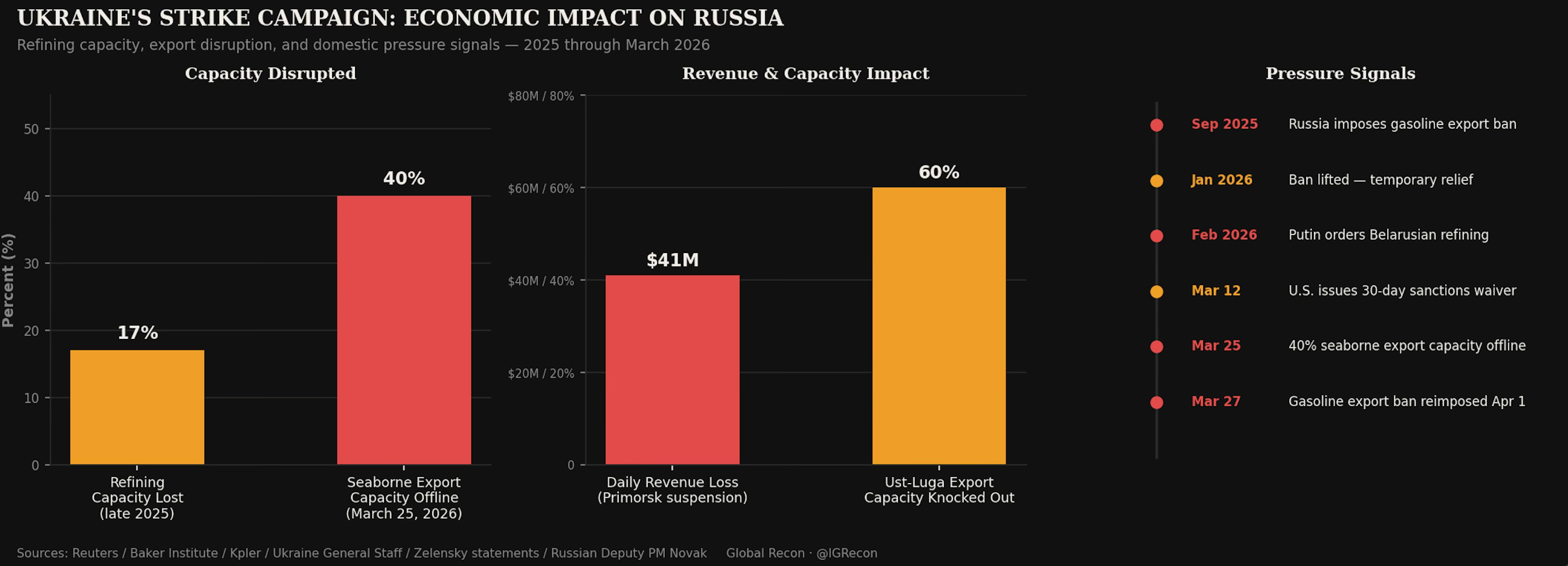
March strikes compounded this sharply. As of March 25, Reuters reported Ukrainian attacks knocked out roughly 40 percent of Russia’s seaborne oil export capacity, approximately 2 million barrels per day, described as the most severe oil supply disruption in modern Russian history. Zelensky stated March 28 that Ust-Luga alone lost 60 percent of its export capacity. Ukrainian monitoring channels estimated daily revenue losses from Primorsk suspension at up to $41 million. On March 27, Russian Deputy Prime Minister Alexander Novak announced a gasoline export ban effective April 1, citing domestic supply pressure, the same measure Russia imposed in September 2025 and lifted in January. Ukraine’s strikes forced it back.
Baker Institute analysis from early 2026 highlighted the asymmetry: creating shell companies and reflagging tankers is fast and cheap. Replacing infrastructure destroyed by explosives is slow and expensive. The repair backlog grows faster than Transneft can close it.The Endpoint Is the Target
Pipelines can be rerouted and refineries partially repaired. Primorsk cannot be substituted. It terminates the Baltic Pipeline System with no redundant Baltic route handling equivalent volume. When Primorsk stops loading, crude sits. The port was first struck in September 2025, disabling berths and delaying loadings. The March attack was the second strike in under a year, reaching the tank farm and oil loading infrastructure. September demonstrated the concept; March escalated the damage.
The interval between Primorsk and the next Baltic strike was 48 hours. On March 24–25, the SBU hit Ust-Luga directly, striking Novatek‘s fractionation and transshipment complex, which processes gas condensate into petroleum products for export, including via shadow fleet. The General Staff confirmed tank farm and loading rack damage. Bloomberg described the March 25 operation as the most intense Ukrainian air strike on Russia in over a year. Ust-Luga resumed loadings on March 23 after Primorsk alert lifted; it was offline again within two days.
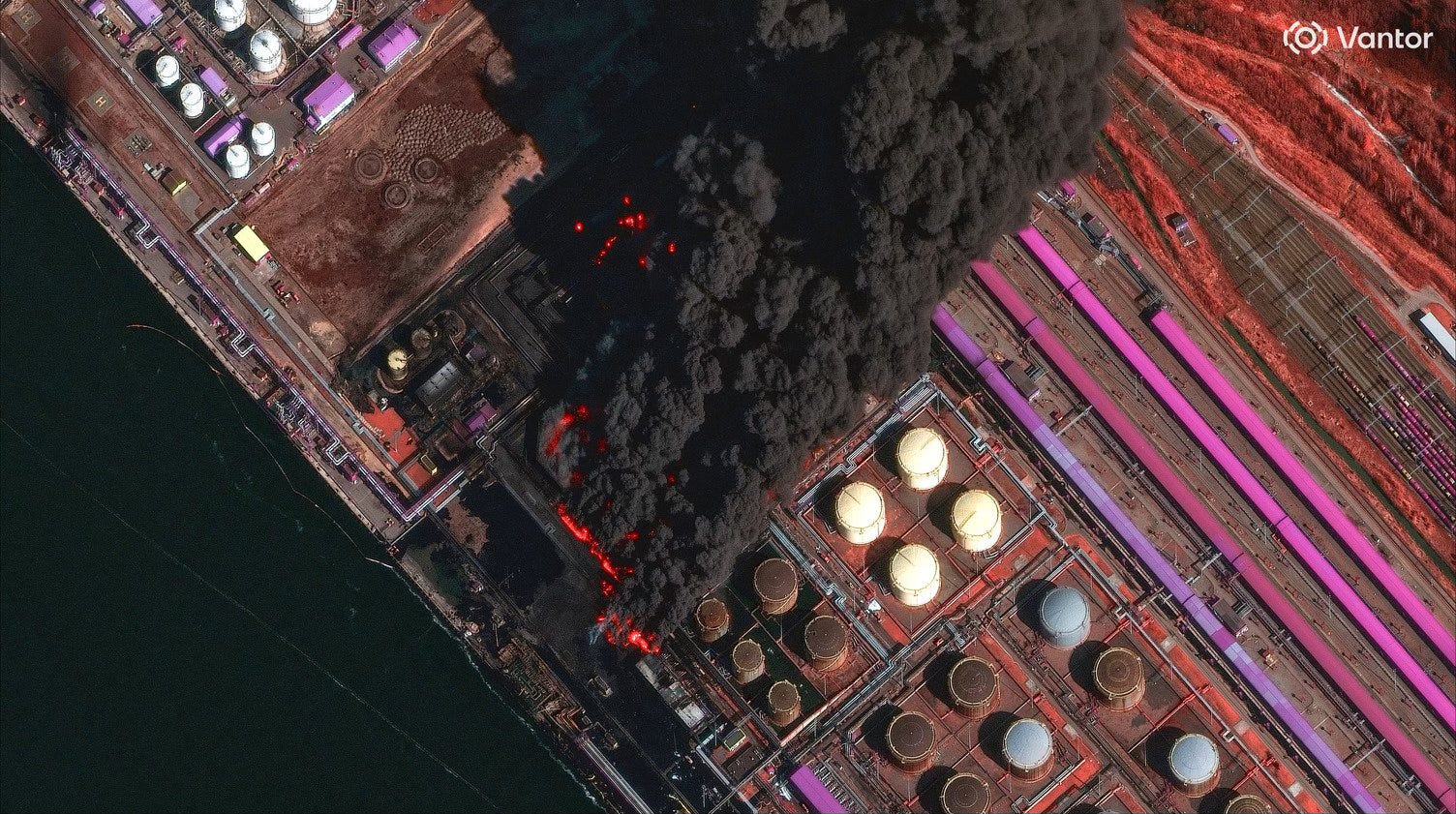
The campaign continued. On March 25–26, Ukrainian drones hit the Kirishi refinery in Leningrad Oblast, accounting for roughly 7 percent of Russia’s total refining output. The General Staff confirmed damage to primary refining units, bitumen production, hydrotreating units, and gas fractionation systems. The facility halted operations. Ust-Luga was again ablaze the same night. Flights at St. Petersburg’s Pulkovo Airport were suspended for the second consecutive night.
On March 28, drones reportedly struck the Slavneft-YANOS refinery in Yaroslavl, one of Russia’s five largest, capable of processing over 15 million tonnes annually. Yaroslavl is 700 kilometers from Ukraine’s border and 230 kilometers northeast of Moscow. The reach is not incidental. Ukraine is pressing across the full depth of Russia’s energy geography.
Overnight March 29, Ust-Luga was struck again, the fourth hit in under a week. The SBU’s Alpha unit confirmed the operation.
Strikes will continue. Oil facilities are directly tied to Russia’s military-industrial system.
Ukrainian drones also hit an oil storage facility in Rostov Oblast. The Baltic corridor and southern supply chain are worked in parallel.
Novorossiysk Complications
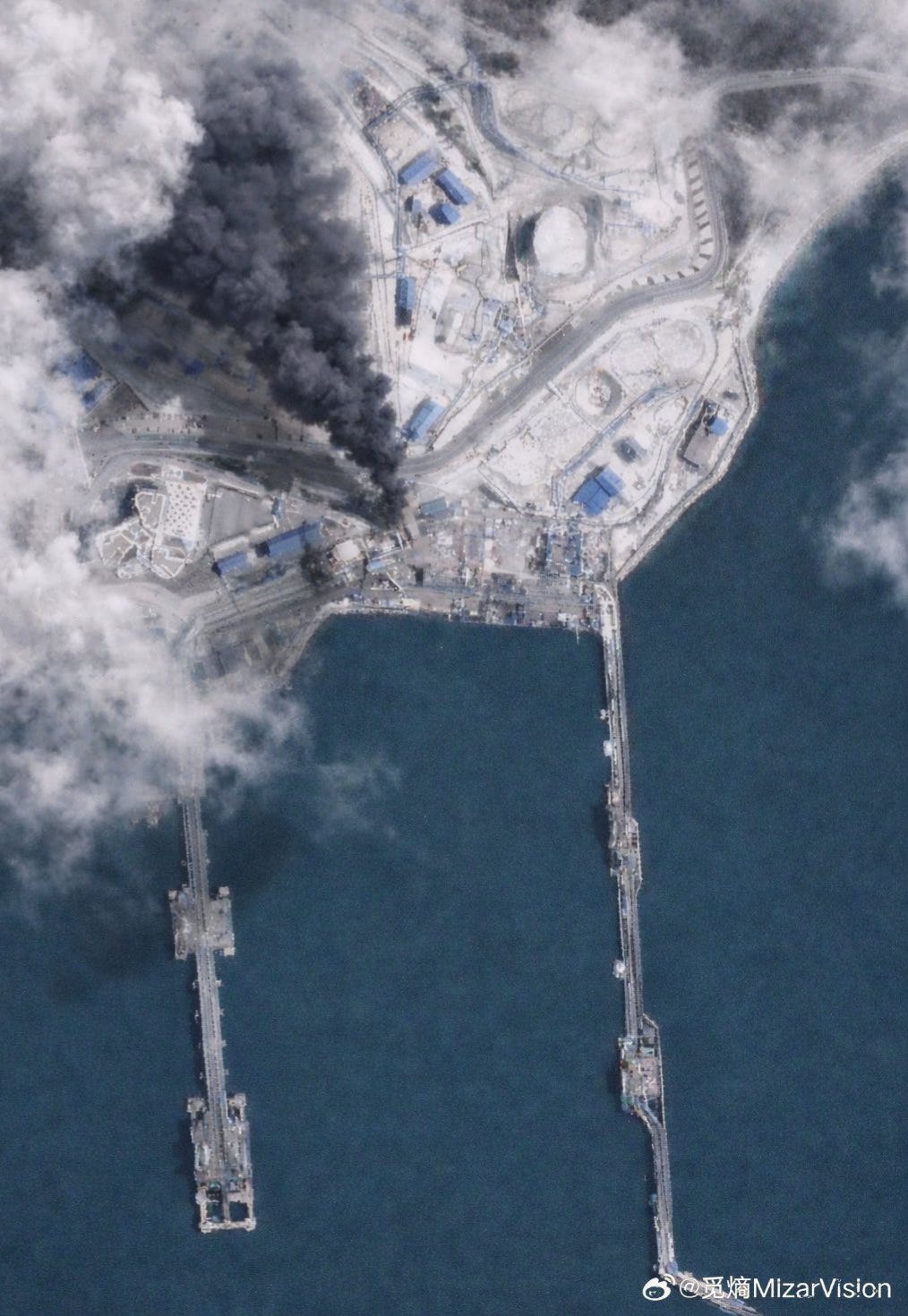
Novorossiysk carries complications. Sheskharis terminal shares pipeline infrastructure with the Caspian Pipeline Consortium, handling roughly 80 percent of Kazakhstan’s oil exports and partly owned by Chevron and ExxonMobil. Following November 2025 strikes, the U.S. State Department issued a formal diplomatic protest to Kyiv, publicly confirmed by Ukraine’s ambassador to Washington in February 2026. Ukraine acknowledged the note and continued striking. The March 2 attack on Sheskharis came weeks later. Ukraine has concluded the revenue flowing through these terminals outweighs the diplomatic cost.
The campaign extends to the fleet itself. On March 26, a tanker carrying Russian crude was struck by drone near Istanbul, with Turkish officials reporting engine room explosion. Ukraine used naval drones to push Russian warships from the Black Sea. The same logic now applies to the commercial vessels moving the oil those warships were protecting.
The Question the Strikes Raise
Russia’s energy export architecture was designed for a world where adversaries couldn’t reach it. That assumption is gone.
Ukraine has demonstrated ability to hit economic infrastructure at strategic depth across both coasts, in sequence, with enough frequency to prevent full recovery between attacks. Ufa refinery is 870 miles from the front; Primorsk 675 miles north of Ukraine; Yaroslavl 230 kilometers from Moscow. All were hit within a five-day window.
Timing sharpens the pressure. Oil prices climbed sharply after the U.S.–Israeli campaign against Iran began February 28, with Brent crude rising from roughly $70 per barrel to over $100 by mid-March. Russia stood to benefit significantly. The U.S. compounded that advantage March 12 by issuing a 30-day sanctions waiver allowing countries to purchase stranded Russian oil, a move Zelensky said could hand Moscow roughly $10 billion for the war. Ukraine’s response was accelerating the strike campaign. The windfall Russia was positioned to collect is precisely what Ukraine is trying to intercept at the source. Per CREA analysis, Russian daily oil revenues had already risen roughly 20 percent in the 24 days following Iran war commencement. Ukraine is racing to cut the pipe before the money converts to military spending.
The question isn’t whether Ukraine can continue reaching targets. It can and will. The question is whether accumulated damage across refineries, depots, pipelines, and terminals reaches a threshold degrading Russia’s ability to fund the war from oil revenues in operationally meaningful ways. That threshold hasn’t been crossed yet. But Russia’s public acknowledgment that it cannot defend its own territory, the reimposed gasoline export ban, and Washington’s conflicted posture toward Kyiv’s campaign all suggest the trajectory is being tracked carefully on all sides.