Khamenei is dead. The IRGC’s top brass is decimated. But the militias that built Iran’s regional empire are still armed, still funded, and still watching for orders that may never come.
The Strike That Changed the Equation
Based on converging reporting from Israeli, U.S., and regional sources as of publication, Operation Epic Fury did something that years of sanctions, targeted killings, and diplomatic pressure never could: it removed the clerical architecture that sat above Iran’s entire proxy network.
Supreme Leader Ali Khamenei the man whose office issued the strategic directives that flowed down to groups like Kata’ib Hezbollah in Iraq, Hezbollah in Lebanon, and the Houthis in Yemen is confirmed dead. So are several of the IRGC’s senior commanders, including IRGC chief Mohammad Pakpour, Defense Minister Amir Nasirzadeh, Armed Forces Chief of Staff Abdolrahim Mousavi, and National Security Council Secretary Ali Shamkhani. The IDF confirmed seven senior Iranian security figures killed in a single strike window a decapitation event with no modern precedent.
But there is a detail buried in Associated Press reporting that reframes the entire proxy picture. Two officials with different Iran-backed militias reportedly told the Associated Press that a meeting took place roughly two months ago between Iranian officials and allied Iraqi militias to pre-plan a coordinated response in the event Iran was attacked, including the distribution of specific operational tasks among Iraqi armed groups. That reporting has not been independently corroborated as of publication.
The response now unfolding is not improvised. It was rehearsed.
That detail matters because it suggests decapitation was anticipated and planned for. The proxy network was structured to continue functioning even if the apex was removed.
Jurf al-Sakhar: What the Targeting Tells You
Before examining broader network behavior, it is worth looking closely at what happened on the ground in southern Iraq because the targeting pattern itself carries intelligence value.
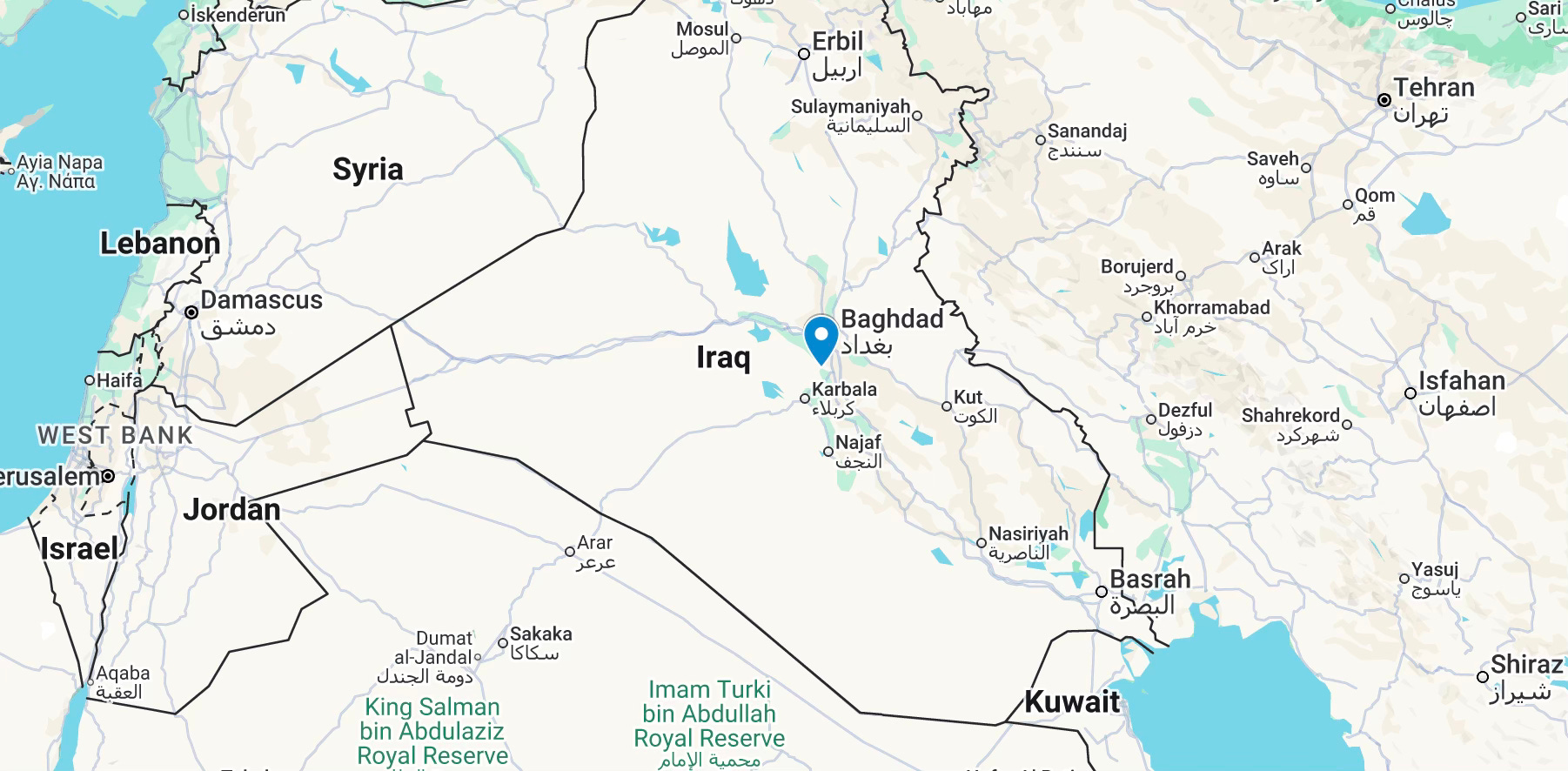
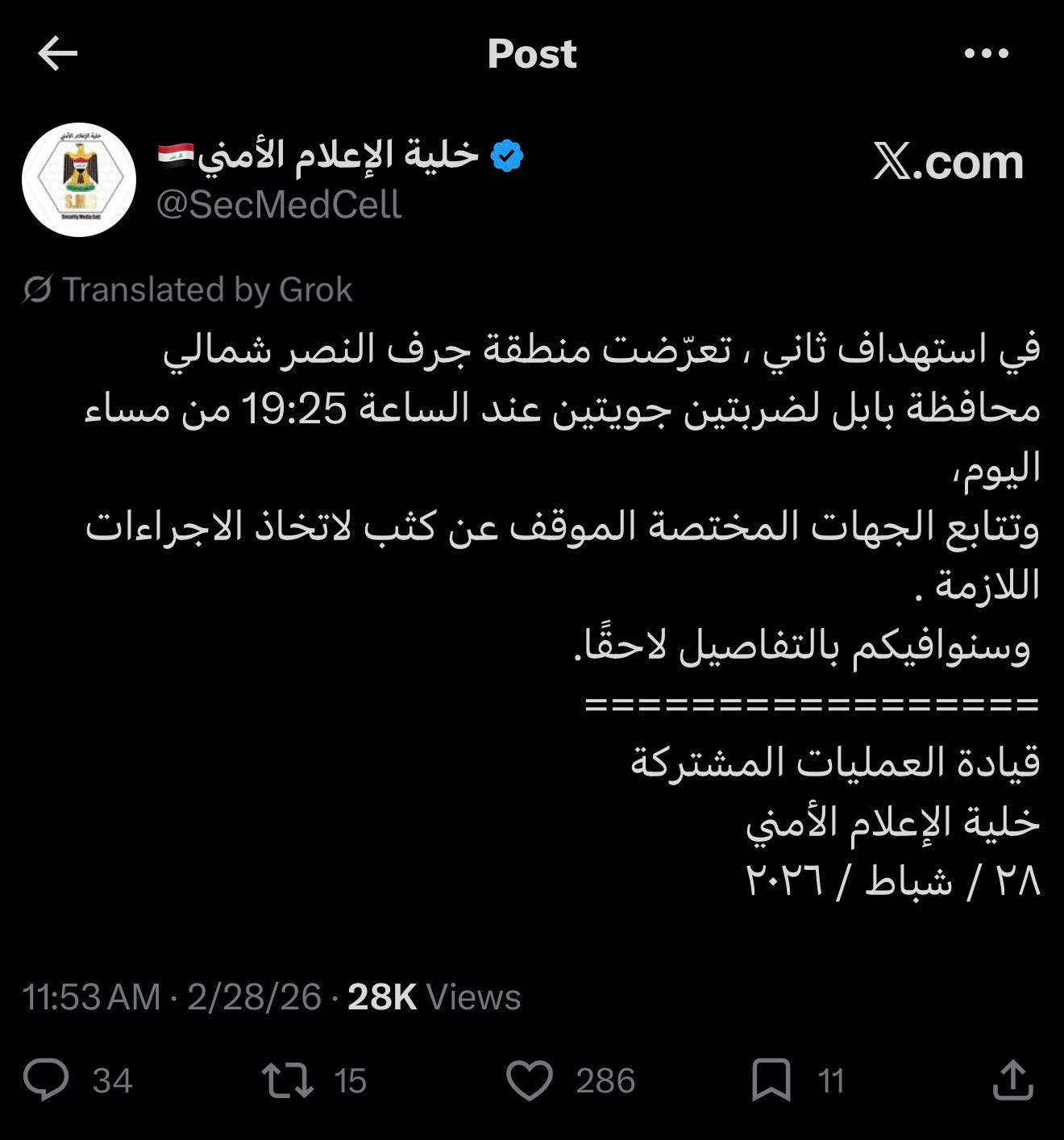
U.S. and Israeli forces struck the Jurf al-Sakhar base also known as Jurf al-Nasr twice on February 28. The first strike came within two hours of the opening wave on Iran, killing at least two Kata’ib Hezbollah fighters and wounding five. The Iraqi government’s security media cell confirmed a second strike at 7:25pm local time; a KH official confirmed it independently.
Two strikes on the same position within one operational day indicate a suppression-and-restrike pattern. That suggests the target either remained operational after the initial hit or required further degradation to neutralize ongoing activity.
This matters because Jurf al-Sakhar has functioned as more than a KH base. In a previous strike on the site (2023), a mid-level Houthi technical commander was previously reported killed alongside KH fighters. He was later identified through Houthi obituaries and was wearing the rank insignia of a Yemeni Republican Guard officer. Iraqi factions claimed he was assisting with drone reconnaissance for Shia pilgrimages. Analysts at the Washington Institute disputed that explanation.
If Jurf al-Sakhar was serving as a cross-proxy coordination hub for drone and missile development, the February 28 strikes may not have destroyed that infrastructure. They may have dispersed it.
From an OSINT standpoint, Jurf al-Sakhar satellite imagery should be a priority watch. The site has been a closed zone for over a decade, with Iraqi Interior Ministry sources describing missile and drone facilities constructed with Iranian support. As of publication, no post-strike imagery has been released. When it does emerge from Planet Labs, Airbus, or Maxar the key question will be whether the strikes penetrated core production infrastructure or only hit perimeter and support facilities.
Erbil: The Northern Front and What the Volleys Signal
The Erbil attacks have received less analytical attention than they deserve.
Between February 28 and March 1, Erbil was subjected to multiple waves of drones and missiles targeting Erbil International Airport which hosts U.S. military and coalition forces and the U.S. consulate. Six Peshmerga and KRG security officials told Alhurra that U.S. missile defenses intercepted more than seven separate volleys.
Seven volleys against a single target cluster is not symbolic signaling. It reflects a sustained saturation attempt the logic used when an attacker is either confident in interceptor depletion or willing to expend scarce munitions to force a breakthrough.
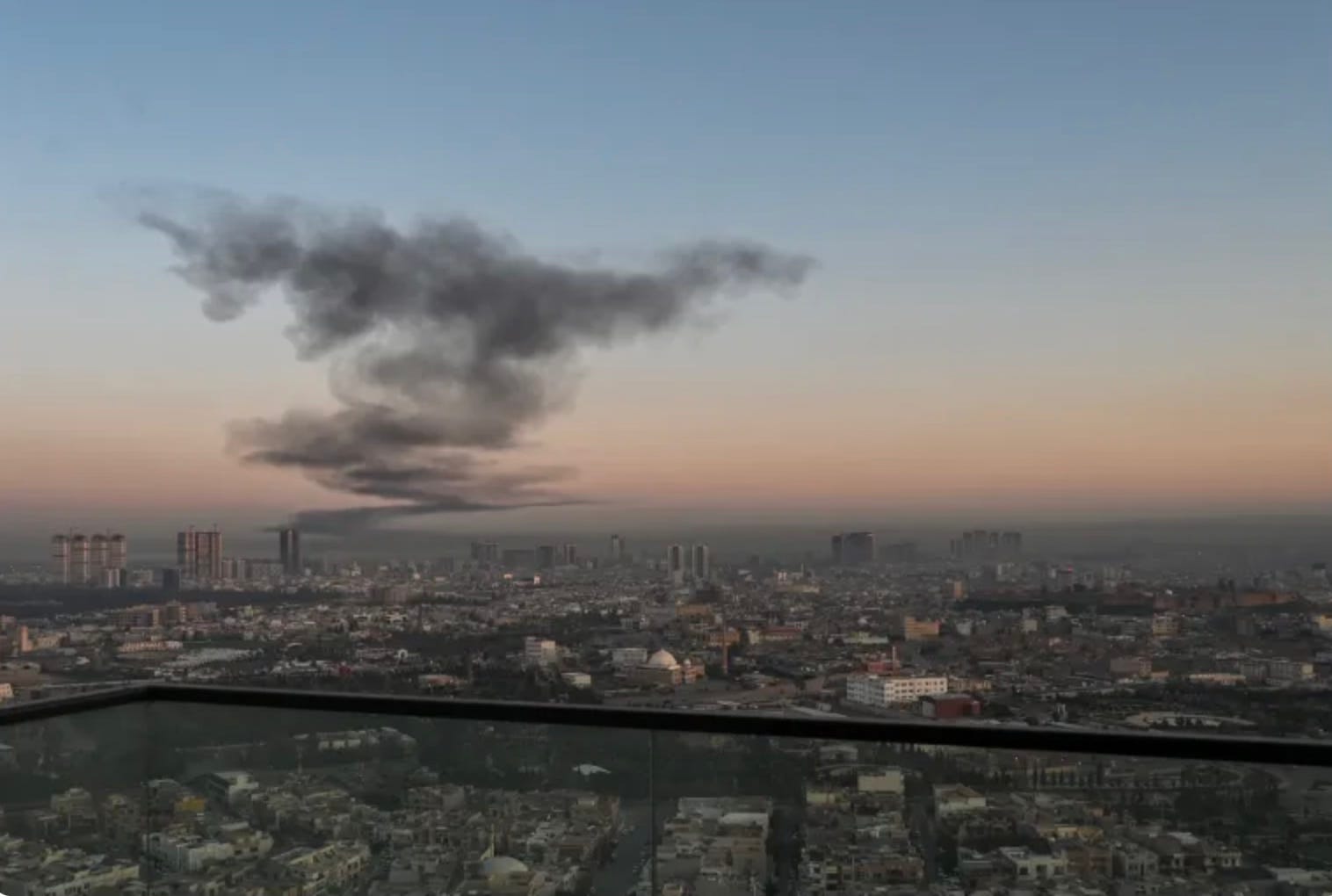
On March 1, the airport attack was claimed not by Kata’ib Hezbollah but by Saraya Awliya al-Dam, a smaller Iran-aligned Iraqi militia.
That distinction matters. Saraya Awliya al-Dam has historically exhibited less Iranian strategic oversight and a higher tolerance for risk. Assigning Erbil to this group rather than KH suggests either deliberate deniability management preserving KH for later escalation or early fragmentation in the proxy tasking chain.
The attacks also triggered a cascading infrastructure effect. Gas supplies from the Kormor field were halted, cutting power across much of the Kurdistan Region. Erbil went largely dark during the assault a degradation of the operational environment that does not show up in strike tallies but directly affects crisis response capacity.
KRG authorities suspended schools and universities. Senior Peshmerga commanders stated publicly that forces are on alert and “prepared for any eventuality” language that reflects contingency planning for escalation beyond air attacks.
Baghdad: The Green Zone and an Impossible Balancing Act
The street-level situation in Baghdad is where the political and military dimensions of the proxy network converge.
Hundreds of organized demonstrators carrying Kata’ib Hezbollah flags and portraits of Khamenei attempted to march across al-Muallaq Bridge toward the U.S. embassy. Iraqi riot police deployed tear gas to hold the perimeter. A security source told AFP: “Their attempts had been thwarted so far, but they keep trying.”
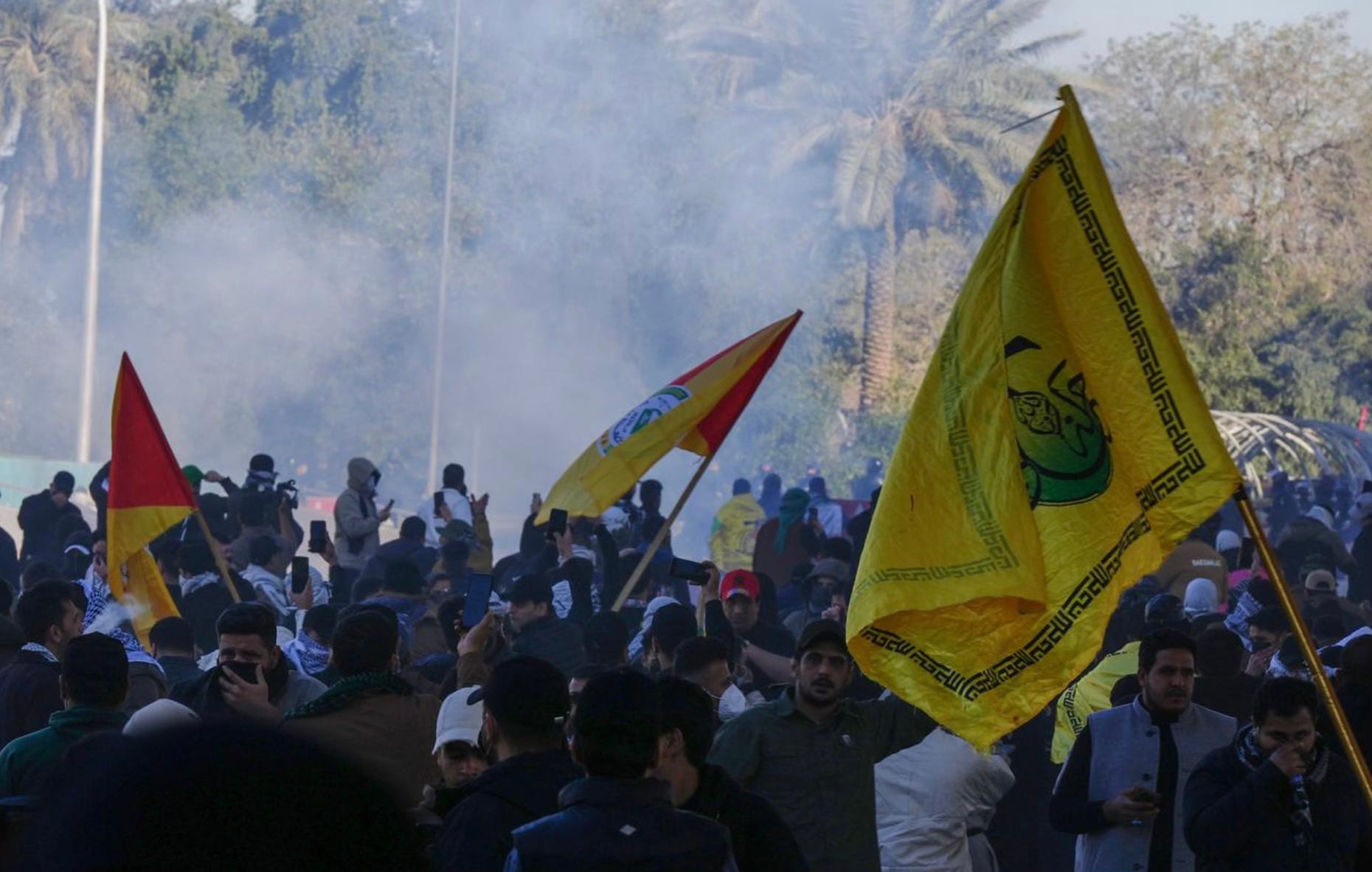
This places Prime Minister Mohammed Shia al-Sudani in a three-way veto trap. He cannot suppress PMF factions without risking coalition collapse. He cannot allow militia escalation without inviting Israeli or U.S. strikes on Iraqi soil. And he cannot satisfy Washington without alienating the very blocs that sustain his government.
Sudani publicly rejected “war and aggression in all its forms” and warned Iraq would not be used as a launchpad against Iran. He convened the full security leadership interior minister, PMF chairman, intelligence chief, army chief of staff, and Counter-Terrorism Service and declared three days of national mourning for Khamenei.
Alhurra reported that before the strikes, Washington sent a message to senior Iraqi officials warning that preventing militia attacks on U.S. interests would prevent Israeli involvement in Iraq. The message was reportedly circulated via WhatsApp. It did not hold. Jurf al-Sakhar was struck anyway, and Iraqi militia retaliation followed.
The PMF chief of staff had previously stated publicly that the PMF took orders from Khamenei. With Khamenei dead, the formal chain of command above Iraq’s militia-embedded security forces has been severed while those forces are mobilizing in Baghdad’s streets.
Kata’ib Hezbollah: The Most Dangerous Variable
Before the first strike, KH leader Abu Hussein al-Hamidawi warned of “total war” if Iran were attacked. Al-Nujaba and Sayyed al-Shuhada have since declared participation. After the second Jurf al-Sakhar strike, KH issued a statement: “We will soon begin attacking American bases in response to their aggression” (Al Jazeera, March 1, 2026).
This is no longer rhetorical positioning. It is a declared operational posture from a group embedded in Iraq’s official security architecture.
KH’s danger lies in its dual identity: an armed militia with ideological roots in revolutionary Shia militancy and a legally sanctioned component of the PMF. Decapitating the IRGC advisory layer does not disarm KH. It likely increases its operational autonomy with fewer constraints and greater incentive to act independently.
The 2020 precedent matters. The killing of Abu Mahdi al-Muhandis did not weaken KH; it radicalized successor leadership. A paramilitary commander told The New Region at the time: “Whenever they strike, we will strike.” That doctrine is now activating at scale.
From an OSINT perspective, Telegram behavior will be diagnostic. Unit 10,000 remains KH’s primary media facade. Abu Ali al-Askari the harder-line account that went dark in late 2024 and resurfaced in 2025 is the clearest signal of leadership coherence. Posting indicates centralized intent. Silence amid activity by smaller groups signals fragmentation. Either pattern is intelligence.
The Houthis: A Wildcard with Constraints
The Houthis have announced resumed missile and drone attacks on Israel and Red Sea shipping. But a Chatham House analysis published today highlights an important constraint: the Houthis have historically resisted being framed as Iranian proxies and have denied Tehran’s influence even when evidence was strong.
Yemen lacks the clerical and social structures that underpin durable proxy loyalty in Iraq or Lebanon. Direct intervention framed as defense of Tehran carries less internal legitimacy than operations framed around Palestinian solidarity. The Houthis are also still recovering from U.S. strikes in 2025 that degraded parts of their military infrastructure.
Red Sea operations are more credible than direct escalation against Israel or Iran, and should be monitored separately through ship tracking data and Houthi Telegram channels over the next 72 hours.
Three Possible Trajectories
Scenario One: Coordinated Escalation.
The pre-planning meeting suggests a distributed response architecture designed to survive leadership loss. Coordinated messaging across Unit 10,000 and the Iraqi Resistance Coordination Committee channels would confirm centralized execution.
Scenario Two: Fragmentation and Local Autonomy.
Saraya Awliya al-Dam claiming Erbil may be the first visible crack. Groups may increasingly act on Iraqi political incentives rather than Iranian strategic direction, creating limited openings for state reassertion if Sudani has the capacity to exploit them.
Scenario Three: Strategic Restraint Pending Succession.
Hezbollah’s restraint remains the clearest indicator. If Tehran’s temporary leadership is signaling preservation rather than escalation, proxy channels will emphasize condemnation without operational claims.
The Structural Problem the U.S. Hasn’t Solved
Operation Epic Fury inflicted real damage on Iran’s command structure. But the pre-planning revelation should temper any assessment of decisiveness. Iran anticipated decapitation and distributed tasks in advance.
Jurf al-Sakhar absorbed two strikes and may still be partially functional. KH has declared intent to attack U.S. bases. Erbil absorbed seven volleys. The Green Zone is under sustained pressure. Across the network, the proxies are activating some in coordination, some fragmenting, some calculating but none dissolving.
The Axis of Resistance was never a simple hierarchy. It was a franchise. Removing the apex does not dismantle the system. It makes it less predictable. And in a conflict where miscalculation is already the central risk, unpredictability is the most dangerous outcome of all.