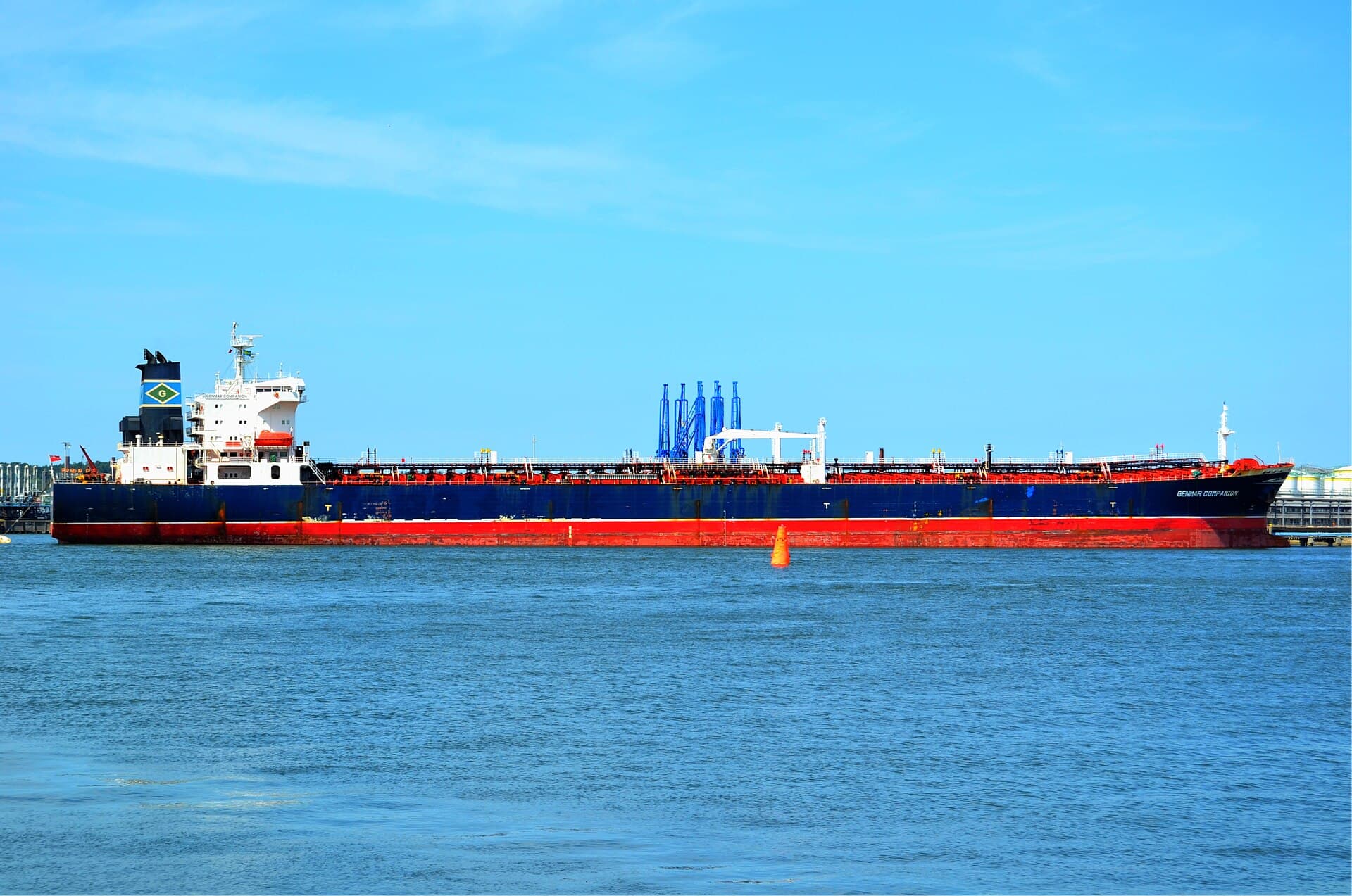
On 23 September 2026, a ship broadcasting the name Nautilus I spent about 30 hours at the Khor Fakkan anchorage on the UAE’s Gulf of Oman coast, according to a port-visit inference by Global Fishing Watch. The IMO number it broadcast, 9193721, appears in a Treasury designation from 25 February under the name Danuta I, one of 12 Iran-linked vessels named that day.
Nautilus I is the third identity broadcast under that IMO number since the designation. Danuta I went silent on 30 April. Nautilus I appeared on an Angolan number on 13 May and moved to a Nicaraguan one on 17 September. Some switches came faster. The Felicita identity last transmitted on 9 March, and a vessel broadcasting the same IMO number appeared that day as Cita, on a Nicaraguan number.
Records broadcasting the IMO numbers of seven of the 12 vessels later carried replacement identities. The designation still attaches to those numbers, because Treasury listed them, and a new name does not lift a block on property. What changed were the names and the flag claims carried by new identifiers.
Those identifiers follow a pattern. Inside Nicaragua’s MMSI range, a run of numbers paired with call signs in lockstep appears in broadcasts from ship after sanctioned ship, most of them first observed this summer. The shared scheme and the concentration of sanctioned hulls on it point to a common allocation process serving those ships.

The Nicaraguan Number Block
Every MMSI opens with a three-digit code tied to a flag state, and 350 is Nicaragua’s. The International Telecommunication Union allocates call signs beginning H7 to Nicaragua. Among ship identities between 350602000 and 350642000, the two identifiers move together. MMSI 350604000 carries H7XD1, and 350605000 carries H7XE1. At 350627000 the pattern rolls over to H7AZ2 and runs to 350642000, H7PZ2. With two exceptions, the fifth and sixth digits of the MMSI set the letter in the call sign. The first identity following the pattern appeared on 26 June.
Three of Treasury’s February ships sit inside that run: Banian on H7EZ2, Hoot on H7MZ2 and Nautilus I on H7OZ2.
Global Fishing Watch records hold 39 identities between 350600000 and 350700000 that broadcast IMO numbers, each on its own MMSI and each with a distinct IMO number. Thirty-one of those IMO numbers match entries on the OFAC sanctions list as published on 23 September. Most of the 39 were first observed in AIS between July and September. Across Nicaragua’s full MMSI range, 73 of the 76 identities carrying IMO numbers and recorded AIS periods extending into 2025 or later first appeared in 2026.
Bellingcat has documented one channel into the Nicaraguan flag. It reported in February that NIATA, a registry website launched in July 2025 in Nicaragua’s name, had links to Suniel Kumar Sharma, whom several governments and IMO have condemned for issuing fraudulent flag paperwork. Sharma told the Financial Times he had set up no further registries. Bellingcat found a certificate issued on 2 February for Al Jafzia, a sanctioned tanker that began broadcasting a Nicaraguan flag on 11 February, and found that IMO’s GISIS database showed no organization approved to register ships for Nicaragua. Al Jafzia’s record sits at 350603000, one of the two numbers that break the letter pattern. International Telecommunication Union records of each administration’s latest submission show no ship station notification from Nicaragua at any date, so none of the numbers in the run sit in the international register of maritime identities. Neither that reporting nor the broadcast data identifies who allocated the sequence observed here, and first appearance in AIS is not the date a number was issued.

Ships Move Between Blocks
Six identities in the Nicaraguan run came from an adjacent Angolan block, 603914000 to 603925000, between 11 August and 23 September. Banian moved on 22 August and Nautilus I on 17 September. Their Angolan call signs were as regular as the Nicaraguan ones: D3Q50 for Banian and D3Q506 for Nautilus I.
Lloyd’s List reported in September 2025 that Angolan and Mozambican fake-flag sites were drawing sanctioned ships, which were switching between fraudulent identities at pace. The Nicaraguan run shows ships from the Angolan block moving into the next one over six weeks.
Other identities came straight off Iranian numbers. Darya Bandar 1 left an Iranian MMSI and was first observed in the Nicaraguan run on 16 September. Hoot passed through Botswana, broadcasting as Clout Chaser from 13 March before becoming Hoot on 28 August.
The ships kept moving under their new names. Gas Bella, broadcasting IMO 9147394 on a Guinean number from 25 March, logged port visits that Global Fishing Watch infers at Muscat on 7 and 8 April and at Vadinar, India, from 11 to 14 April, then held off Khor Fakkan and Sohar through 31 May. Those records establish movement under a replacement identity. Cargo and buyers sit outside what they show.
In the Global Fishing Watch map window examined, North Star’s track reaches the northern approach to the Malacca Strait, and New Star’s begins in the same area. New Star’s AIS identity record starts on 27 April. Across ten pairs of old and replacement identities in the cohort, four replacement records began before the earlier record ended. Four more began within 48 hours after the earlier record ended, according to Global Fishing Watch identity records.

Flag Claims on the Record
The IMO numbers stayed on the air. Global Fishing Watch matched each replacement identity to a designated IMO number because the vessel broadcast that number, so the new names hid little from anyone screening IMO numbers. What each new identity carried was a claim of nationality.
Article 110 of the Law of the Sea Convention lets a warship visit a vessel it reasonably suspects of being stateless or sailing under a false flag, to verify its nationality, as a House of Commons Library briefing sets out. Article 92, quoted by USNI News, provides that a ship sailing under two or more flags according to convenience may be treated as a ship without nationality. The public record does not show whether the claims in this sequence delayed or complicated any boarding.
The records leave identity questions open. None of the post-switch identities in the cohort has a matching registry record in the Global Fishing Watch results examined. Treasury’s entry for Remiz lists MMSI 352005545. That identity broadcast its IMO number until 14 February, reappeared as REMIZE without it from 16 to 22 February, then went silent three days before the designation.
A second identity, Silvio, had broadcast the same IMO number on a Cameroonian MMSI since 22 January, and Global Fishing Watch records place both in use through 14 February, one claiming Panama and the other Cameroon. Two records sharing an IMO number do not show that one hull carried both. Neither has transmitted since 14 March.

Where the Listed Ships Stand
Treasury’s listings attach to IMO numbers, and the designated hulls stayed exposed under any name. Iran’s navy said it seized Ocean Koi in the Gulf of Oman on 8 May, accusing the tanker of disrupting Iranian oil exports, a day after its last reported position in AIS data cited by Seatrade. Ateela 1 and Ateela 2 stayed on Iranian numbers and were still recording port and loitering events in late September. Luma’s recorded events stop after 1 March.
IMO’s Legal Committee approved guidelines on ship registration in April, noting that no binding international framework regulates how ships are registered.
Axon I entered the sequence on 23 September, fresh from an Angolan number, the same day Nautilus I reached the Khor Fakkan anchorage. The broadcasts reveal a shared numbering scheme. Who supplies the replacement identities to vessels broadcasting sanctioned IMO numbers?
John Hendricks is an OSINT analyst and the founder of Global Recon. Follow on X: @IGRecon