Three weeks into Operation Epic Fury, the Pentagon says Iran’s ballistic missile capacity is “functionally destroyed.” The White House claims 83 percent of drone launches have been suppressed. The IDF reports more than 400 missile launchers eliminated. And yet, on March 26, the UAE Ministry of Defense confirmed it intercepted 15 ballistic missiles and 11 drones launched from Iran, the conflict’s 27th consecutive day of strikes against the Emirates.
The conventional framing treats Iranian strikes as a declining trendline, a countdown to exhaustion. That framing misses what matters: how Iran is doing what it is doing. The launch system was designed to survive the destruction of visible infrastructure. Every section of this conflict reflects that design.
The Shahed Launch Cycle
The Shahed-136 does not require an airfield, a runway, a silo, or a fixed facility of any kind. The entire launch apparatus fits on the back of a commercial truck.
The drone sits on an angled rail, configured in batteries of up to ten per vehicle. A solid-fuel booster kicks the airframe off the rail. Once airborne, the booster detaches and the drone’s own engine takes over: a reverse-engineered copy of the German Limbach L550E, a 550cc two-stroke piston engine driving a rear-mounted pusher propeller. From there, the Shahed flies autonomously along pre-loaded GPS waypoints at roughly 185 km/h, navigating via commercial-grade inertial guidance corrected by civilian GPS and GLONASS.
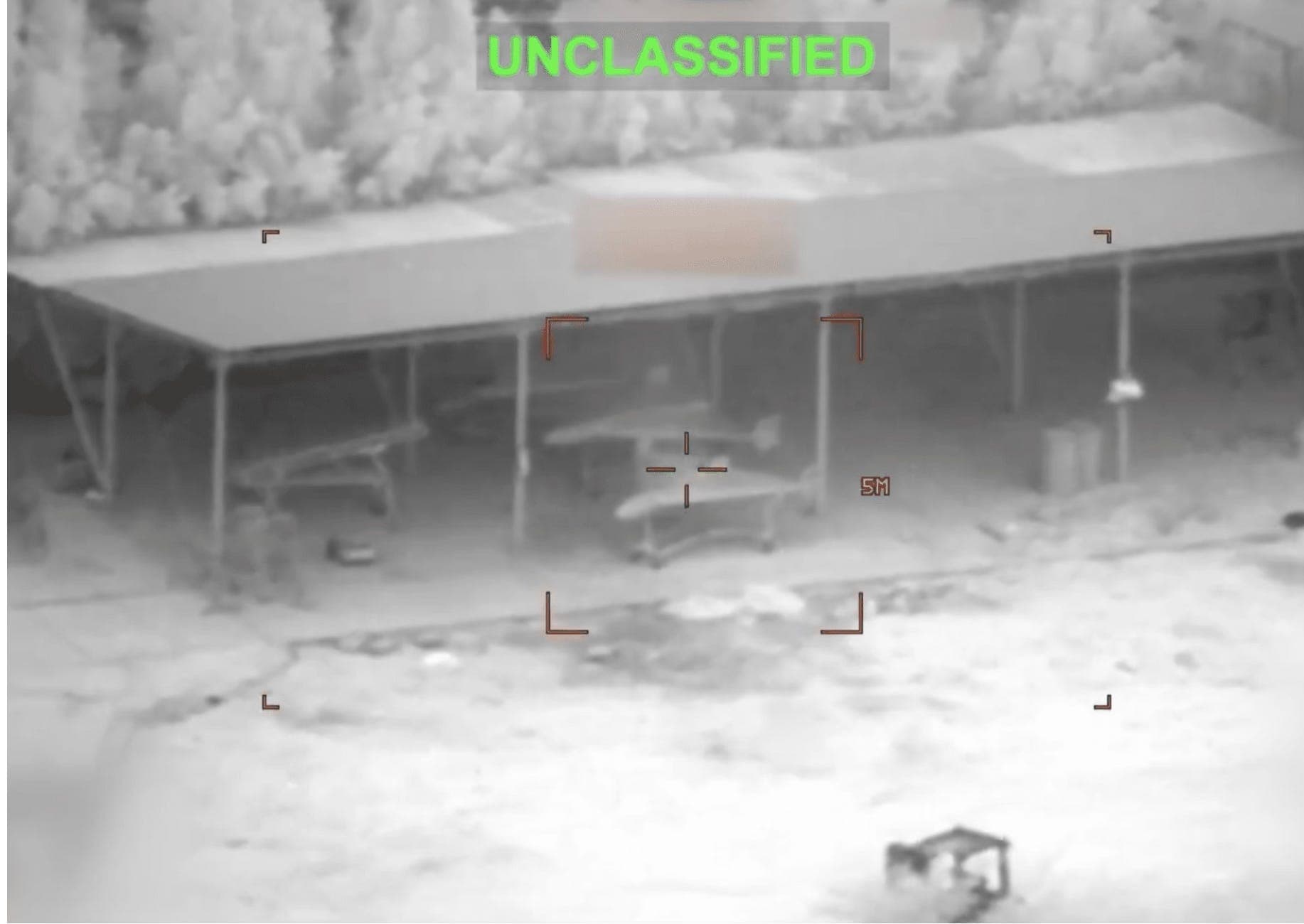
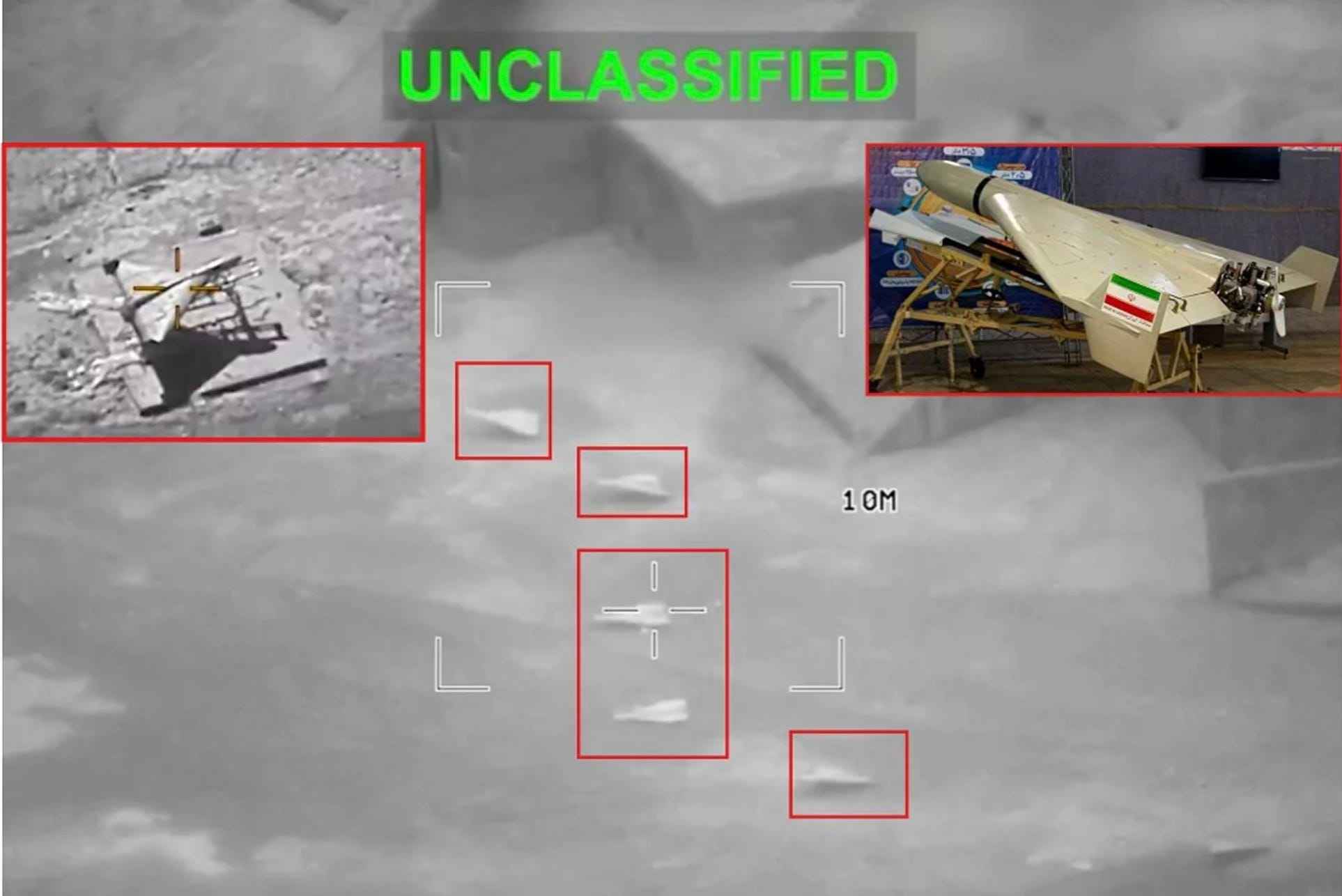
A launch crew can park a loaded truck in a garage, a forest clearing, or an underground parking structure, fire ten drones in under two minutes, and relocate before overhead ISR can fix the position. There are no preparation signatures that distinguish a warehouse full of Shaheds from an empty one. CENTCOM has released footage of strikes destroying launch sites caught in active configuration, drones visibly aligned on rails. Those were the ones they found.

Wreckage analysis from both Ukraine and the Gulf has filled in technical details. Captured Shaheds contain 4G cellular modems and SIM cards. A four-puck GNSS antenna assembly sits on the right wing. The airframe uses a honeycomb structure to reduce radar cross-section. The warhead, near the nose, carries 30 to 50 kilograms of high-explosive fragmentation.
The Shahed-238, a turbojet variant powered by the Toloue-10 engine, flies at roughly 500 km/h and presents a radar return closer to a cruise missile than a drone. Three variants exist: a baseline GPS/INS model, an infrared-seeker version for terminal guidance against moving targets, and a passive anti-radar model that homes on emitting defense systems. The UAE Ministry of Defense recovered Shahed-136, Shahed-107, and Shahed-238 wreckage in the first week.
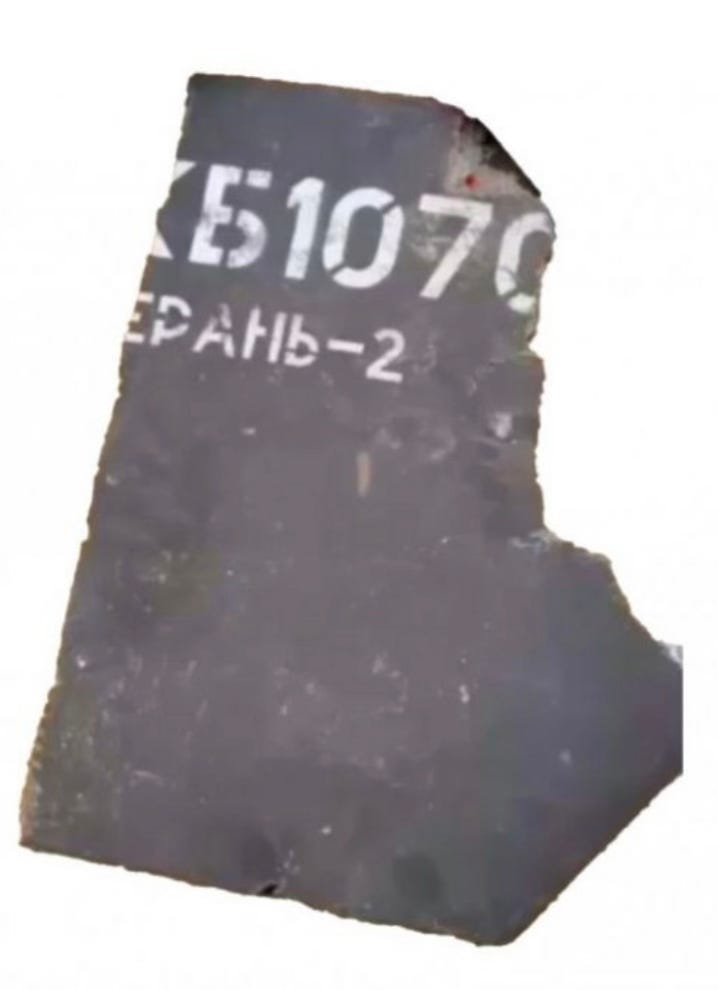
The most significant wreckage finding has received the least attention. CSIS open-source analysis of debris from UAE impacts identified serial markings on at least one airframe consistent with Geran-2 production at Russia’s Kupol plant in Izhevsk, with modifications including the Kometa-M jam-resistant navigation module. If confirmed, this inverts the assumed direction of the Iran-Russia drone relationship. Tehran supplied Shahed airframes to Moscow starting in 2022. Moscow may now be backfilling Tehran’s wartime inventory with Russian-manufactured variants. That is not technology transfer. It is a wartime supply chain operating in both directions, and it changes the math on how long Iran can sustain drone operations under sustained strikes on its domestic production.
The Ballistic Missile Kill Chain
Iran’s ballistic missiles run on different infrastructure but the same survivability logic: mobility.
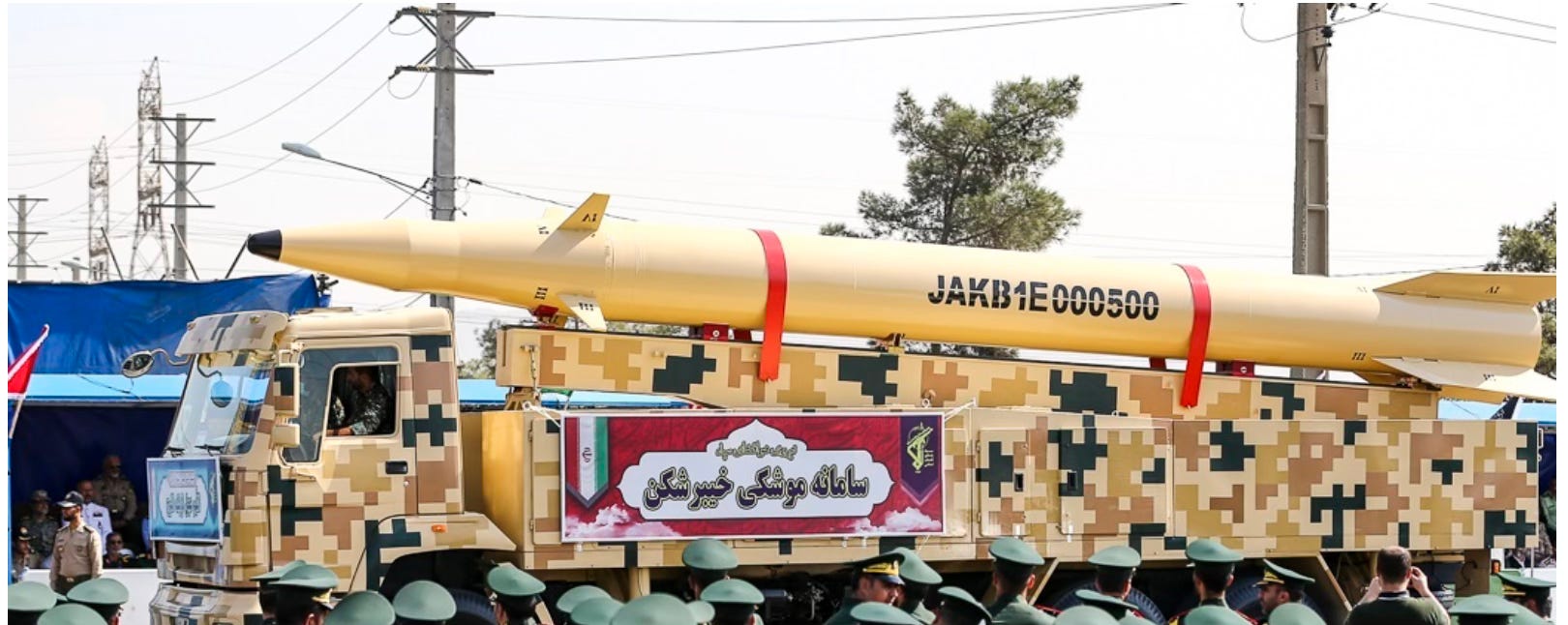
The IRGC Aerospace Force fires from road-mobile transporter-erector-launchers (TELs), multi-axle trucks that carry, raise, and fire a missile from any pre-surveyed point. Iran maintains a network of these points across western and southern provinces, each surveyed for coordinates and approach routes. A TEL can drive in, erect, fire, and leave within minutes.
Historically, hunting mobile launchers from the air has failed. During Desert Storm, coalition forces ran an intensive Scud hunt and achieved zero confirmed TEL kills. In Kosovo, Serbian mobile assets survived NATO air superiority largely intact. The problem is fundamental: unless ISR catches a launcher in the narrow firing window, it disappears into traffic.
The current campaign may have broken that pattern. The IDF claims over 400 launcher kills since February 28, enabled by persistent overhead ISR and loitering munitions maintaining watch over known operating areas. By March 2, IDF reporting indicated Iranian crews had begun abandoning launchers after a single shot to avoid counter-fire. That behavioral shift, from multi-shot operations to single-fire-and-flee, is real pressure. CSIS assessed that 70 percent of Iran’s ballistic missile launchers had been disabled by Day 16.
But behavioral change is not destruction. The IRGC entered this war with an estimated 2,500 ballistic missiles. TEL estimates range from 200 (Israeli post-Twelve-Day-War assessment via Iran Watch) to 480 (Hudson Institute pre-war estimate). Bloomberg reported in mid-March that launcher counts had held steady after a week of strikes, consistent with the limits of air-only targeting against dispersed mobile systems across a country of 1.6 million square kilometers.
Iran’s solid-fuel short-range systems compound the problem. The Fateh-313 can erect and fire in under ten minutes with no fueling signatures. At 500 km range, it puts every Gulf capital within reach from western Iran.
Underground
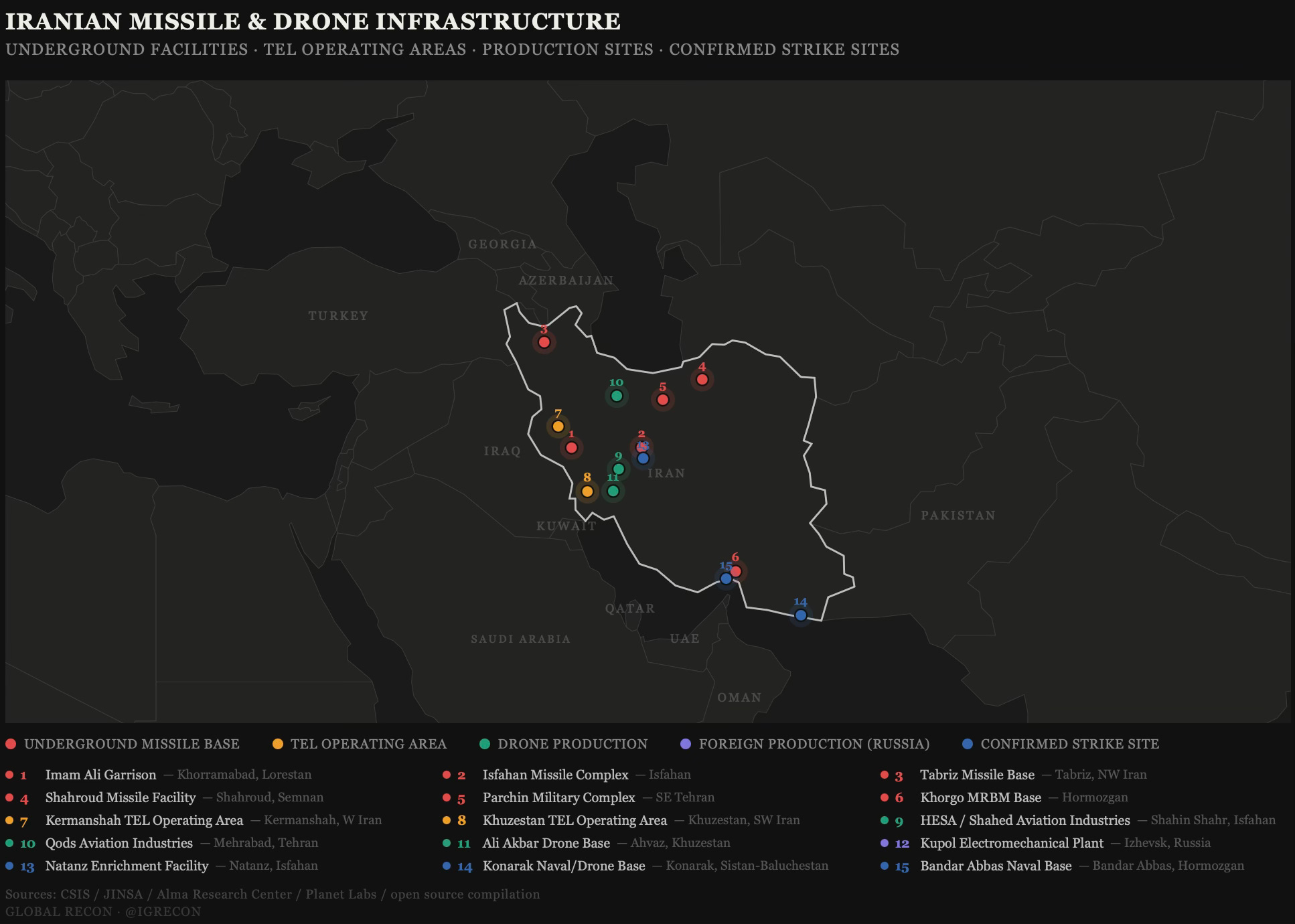
Beneath the mobile layer sits fixed storage. Iran claims underground missile bases in every province, some at 500 meters depth. A March 2025 propaganda video showed IRGC commanders driving through tunnel systems stocked with Kheybar Shekans, Sejjils, and Paveh cruise missiles on TELs, positioned for rapid deployment through tunnel exits to external launch pads.
The best-documented site is the Khorramabad complex (Imam Ali Garrison) in Lorestan Province: at least eight tunnels and launch shafts carved into the Sefid Kouh Mountains, with a storage facility and an operational launch facility connected by automated railway systems that move missile magazines into firing position. The Alma Research Center published detailed analysis of this site after the IDF struck it during the June 2025 Twelve-Day War. B-2s have hit underground facilities in the current campaign with 2,000-pound bunker-busters.
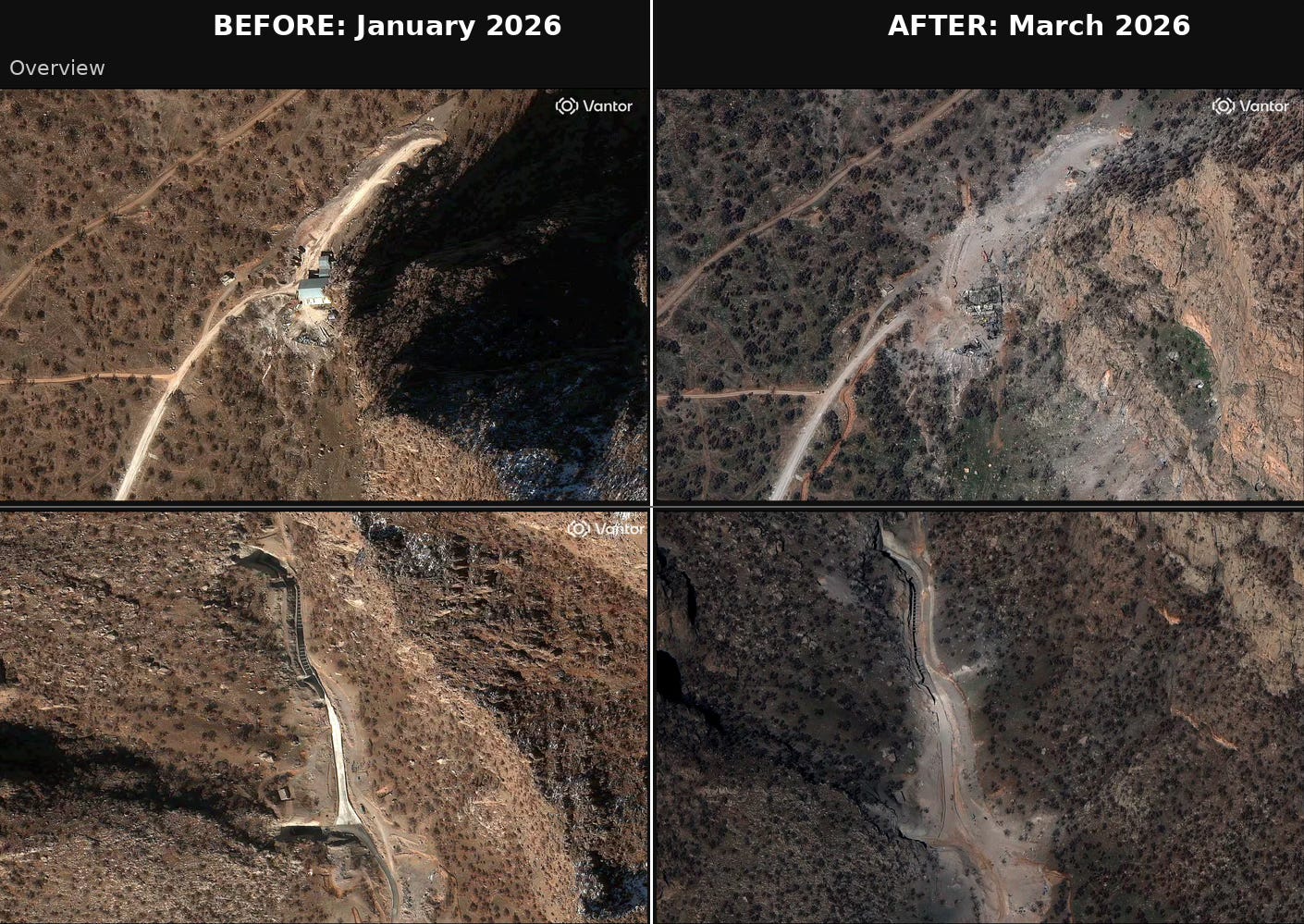
The design question is whether strikes have severed the link between storage and launch. Redundant entrances and dispersed internal architecture mean partial destruction does not necessarily mean operational elimination. That answer requires intelligence that remains classified.
Wave Doctrine
The IRGC has designated each attack sequence as a numbered wave, with more than 80 recorded through March 25 according to Iranian state media. The numbering is not cosmetic. It reflects targeting logic.
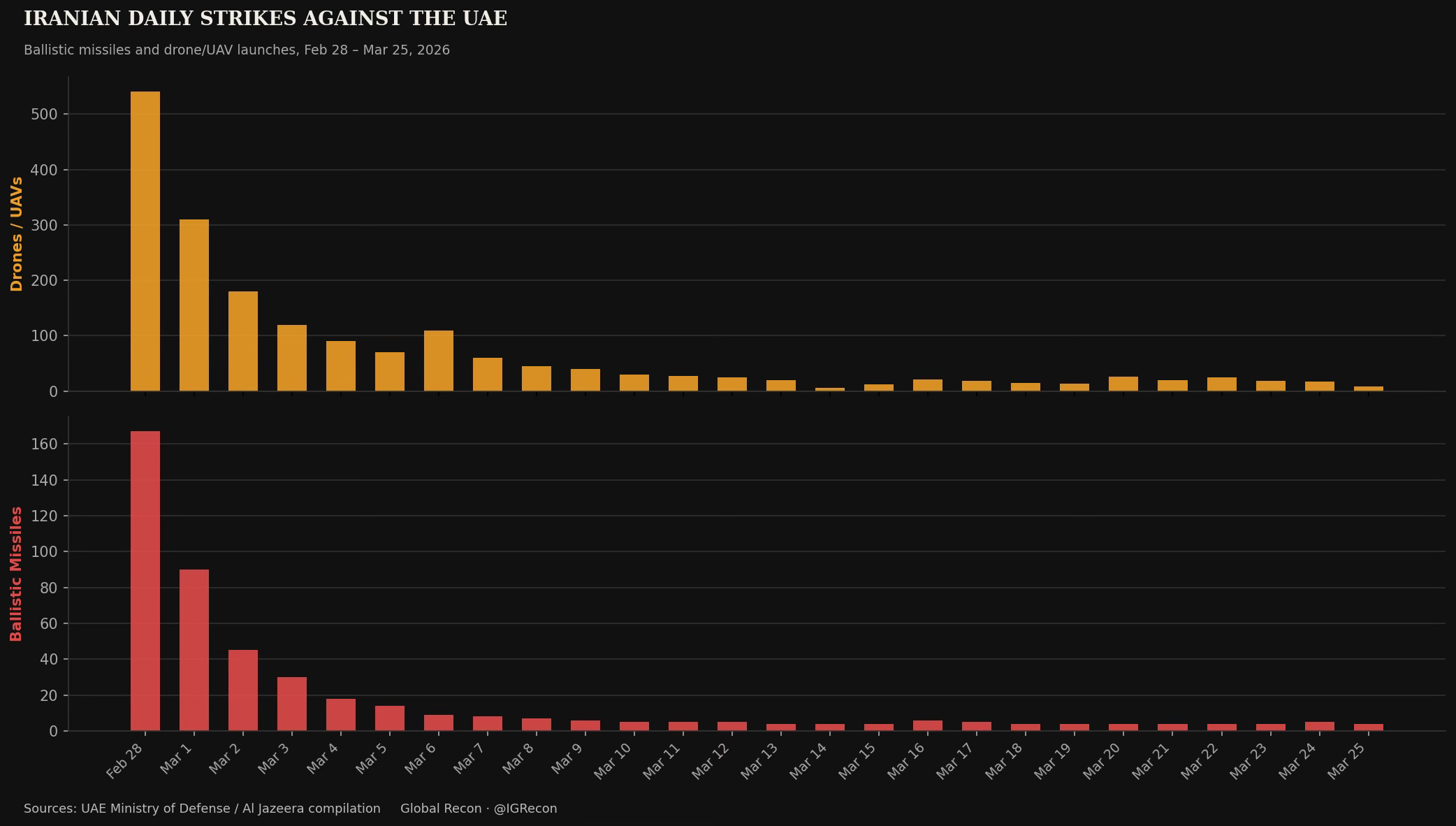
Opening salvos on February 28 were massive: 167 ballistic missiles and 541 drones at the UAE in the first 24 hours, per UAE Ministry of Defense tallies, with simultaneous strikes on Israel, Qatar, Kuwait, Bahrain, Saudi Arabia, and U.S. bases. Fars News Agency reported over 500 missiles and nearly 2,000 drones in the first five days. The target set escalated deliberately: military installations first, logistics and communications nodes second, energy infrastructure and economic targets third.
This is not the pattern of an adversary burning through stockpiles in panic. It is inventory management layered onto coercive escalation.
The tactical model repeats what Iran tested in April 2024: slow drones saturate radar tracking and interceptor channels first, cruise missiles follow, ballistic missiles arrive last when defensive batteries are occupied or spent. The drones are not expected to survive. They are expected to make the missiles behind them more likely to get through.
By mid-March, tempo had dropped to single-digit missile launches and a few dozen drones per day, with four missiles and six drones recorded on Day 15 against the UAE alone per Al Jazeera’s tally of UAE Ministry of Defense statements, and missile volume down 90 percent from Day 1. The Pentagon called this degradation. Kelly Grieco at the Stimson Center, writing in War on the Rocks, called it recalibration, arguing the target sequencing was consistent with deliberate inventory management, not exhaustion.
Decentralized Command and the Targeting Question
The IRGC anticipated decapitation before the first strike landed. After Supreme Leader Khamenei was killed on February 28, Foreign Minister Araghchi announced activation of the “decentralized mosaic defense,” a doctrine built over two decades after watching the U.S. collapse Iraq’s centralized command in 2003.
Each figure in the command structure has named successors three ranks deep. The IRGC’s new commander, Ahmad Vahidi, reportedly sits in every senior wartime meeting, but operational units are running on pre-distributed instructions rather than real-time direction. Launch authorization, targeting packages, and timing windows were issued before the war began. Field commanders adjust fire based on local inventory and conditions.
The open question is how targeting data reaches those commanders now. Are launch crews firing exclusively at pre-surveyed fixed coordinates loaded before Day 1? Or is there a live intelligence feed? The 4G modems found in Shahed wreckage suggest at least the technical capacity for mid-course updates. If crews are receiving real-time target adjustments through cellular or satellite channels, that implies a surviving intelligence and communications backbone that strikes have not yet severed. If they are not, and every strike is hitting coordinates loaded weeks ago, the campaign is on a fixed clock that runs out when the pre-loaded target list does.
The risk of delegated authority is already visible. Iran’s strike on Turkey, a NATO member, may reflect miscalculation by empowered mid-level officers. The expanding target set against Gulf civilian infrastructure may not be escalation ordered from Tehran. It may be autonomous decision-making by field commanders whose strategic horizon extends no further than the next launch window.
The Hard Question
Iran’s ballistic missile campaign is in steep decline, constrained by launcher attrition and stockpile exhaustion for its most advanced systems. Its drone campaign is diminished but persistent. The IRGC’s command structure is holding, even as coherence frays.
The question is not whether Iran can keep firing. It can. The question is whether a few missiles and a few dozen drones per day are enough to keep the Strait of Hormuz closed, Gulf economies under pressure, and the cost of this war high enough that the political calculus shifts before the last launcher is found.
One successful drone on a desalination plant, an oil terminal, or an airport runway produces strategic effects that a hundred intercepted missiles cannot. Iran does not need to win the air war. It needs to win the arithmetic.
────────────────────────────────────────
John Hendricks is an OSINT analyst and the founder of Global Recon. Follow on X: @IGRecon